Welcome to Our Seder

While the fundamentals remain the same, different cultures, different backgrounds, and even different creativities can result in very different Sedorim

No matter the city, the ages of those participating, or the language spoken, Leil HaSeder is still conducted in a very specific, well, seder. There’s an order to the night’s mitzvos, and every three-year-old knows it by heart.
Kadeish, Urchatz, Karpas, Yachatz…
But the beauty of Leil HaSeder is that while the fundamentals remain the same, different cultures, different backgrounds, and even different creativities can result in very different Sedorim.
Let’s explore some unique Sedorim.

The Fredmans live in Boro Park and are Bobover chassidim
Urchatz
At our Seder, only the head of the household washes for Urchatz.
Yachatz
During Yachatz, the broken matzah remains in the matzah tasch (decorative matzah bag).
Maggid!
Something beautiful that is well-known in Bobov circles, the Bobover Rebbe takes all of his children, grandchildren, and great-grandchildren until bar and bas mitzvah age onto his lap to ask the Mah Nishtanah.
Maror
For maror, only romaine lettuce is used (no horseradish); the lettuce is dipped into charoses, which is then shaken off and not eaten.
Ke’arah
We do not use a ke’arah, we simply place the items for the Seder plate on the matzah tasch.
During Avadim Hayinu, my father-in-law takes the afikomen bag, puts it on his shoulder, and marches around the table, symbolizing the Jews who left Mitzrayim with matzah dough on their backs. When I was a kid, my father used to ask my grandparents to talk about their ovdus in the Holocaust at this point. They’d speak about how Hashem saved them and took them out of their despair. They’re no longer alive, so now we repeat what we remember them sharing.
»We’re very careful about gebrochts. My mother-in-law doesn’t stack the plates when clearing the table on Pesach, for fear of gebrochts. If a fork or knife falls on the floor, it is not used until the last day of Pesach (when we are less strict). Everyone, including the women, have a matzah tasch (matzah bag) at the Seder. We keep it under the plastic tablecloth in order to avoid gebrochts. But interestingly, the female descendants of the Bobover Rebbe do eat gebrochts on Pesach, on separate dishes.
»The second night, the men leave the Seder in the middle to go to a shtibel to count the Omer with a minyan.
»There’s someone in the Bobover kehillah named Fishel Beigel. The entire Pesach no one refers to him by his last name, as it is chometz!
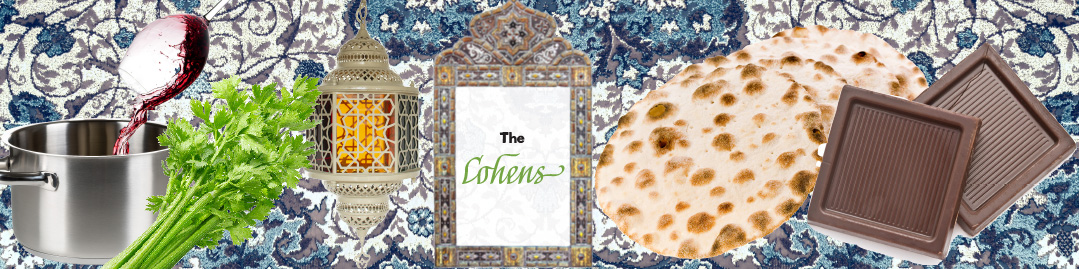

The Cohens live in Israel and are Syrian Sephardim
Kadeish
For Kiddush and the Four Cups of wine, we add three drops of water to the wine. We also make sure to rinse the cups before refilling them.
Yachatz
After Yachatz we take the afikomen bag, and each participant takes a turn holding it with their right hand over the left shoulder and says “misharotam tzerurot b’simlotam.” We demonstrate that we are leaving Mitzrayim with the matzah on our backs.
Karpas
Our Seder plate doesn’t have potatoes (for Karpas). We use celery dipped in saltwater.
Maggid
Before Ha Lachma Anya, the oldest single girl at the table takes the ke’arah away and then brings it back before Mah Nishtanah.
When the head of the Seder reads the Makkot aloud, the oldest single girl holds a pot, and the head of the Seder pours wine into the pot as he recites each Makkah. As he says datzach adash bachav, he empties the entire wine cup. The girl then takes the pot to the bathroom and flushes the wine away. It is a special eit ratzon to pray for a ben zug. The girl is not supposed to look at the pot as the wine is poured or as she pours it out.
Matzah
We use special “chatzot matzot.” These matzos are soft and dense, like pita, although we use some thin, crispy matzot as well.
Maror
We don’t use horseradish for maror — we use lettuce and endives, and our charoset is made from dates with just a pinch of wine.
Tzafun
The kids hide the afikomen and bring it back when we need it. We don’t get up and search for it, but it’s still a lot of fun.
»My husband’s grandfather would always distribute Napoleon chocolates to the children as they said their divrei Torah, so my husband always makes sure to buy a stash of the exact same chocolates, to preserve the tradition!

The Daharis live in Israel and are Teimanim
Karpas
There’s no saltwater and no potatoes. For karpas they use celery.
Maggid
Instead of Mah Nishtanah, the children recite Mah Kaber. It’s a version of Mah Nishtanah, in question-and-answer format, and they recite it while holding an egg and one of the Kosot of wine, zecher the Korban.
At datzach adash bachav we pour wine out of the cup (instead of just dipping with a finger). The poured wine is then spilled out; it’s considered unholy.
Matzah
My mother-in-law, along with my husband and his brothers, make the matzot Erev Yom Tov in a tabun oven outside. They are different from the matzos Ashkenazim are used to — more like laffas. We also have “hard” matzot (the regular kind of matzos that Ashkenazim use) because my mother-in-law used to work in Komemiyut, a moshav well-known for their hand matzot. But we make the brachah at the Seder on the soft ones.
Maror
Maror is lettuce and not horseradish.
Hallel
We don’t recite Shefoch Chamatcha or have a kos shel Eliyahu.
In general, there’s a lot more reading than singing, and the Seder doesn’t take so long.
Ke’arah
There’s no ke’arah. Everything is placed on a big Yemenite-style handmade tray.
»Kitniyot of course are part of the meal — beans and rice and corn.
»The men do not wear kittels. Actually, there are no kittels in Teimani culture. Ever.

The Kuntslers from Yerushalayim are Ashkenazim
Obviously, the focal point of the Seder is to keep the kids interested in what you’re doing. So here are some ideas I’ve incorporated in the past to just keep things… happening:
Makkos
Some years I have each kid do some homework in advance, and at the Seder they present the amazing detailed miracles of a specific Makkah.
»I purchased an old wooden walking stick (they sell them in most costume stores Purim time) and I carved out datzach adash bachav. Then I made a big deal about being able to obtain a very special item from a museum. I hyped it for almost ten minutes before taking it out and showing everyone “Moshe’s staff.”
»Right before rechush gadol, my wife takes all the kids around the house and into the hallway, where we have fish stickers stuck all over to make it look like Kri’as Yam Suf. When they return to their seats after “Crossing the Sea,” everyone has a present at their seat, chosen specially for them, like games, jewelry, or seforim.
»I generally don’t say too many divrei Torah until the Makkos (except for some really short ones). It keeps the kids more interested. I save the longer divrei Torah for the seudah.
»For the older kids, it’s really all about the singing of the familiar Pesach songs, especially the fun ones at the end of the Seder.
Afikomen
I don’t do the “trying to steal from Abba” thing. I hide the afikomen in a pre-planned place and throughout the Seder I reveal another letter — not in order! — of where it is hidden.
May we all merit the ultimate Geulah this Leil HaSeder. L’shanah hazos Bi’Yerushalayim habenuyah!
(Originally featured in Mishpacha Jr., Issue 907)
Oops! We could not locate your form.
RELATED CONTENT

Don’t want to work in any of the standard professions? No prob. This list has you covered. Or… maybe not!

Unfortunately, Nellie had forgotten exactly how big the Mendelson backyard was


“If you have a good voice, it’s a gift from Hashem and a responsibility”

An amazing true story that shows how important it is to ask for mechilah
