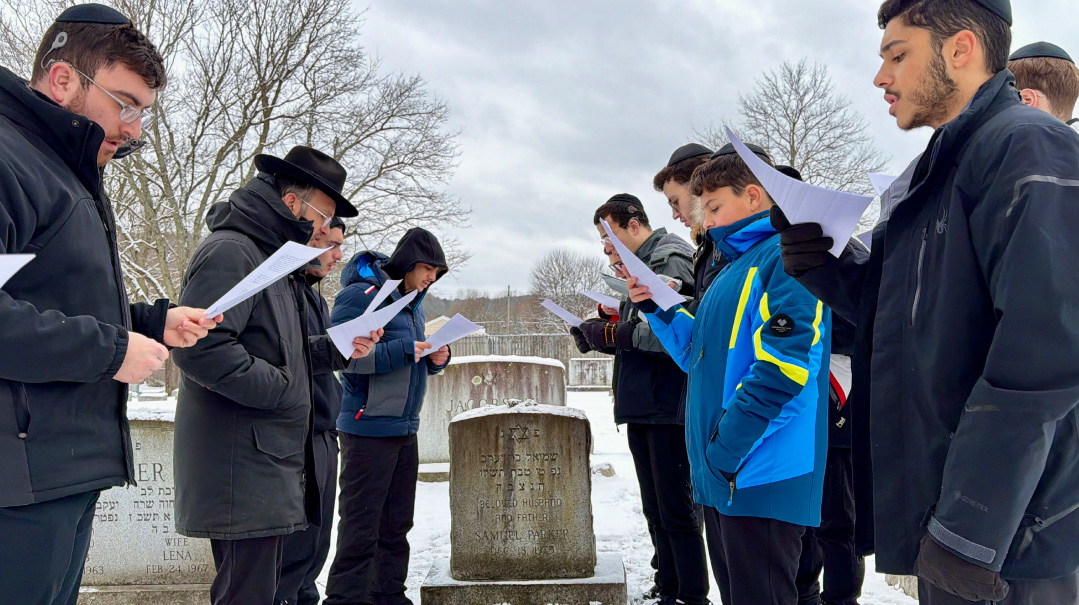
One talmid’s words captured it best: “I’m deaf but even I can hear the tumult going on in Shamayim now”
Living Higher
S
amuel Parker was born in Elmira, New York. As a baby, he contracted meningitis and subsequently lost his hearing. His disability notwithstanding, he persevered, earning an education, marrying, and raising two daughters in Frederick, Maryland, where he was employed at the Maryland School for the Deaf. Samuel passed away suddenly at just 42 years old, on the 15th day of Teves, 1975.
Mrs. Joely Bernstein of Toronto is one of the two daughters Samuel left behind, both of whom found their way back to Torah Judaism. She and her husband Shimmy are prominent supporters of Yeshivas Nefesh Dovid. Led by Rav Chaim Tzvi Kakon, the yeshivah is a shining jewel on Toronto’s yeshivah landscape and the only boys’ yeshivah high school in the world dedicated to boys with hearing impairments.
In an effort to show hakaras hatov to the Bernsteins, one bochur in the yeshivah, Shmaaya Dovid Friedman, completed all of masechesBerachos in memory of Samuel Parker on his 50th yahrtzeit.
The siyum was held in the Bernstein home this past Motzaei Shabbos, with students and staff in attendance. The following day the yeshivah made a trip to Elmira, New York, where Samuel is buried. A minyan was formed, Kaddish was recited, and words of hisorerus were shared.
One talmid’s words captured it best. “I’m deaf but even I can hear the tumult going on in Shamayim now.”
And up Above, Samuel surely heard the siyum, the Kaddish, and the divreiTorah with blazing clarity as well.
Through a lifetime of silence, he created the most beautiful music of all.
Sefer of Salvation
S
ome five years ago, Rabbi Daniel Glatstein was delivering a weekly Chumash shiur for the OU’s All Parsha platform. The shiur was slated to be on Ramban and the Baal HaTurim but he issued a personal request: to share the Torah of the Ben L’Ashri as well.
Who was the Ben L’Ashri?
His name was Rav Yitzchak HaKohein Huberman. He hailed from Sochatchov and was a student of the Shem Mishmuel. Rabbi Glatstein’s great-grandfather had been his chavrusa. But while Rabbi Glatstein’s great-grandfather perished in the war, leaving none of his written works behind him, Rav Yitzchak Huberman did survive and moved to Eretz Yisrael, where he became known as the “Tzaddik of Raanana.” The sefer BenL’Ashri is his composition.
Rav Huberman — who had no children of his own — wrote that he will intervene on behalf of anyone who learns his sefer, praying that they see salvation.
Rabbi Glatstein, who saw the sefer as a link to the great-grandfather he never knew, wanted to disseminate its Torah and added it to the syllabus of his weekly shiur. He also embarked on an effort to have the sefer reprinted. Since much of the sefer discusses very lofty content, he worked tirelessly to select pieces that were more accessible to be compiled into a single sefer.
One day, Rabbi Glatstein received a call from a woman whose last name was Kushelevsky. She listened to his shiur on the Ben L’Ashri, she said, and wished to contribute toward the sefer’s publication.
After several more calls from this woman, one day Rabbi Glatstein asked, “Are you related to Rav Tzvi Kushelevsky?”
“Yes,” she responded, “he is my husband.”
Rebbetzin Kushelevsky was so taken by story of the Ben L’Ashri, and believed so strongly in the segulah, that she prevailed upon her husband — whose every moment is dedicated to intensive learning — to make time to study his Torah.
At the bris of Eliyahu Kushelevsky, the miracle baby born to Rav Tzvi and his rebbetzin, the Rosh Yeshivah presented pamphlets of his own insights on the commentaries of the Ben L’Ashri — so deeply did he associate the miracle with the tzaddik’s merit.
This past week was the yahrtzeit of the Ben L’Ashri and Rabbi Glatstein joined the Kushelvskys in Yerushalayim, where he heard the following miraculous story.
About a year and a half before the miracle took place, Rav Kushelevsky traveled with his gabbaim to the kever of the Ben L’Ashri to daven for a child. It was Erev Shabbos afternoon, heavy rain was pouring down, and they simply couldn’t find the kever. But Rav Kushelevsky refused to give up.
At that very moment, a car stopped nearby. A Yid stepped out and asked, “KevodHarav, what are you looking for?” He then led them straight to the kever — and afterward brought them back to the yeshivah in time for Minchah.
Rav Kushelevsky commented that he felt he received this help from Shamayim specifically because he did not despair.
The yahrtzeit event was a fusion of Torah, emunah, and the power of tzaddikim.
May they be meilitzei yosher for all of us.
The Lens
Last week, the Bobover Talmud Torah in Boro Park celebrated a hachnassas seferTorah, at which the family of Reb Leibel Rubin z”l, the prime benefactor of the Bobover Talmud Torah, gifted the institution that bears his name a sefer Torah.
The Rebbe made it clear to his chassidim that the talmidim of the Talmud Torah would be the prime participants. In the weeks leading up to the event, age-appropriate speeches and presentations were held throughout the Talmud Torah as the melamdim prepped the talmidim. A week before the hachnassassefer Torah, a special kesivasseferTorah took place, when every melamed in the Talmud Torah went with his talmidim to write an ois, with his young charges standing around him as their melamed took the ink and quill, writing the very words that they were learning.
Invitations to the actual hachnassasseferTorah were limited to family members and talmidim enrolled in the Talmud Torah. Afterward, the Rebbe held the traditional l’chayim, which he followed with divreiTorah and brachah. And then, for over an hour, the Rebbe himself personally handed each child a piece of cake — “shirayim” — personally ensuring that each talmid felt a part of the simchah.