Operation Home Front

Israeli citizens are redefining the meaning of the term, “Home Front”

Photos: Flash 90, Personal archives
Six weeks into Israel’s war following the Gaza massacre, Israeli citizens are redefining the meaning of the term, “Home Front.”
In the days after Simchas Torah, thousands of residents of the Gaza periphery were given hours to pack up their lives and board buses away from the war zone, temporarily resettled in hotels in Eilat and the Dead Sea. Thousands more, too fearful to remain in homes where they’d had to cower in bomb shelters, fled on their own. Like shipwreck survivors, they washed up on the shores of towns and cities across the country.
Days later, the same happened to thousands of residents of Israel’s northern border regions. With Hezbollah poised to attack, authorities ordered entire communities emptied. In their wake, many more fled, as the Lebanese terror group rained missiles on the region.
As up to 200,000 refugees — those evacuated and those having decided to flee on their own — suddenly drained into the country’s center and authorities were caught flat-footed and struggled to cope, civilian society stepped up to the plate.
Neighborhood by neighborhood, in moshavim, towns, and cities across the country, WhatsApp groups and email lists buzzed with requests for clothes, cribs, food — and most critical of all, for thousands of roofs to put over the heads of the suddenly homeless.
What happened across the Anglo communities of Jerusalem and Beit Shemesh is a snapshot of this newest Operation Home Front — a story of individual and communal kindness in the face of sudden disaster.
October 15th, the first email pops up.
URGENT HELP IS NEEDED:
There are at least 2000 people from Sderot who need help with their laundry. If you can help with doing one or two loads please reach out
October 16th 6:03 pm. The laundry is waiting for pickup at the shul, if you can do a bag.
October 16th 6:37 pm. The laundry has all been picked up. Tizku lmitzvos!
October 21. If you can cook for the displaced families*Important Reminder* The families are used to one meat meal a day for Lunch at 1:30/2pm and they will figure out a light dinner themselves.
October 22: Due to the influx of families that continue to arrive from the South and North, we would like to create a community-wide “Adopt a Family” program.
Almost a month later, the influx of emails to our inboxes from the local Neshei hasn’t slowed. Time hasn’t reduced the urgency of the requests and repetition hasn’t dampened entire communities’ fervent responses. “We want to help” is the ever-present mantra. We, who go to sleep in our beds, our arms around our children, we want to help those who have been displaced, evacuated, or scarred. And so, when the government can’t help, when these displaced families have no place to go as war has reached their doorsteps, they’ve turned to those whose arms are outstretched, and that includes us — Anglos whose Hebrew might not be fluent, but who speak the language of the heart. Apartment placing, meal organization, clothing and toy drives, white shirts, coats, shoes, pots and pans. Regular people-turned-chesed coordinators. Because when all of our nation is family, no one is ever homeless.

Don’t Look Back
After the October 7th massacre along the southern kibbutzim near the Gaza strip, Israel evacuated 30,000 residents from their homes via the military. The survivors left in their pajamas or with the clothing on their backs and nothing more — their towns and kibbutzim up in flames.
In the days and weeks following October 7th, the government evacuated an additional 80,000 people, beginning with the 20,000 residents of Sderot, plus 60,000 residents of the north, in range of Iranian-backed Hezbollah rockets and mortars from Lebanon. Additional thousands left of their own accord due to shelling proximity, trauma, and fear.
Several weeks into the war, the government announced concrete economic measures aimed at helping the evacuees and the displaced, starting with an occupancy grant to residents of localities in the north and south who evacuated independently to a place of accommodation that is not funded by the state.
Today, a month and half in, 88,000 people are still living in hotels across the country, with an additional 87,000 being hosted in residential areas. A further 73,000 — those who chose to self-evacuate — are staying in temporary accommodations.
Some families didn’t wait to find out if they were being evacuated or not. They grabbed their loved ones and ran to find shelter with friends and family. These residents are now coming forward in search of more permanent accommodations, finally coming to a place where they can begin to process their trauma.
Shira, an evacuee staying in one of the hotels off Jerusalem’s Highway 1, relates her October 7th experience:
“I saw the terrorist run past my window toward the front door. He had rows of bullets wrapped around his arms. I grabbed my four children, locked us in the safe room, and with a calm that came from somewhere deep within, I told them, ‘We are going to die now. So let’s say Shema Yisrael together.’
“My biggest fear,” Shira says, “was that we would all die except one child, and then how would he ever know Hashem’s ways?”
Eventually the bullets stopped, all grew quiet, and after hours, Shira and her children stumbled out of the safe room and into IDF evacuation.
War at our Windows
We all remember the isolation, despondency, fear, and the dreaded quarantine of Covid. Now throw rockets and shells into that equation, and a sketch of what the families from northern and southern Israel have been facing on a daily basis begins to merge. Because even for families who haven’t been forcibly evacuated, their schools have closed, the streets are empty, families wound up sleeping all together in a safe room, jobs and kollels have been on hiatus, and there’s that ever-present BOOM as mortar shells explode with enough force to shake the walls and rattle the windows.
“I was thinking to myself, it’s really not so bad, why can’t we stay here? Big deal, there are sirens, it may happen a dozen times a day and sometimes only once or twice. We have a safe room, there are plenty of water bottles, we have a battery in case the electricity goes out, plenty of canned and dried food — we’re prepared for this war,” says a woman from Netivot who finally relocated to Jerusalem’s Sanhedria area.
But soon, it was much more stressful than she’d ever imagined, and she began to reconsider. “I was smelling the smoke and the guns all the time, and my windows were shaking. My kids were scared to eat, because they didn’t want to have to go to the bathroom (what if there would be a siren?). They didn’t want to shower (what if there would be a siren?). They hadn’t been to school since Erev Yom Kippur, and my boys weren’t learning Torah.”
When they were offered an apartment in Jerusalem, how could they say no?
“We had to get away,” says the mother of another displaced family, Odelya Liani from Netivot. “We just couldn’t live like that anymore. From Simchas Torah, we stayed indoors. We wouldn’t even set foot on the porch. I’d look out the window, and I wouldn’t see another soul for hours.” A mother of five small children, Odelya had to prioritize their physical safety and kept them in the house. But eventually, it was getting to be too much. Someone told her to call Margalit Fixler of Jerusalem, and the next day, Odelya wheeled out two suitcases for her family of seven, and they were Jerusalem-bound.
“I heard that people needed places to stay,” says Margalit, who has so far helped to place 200 families, “and because I had an empty apartment, I offered it. After that, word spread, people began calling and I saw what a need there was. Someone put out an ad, and it snowballed from there. Now there’s a small army working hard, splitting up apartment placements city by city.”
Her partner is Fraidy, a real estate agent who is now fundraising thousands of dollars, and has become a go-to address for comfort, chizuk, and action.
“I saw an ad on our Neshei list, that someone named Margalit was looking to place displaced families in apartments far away from the fighting. I’m a real estate agent, and I know the ins and outs of the apartments in Jerusalem — I had three apartments immediately available.”
Some of the apartments were offered for chesed, some for a reduced price. Peninat Chemed, just opposite the Rav Shefa mall and known for its luxury studio apartments, had several openings, with a price reduced by a third.
“That was Wednesday. We now needed to raise the money for the rent,” says Fraidy.
“We somehow managed to borrow the money and by Thursday, we had informed 13 families down south that they would be able to relocate to Jerusalem. Nine-thirty a.m., the vans came to pick them up. We were waiting for them to arrive — the van doors opened and pots and pans came flying out, everything but the kitchen sink. And then we watched the neighborhood rally. Woman after woman showed up at Peninat Chemed with pans of schnitzel and kugel and rice. The staff didn’t know what to do. We told them to announce that food was going to be set up in the lobby, and the grateful families were able to take up to their children something warm and nutritious.”
Meanwhile, Fraidy’s cousin Tirzta, a young mother of three small children and many connections to people in America who want to be involved and wish they could help, sprang into action. Last week she organized a “chalukah” where the displaced families could pay a tiny entrance fee and then go “shopping” in a simchah hall set up with brand-name clothing generously donated from abroad.
For the 200 families that Fraidy and Margalit have so far placed, their lives might have been put on hold, but that doesn’t mean time stopped. One man from Netivot told Tirtza that his daughter was to be bas mitzvah that week. Tirtza and her friends threw the young girl a party fit for a princess. They made a bris for a new baby, a pidyon haben for a baby born on Succos, challah bakes manned by seminary girls, and countless Shabbos meals.
Meanwhile, Odelya and her family are currently on their third apartment, and each time they’ve relocated, Margalit and her team made sure that they had whatever they needed, from ways to do food prep to clothes shopping. They’re planning on returning to Netivot next week.
“Like everyone else, we’ve had good days and bad days here,” Odelya says. “My children are enrolled in schools here, and there have been so many special, uplifting events organized for us, but it’s time to try to go back.” The government has been encouraging families to return South, and jobs and kollelim have slowly begun to reopen their doors.
Fraidy was on the phone with a woman named Chana when the missile siren rang out in Chana’s city. Fraidy was left holding a dead phone as the family dashed for cover. Several minutes later, Chana called back.
“She sounded so calm and unruffled,” Fraidy says. “She said everyone was doing great, except one child who had started to stutter and wet his bed since Simchas Torah, and another whose glasses broke but since there was no way to go out, he couldn’t fix them and couldn’t really see.
“It’s like learning a thousand mussar seforim to spend time with these women,” Fraidy says. “And it’s the best chinuch I could possibly give my children.”
My Small Part
The children of Jerusalem’s Ramat Eshkol, Arzei Habirah, Maalot Dafna, and Rehavia neighborhoods have gotten involved, drawing cards, donating toys, and socializing with the new friends that have appeared in their classrooms, trying not to pry into the circumstances that have brought northern and southern newcomers to their schools in the middle of the year.
“We tried hard to stay in Netivot,” Shlomo, a father of seven, shares. “It’s not pleasant to leave your home. But between the sirens and the shelling and the noise of war, we just couldn’t anymore. A week before we came to Jerusalem, a rocket fell right near our home. So we called Margalit and asked if she could find something for us, but she didn’t have anything large enough to accommodate nine people. We waited patiently, and then she called and said she’d found the perfect place. For no charge. And it’s been wonderful, we’re actually sleeping at night. The people who own this apartment don’t know me, I don’t know them, and if life had continued on its path, we probably would never have connected.”
This war has brought about a lot of things that never would have happened before. “People were legitimately afraid to allow displaced families to stay in their apartments,” Fraidy says, “and they didn’t want to have to kick them out if a rental opportunity arose. People were also worried about their furniture and damages, yet they swallowed their fears and extended their homes — and were treated in kind. Families have treated the apartments they’re staying in with care and consideration.
“Some of these families are staying in extremely luxury accommodations,” says Fraidy. “Some of these are apartments that owners have never lent out are suddenly teeming with families with eight children.”
Mindy owns a small guest suite in the basement of her building in Ramat Eshkol, and in the past, she’s only rented it out to couples without children; crayon murals were just not on her agenda.
“My in-laws were supposed to come for Succos, but unforeseen circumstances arose, and they canceled their trip. And then, someone told us Margalit was looking for apartments.”
Mindy reached out, and explained that her now available suite was a one bedroom, with a sort of side room that could be turned into a second.
Margalit sent her the number for a young couple from Ashkelon with two little kids.
“I couldn’t even reach them half the time to arrange logistics, because they were living in the bomb shelter,” Mindy says. By the time they arrived in Jerusalem, it was already Friday afternoon. “My building had put together Shabbos for them, everything from soup to nuts. Then when things became a little calmer in their city, they went back home and a family from Netivot came. He was a rosh kollel, they were extremely dignified, and she kept explaining to me that she’s not a taker. When they left, she penned me the most beautiful letter filled with gratitude. Families are coming and going as the government tries to convince people to restart regular life even as war booms outside their windows — and I’m just grateful I can do my small part.”
Fraidy sent one family to an apartment in Har Nof, to live with an older couple who had several vacant bedrooms. “We weren’t sure how that would work out, but the two wives became best friends, forming an instant mother-daughter-like connection. The older woman has told her new friend from the south that they are not allowed to leave until after the war. They cook and clean and take care of the children together.”
Miriam from Netivot and her large family were happy to be placed in Bnei Brak (which is about the same traveling time as Jerusalem) but still needed to find a solution for her children as she was expected to show up for work every day in Netivot.” A special Bnei Brak family watches Miriam’s young children while she makes the daily commute.
And then there’s the teacher, a mother with eight children who are staying in a 32-meter basement apartment because that’s what was available when they fled Ashkelon. Their special needs child couldn’t handle the sirens and would become hysterical every time an azakah went off. “You can see her sitting on the bench in the park every day,” Fraidy shares. “She’s teaching over the phone. The apartment is too small for her to speak in peace, so the bench has become her remote classroom.”
A Good Deal
Avi Shleifer of J Town rentals is used to making sales. But explaining to apartment owners why they should allow displaced families from the north and south of Israel to live in their apartments was a new experience.
“Homeowners living in chutz l’Aretz or even Jerusalem need to understand what these families are facing. If they’re not category one or two, meaning they haven’t been officially evacuated, they receive no housing and no money from the government. Zero. And since the government does have to draw a line somewhere, the difference between an evacuated family and a family left to their own devices can be the next community over. Netivot hasn’t been evacuated, yet over half the city moved out after Simchas Torah. Streets are empty, the supermarket opens for a few hours a day, and that’s it.”
It’s a huge responsibility to place these families in apartments, the real estate agent admits, not only because of the apartments being offered for free or low rent, but because once a family joins the neighborhood, the locals jump up to bake, cook, shop, and sometimes even neglect their own families to make the new ones feel welcome.
“We’re in touch with rabbanim of these cities — Ofakim, Netivot, and Ashkelon — doing in-depth checks into each family looking for accommodations. We want to help each person, we are obligated to help each person, we just need to be sure that there’s no other option for this particular family, because for another family there really might not be.”
Many families arrived with nothing, and the communities hosting them have rallied. “Some arrived empty-handed because they came right after the initial attack, and they were running for their lives,” Avi explains. “Some came by bus and just couldn’t pack pots and pans and everything a family of nine might need. And some were lacking basic things even before the war.” But if a family rushed out, Avi offers to drive them back to Netivot with an armed escort in order to pack up some more things.
“We’ve managed to create an enormous operation with relatively low expenses,” he says. And that’s mainly due to people giving where they can.
“A guy called me up and said I don’t have an apartment to give out, but I have me.” Avi asked him if he could clean an apartment; the guy was thrilled. Yeshivah bochurim have shlepped furniture and driven pickup trucks loaded with linens and beds.
Not all the families have come to stay for the long haul — some come just for a week, to get away from the tension on their home turf. “It makes all the difference to a traumatized child to have a break,” he says. One father shared that his son won’t allowing him to pull out the bottom bed of their high riser because maybe a terrorist is hiding underneath. Another 10-year-old won’t go to the bathroom by himself. “Kids are resilient though — sometimes that break is all they need to start to heal.”
But Avi has to make room for new families, and when he feels the time is right, he calls and breaks the news that it’s time to return to their cities — if they can.
“Some have uninhabitable homes. And here’s a fun fact: If a rocket hits your house but all four walls are still standing, the government will pay for the repair but they won’t give money for alternate housing. Same thing if a rocket hit the house next door to yours and blew out your windows and electricity. But if someone can go back, and they’ve had a few weeks respite, we need the space for newcomers.”
For example, families from Sderot living in the hotels with six kids to a room would like nothing more than to be placed in normal functional homes where they can all sleep on beds, cook in kitchens, and resume their lives.
And that’s Avi’s next big project, along with Elisheva Soloveitchik and Reuven Shub.
“Right now, the families up north have been told to pack up and evacuate for the entire winter. It’s bad up there, with rockets and tank fire from Lebanon. The situation is far more complex than the south, and there’s going to be a major influx of people in need of accommodations. But all of our work from the past few weeks has prepared us to step into high gear. Sometimes, it just takes the human element to convince a homeowner. Take away the word refugee and set up a video call. When the homeowners see the wonderful people who have been displaced, they’re often more than happy to have a part in this mitzvah.
“A woman called to tell me that her apartment is available, but when I went over to do an assessment, I found that the closets were full. I didn’t understand what was going on. ‘What do you mean?’ she said. ‘I have a brother in Har Nof where my husband and kids and I can live, but these families have no one.’ ”
You Can’t Say No
Ortal Rabi and her family managed to remain in war-torn Netivot for three weeks after Operation Swords of Iron began. “Sirens, we could handle,” the mom of four shrugged. “But once the IDF went in on foot, the incessant explosions were too much. My 15-year-old wouldn’t come out of the bomb shelter. It was time to leave.” The Rabi family headed to Ramat Beit Shemesh, one of 140 families taken under the wing of Ezras Achim.
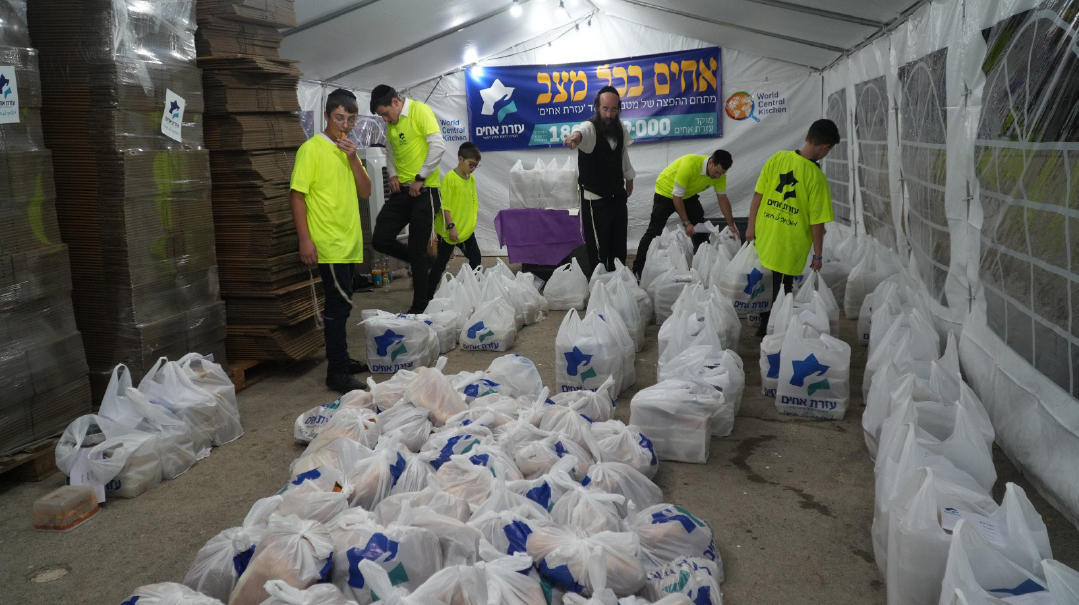
Ezras Achim of Beit Shemesh has its hands full helping families in distress during “regular” times, but ever since war broke out, the chesed organization has tripled its activities, offering housing, food, and more to Israel’s displaced families.
“After the initial attack, the Cohen family jumped in their car and started driving away from the south, just driving with no destination in mind,” relates Reb Arvaham Kop, Ezras Acim founder and CEO. “With attacks up north and rockets raining down on Tel Aviv and central Israel, Liat Cohen told her husband to head toward Jerusalem. They found themselves in Beit Shemesh, opened a window, and asked a passerby how they could find accommodation for a few days until the situation calmed down. They were told, ‘Call Ezras Achim,’ and within two minutes, they had my personal number.
“Initially, I thought of telling them we don’t do that, but then I said to myself, Wait a minute, if they’re asking for help, you can’t say no. At least try. I posted a short message asking if anyone knew where a displaced family could stay for a few days — and five seconds later, I already had a place, and a grocery order.”
And then offers for apartments kept coming — from homeowners who were abroad, from people who’d built studios attached to their homes, from landlords whose apartments were currently empty. And soon, Kop became not only a chesed magnate, but a housing coordinator as well.
At its peak, Ezras Achim had secured 60 apartments, but today, they’re caring for about 15 families, as many others have returned home.
“Food prep is the most challenging aspect for families suddenly landing in an empty kitchen,” says Reb Avraham, “but Ezras Achim has a giant industrial kitchen and cooks hundreds of meals daily for families with hospitalized members, as well as for the elderly and bedridden, and now, also for chayalim. So it was no problem to put a few hundred more families on our list, from both Beit Shemesh and nearby towns where families from the south are staying.”
Tovi of Arzei Habirah hasn’t stopped moving since war broke out, from baking 700 desserts for Shabbos meals and outfitted makeshift kindergartens in the hotels housing those from the north and south, to distributing layette packages for the many displaced women with newborns.
“I had just stopped into the laundromat Rabbi Senter has set up in his yeshivah to help out, when I struck up a conversation with a woman there named Tziona,” Tovi says. “I asked her if she had what she needed, and she said she had grabbed only two outfits per child, and she needed to wash them. And then I asked her about food, if she had the means to shop or cook and she admitted she didn’t. ‘I have a lovely home in the South,’ she told me, and I understood what she was saying: She’s not a taker, she’s a homeowner and a homemaker, and trauma and terror aside, this role she now needs to play is hard.”
Tovi did some quick fundraising and was able to drop 1,500 shekels off for Tziona later that day.
“I asked her if she needed anything, and she admitted that she needed shoes for her daughter, who had just gotten her first pair but were worn out already due to the fact that she was wearing them everywhere.”
Tovi saw that to Dafna, already displaced, far away from all that was familiar, reduced to words like “refugee,” the fact that her daughter’s shoes looked shabby was too much for her. So off they went, Erev Shabbos, to purchase shoes for Dafna’s baby.
Dafna didn’t grab a pair shyly, either. She deliberated, tried on, compared colors and styles. “Because for a moment,” Tovi says, “there was no war, no trauma, no small apartment far from home. She was just a mom, choosing shoes for her child.”
Her phone is constantly ringing, people from America wanting to donate 30 pizzas for dinner one night, l’iluy nishmas a friend, or a suitcase full of clothing landing in Israel with no specific address, help for a displaced mother who needed help putting together an upsherin for her child, a friend who’d done a challah bake and had a significant amount of leftover ingredients. “I could have dropped it off by one of the many women organizing donations for the displaced families, but instead I drove it right over to Dafna’s. I told her to distribute it to her friends staying around Yerushalayim. She thanked me profusely, saying, “Thank you for giving me the chance to be a giver.”
“You don’t need money or big funds to be a giver,” says Tovi. “Just give whatever it is you have. You have creativity, give that. Knowledge, expertise, organizational skills, empathy, a listening ear. Whatever you have, use it to be a part of this tremendous wave of giving that’s taking our nation by storm. Don’t wait, because someone else will come and you’ll miss out on the chance to be a part of something huge. And don’t underestimate your ability to make all the difference in someone else’s life.”
With All Their Hearts
The women behind Mikol Halev of Ramat Eshkol don’t wish to be named, but everyone involved in setting up the displaced families knows who they are.
A few days into the war, Leah* saw an ad posted by real estate agent Elisheva Soloveitchik, asking for apartments to place displaced families.
“I’d just bought a house and hadn’t yet moved in,” Leah says, “so I called Elisheva and she said she needed it for 30 people. My family and I got to work.” Leah and her husband and kids cleaned out the dust and began posting the need for beds and linens. They stuck in a fridge and within a day, the house was set up.
“They were a choshuve family from Ashkelon, he’s a rosh kollel, she’s a menahelet, and they came with children and grandparents, babies and spouses.”
While they were used to sirens, the clan left Ashkelon after witnessing terrorists run past their house. The IDF scurried them out into waiting cars, hands pressed over the mouths of their babies to ensure the terrorists wouldn’t hear them. They left their homes and belongings and escaped with their lives.
“The neighborhood sprang into action as soon as they arrived,” Talia*, one of the volunteers, shares. “Toys and Bimbas, blankets and a lot a lot of food. The family was so overwhelmed by the kindness, they began to cry.”
Leah and Talia were joined by Miriam, and the three divvied up meal plans, entertaining the children, and arranging clothing. “We also needed a washing machine, and one more crib. We posted and within hours, we had what we needed. In the meantime, we took laundry to our own houses and with the help of some wonderful teen daughters, we washed, dried, folded, and returned the clothing.
Elisheva Soloveitchik, Avi Schleifer, and Reuven Shub have worked tirelessly to secure apartments in the neighborhood.
“They know how difficult it is to give your apartment out to strangers, and they also know that there are so many vacant apartments in the neighborhood that can be put to good use. So they drafted a contract covering damages from all sides. This way the landlords had more peace of mind, and it meant more families were placed throughout the neighborhood,” says Leah.
Now that more families were moving in, it was time to help the children move past their trauma and settle into routine. Rabbi Dovid Brafman of Toras Ahron, a local cheder in Ramat Eshkol, said he considered it an obligation to take in the boys staying in the neighborhood, and both local Bais Yaakov elementary and high schools were met with a similar welcoming response.
The pivotal point of coalescence would be an event that would bring together the dozens of women in the neighborhood who’d all been through similar trauma. “True, there’s a war going on and this isn’t a time for frivolity, but there’s nothing frivolous about women coming together to inspire and uplift,” says Talia. “I called songwriter Miriam Israeli, she was adamant that she was coming and not charging a penny. Leah and Miriam helped arrange food and another woman put together care packages for each woman. Someone called me right before and asked if teens were invited. I was hesitant, I wanted the mothers to get away from everything for a few hours, but she whispered into the phone that her own 18-year-old hasn’t gotten out of bed since they’d arrived. So we invited older teens as well.
“We were expecting a dozen women and 50 showed up. We laughed, we cried, we sang, we ate. And there was this palpable shift. These women and girls entered the house withdrawn and terrorized, but slowly, we saw a sparkle return to their eyes and it was so clear that we had to keep doing this as long as there was a need.”
So they held a meeting, and within an hour some of the neighborhood’s veteran chesed movers created an entire organization with clear divisions of labor: intake, food, extracurricular activities and crafts, toys, playgroups, a children’s clothing drive, an information phone line (in Talia’s broken, American Hebrew), a matching service with local families, and even spontaneous bar mitzvah celebrations.
American seminaries, including Sharfmans, Michlala, and Tomer Devorah, put in hours as well.
“One memorable night, the talented Shifra Kahana and Racheli Gottleib led the group in playback theater,” says Talia. “Women from Netivot, Ofakim, Ashkelon came up, one by one, and retold the accounts of the horrors they’d been through. They shared about rockets and gunfire, terrorist infiltration, succahs aflame in the backyard, the neighbor in Netivot who had three generations wiped out with one rocket fire — her father, her husband, and her son.
“And Shifra somehow managed to take it all and find the dark humor in it, so that by the end, each woman’s tears were replaced by some measure of comfort.”
Of course, setting up an evacuated family is much more than just giving the key to an empty apartment. “We do a basic stock up for each apartment, soap, toilet paper, tissues, core groceries. In the beginning we were offering two weeks of food, including Shabbos,” says Talia.
If it was obvious, after intake, that a family had no money, due to jobs and kollelim closing down, they were directed toward Rabbi Yechiel Greenblatt of Kupat Hashechunah, who meets with each family individually, and based on their needs, provides them with vouchers for their food and vouchers for clothing, primarily at the popular clothing store Everywhen.
“There’s so much that goes into it,” Leah says. “We spent $15,000 at Shreiber just purchasing undergarments. We bought out their entire stock. Same with pots and pans at Imperiat Hachesed. These are basics that these families had to leave behind in their run for safety. Sweatshirts were brought in from America, the women of Arzei Habirah are running a coat drive. Winter is coming and these families left their homes with just one or two bags. No one had time to pull winter clothing out of storage units.”
One woman returned to Netivot for the day to see if they could return. “We had no windows, and no electricity,” she said.
Real estate agent Avi Shleifer urges other communities and other cities to copy the Mikol Halev model. “You can do it too,” he says. “Am Yisrael can do anything.” There are now branches in Jerusalem’s Nachlaot, Romema, Givat Hamivtar, French Hill, and Sanhedria Murchavet neighborhoods.
“We’re just the conduit,” Leah says. “We feel privileged Hashem chose us to pass this chesed through. We feel lucky. Lucky to help, lucky to be a part of Am Yisrael.”
“What can I say to these Americaim?” one woman exclaims. “Not Americaim, malachim. Angels!”
Truer words. May Hashem see the way His children are working to rebuild each other’s homes, and speedily, in our days, rebuild His.
(Originally featured in Mishpacha, Issue 987)
Oops! We could not locate your form.
RELATED CONTENT

Jewish Panama may be known for wealth, but its real treasure is a Torah revival

Rav Yitzchak Biton and his wife, Tamar, have become powerful symbols of faith for a nation under fire

A former financial wiz bridges the gap between virtual reality and eternal content

The Pnei Menachem's youngest child opens a rare window into his father’s mesirus nefesh for his chassidim — and for every Yid


