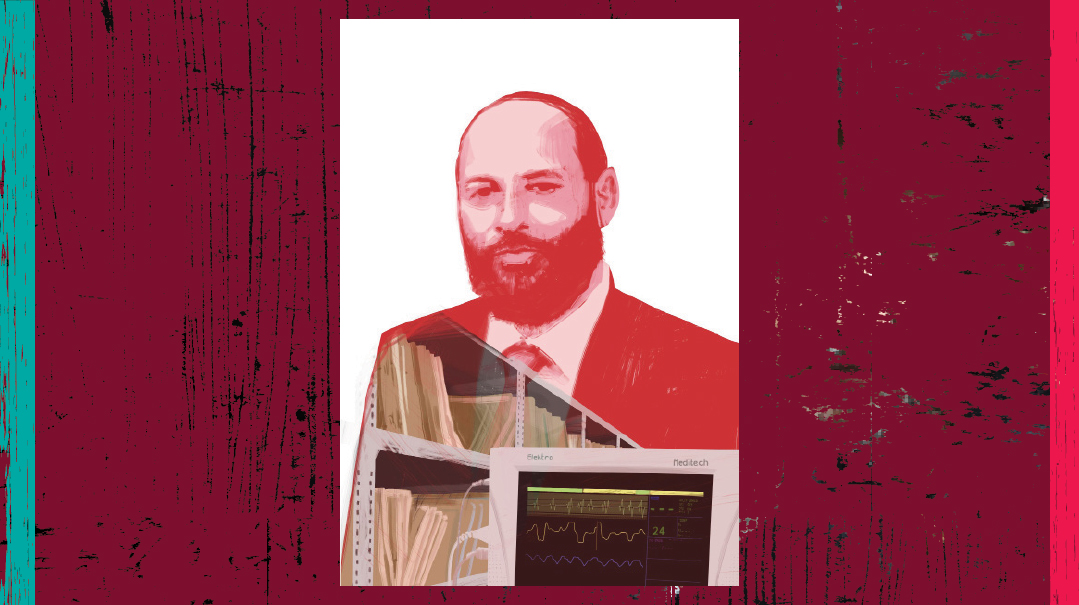
No longer would I be a businessman who squeezed in some medical consulting between meetings. From now on, I realized, I had to devote the bulk of my day to medical advocacy
Yossi Erblich, founder of L’ma’anchem, a medical referral service
Most kids grow up with a rosy picture of the medical world: Someone gets sick. He visits the doctor. The doctor prescribes the right medicine, or performs the right procedure, and the patient lives happily ever after.
I was just 17 years old when I got my first inkling that things aren’t quite that simple.
I was always an out-of-the-box thinker, someone who did things my own way. I was born in Belgium and grew up in Tel Aviv, a background that expanded my horizons and afforded me knowledge of different cultures and lifestyles. I learned in Ponevezh and was still in my twenties when I got my first job as assistant to then-health minister of Israel Tzachi Hanegbi.
When I was just 22 years old, my uncle, the Rebbe of Pinsk-Karlin, required open-heart surgery. Back then it was considered very intimidating, and the entire family was almost paralyzed with fear. I went to visit him, and he told me, “Yossi, I want you to take care of this. You’re going to be the one to research all the options and find the best hospital and doctor for my surgery.”
I almost stopped breathing for a moment — and then I faced the challenge head-on. The Rebbe had commanded; I had my marching orders. And so I became the family’s address for all the questions that inevitably arise in these kinds of situations: whose opinion to rely on, which hospital to use, which doctor was best.
By the time my uncle had successfully completed his surgery, I’d learned something very sobering: that along with excellent practitioners and hospitals, Israel’s health-care system has many gray areas, and that not everyone automatically receives the right care.
Over the ensuing years, even after I settled in Bnei Brak, established a family, and got involved in my family’s real-estate business, I kept getting phone calls. Friends, neighbors, and relatives knew that I was something of a maven — a person with inside information, good connections, and strong instincts. Whenever they were faced with doubt about anything medical, they called me. Between meetings and appointments, I’d find time to research the medical literature and developed good sources in the system so I could direct people to the right sources for treatment. Doctors, initially suspicious, began to trust me, and the bureaucratic authorities who make many of the decisions here in Israel no longer rolled their eyes when I called.
Then, six years ago, I received a call that changed my status forever.
The case seemed simple. A woman had entered the emergency room in critical condition. The only way forward was invasive and potentially life-threatening brain surgery. Time was of essence.
I asked the family a few quick questions. Something just didn’t seem to add up. I had a funny feeling that the same symptoms could be traced to a problem far less significant.
Mustering no small measure of chutzpah, I called in a specialist for a second opinion. “Erblich is right,” he said. “There’s no need for the invasive brain surgery. We can treat this woman without risking her life.”
The brain surgery that wasn’t became a turning point for me. No longer would I be a businessman who squeezed in some medical consulting between meetings. From now on, I realized, I had to devote the bulk of my day to medical advocacy.
Over the past six years, my casual advocacy has been transformed to a proper organization, known as L’ma’anchem, funded by the Avraham Noson and Shoshana Scharf Foundation along with the Ohr Eliezer Fund. Word has spread. My caseload has grown to approximately 600 calls a week. We set up a proper office on the border of Bnei Brak and Ramat Gan. We’ve installed a detailed database and fully computerized system, trained in a full team of advisors with specialties in different areas, and built connections with a large roster of medical professionals.
There is so much to learn in the world of medicine — and every few months, the curriculum expands, as new developments, new techniques, new procedures and drugs are developed. In order to keep current, I spend hours every day just learning.
You can learn a lot by constant reading and research. But I also make sure to get out there and visit the hospitals, attend conferences, and speak to the people who are at the front lines. If you approach them with humility and respect — and if you learn the terminology and make sure to do your homework — there’s so much these professionals can offer. They are my greatest resource as I keep learning more about what medicine can do for people.
Over the years, I’ve also learned a lot about people — the patients fighting to survive, their frantic families, and the professionals who care for them.
Your average religious Jew, at least here in Israel, doesn’t have much medical knowledge. Most of them have this idea that they absolutely must pay for a private doctor. But the truth is that with the right guidance and the right decisions, they can usually get excellent care within the system.
I’ve learned to see the humanity in every person who calls: religious or not, Jewish or not. A person facing his mortality is usually frightened and overwhelmed. But you can see greatness there too: There’s faith and deep belief beneath the fear, and it moves me every time.
Leveraging contacts I’ve cultivated over the years, I work with a network of 80 doctors in Israel, the United States, and throughout Europe (because sometimes the best treatment really does require a trip abroad). Professor Benny Davidson, the former director of Assaf Harofeh, joined my L’ma’anchem team several months ago and together we guide patients to the most promising treatments and most qualified practitioners. I also visit top-tier hospitals throughout the world on a regular basis, not only to stay current on the latest treatments but also to establish or nurture personal relationships with medical professionals who become valuable contacts. I’ve learned there is nothing like a personal relationship when someone’s life is at stake.
People have a certain fascination with experts who are “one-stop shops.” But as the medical world grows increasingly complex, my dream is to build a team where every member has his own specialty. One would be the address for all questions regarding cancer, another would do cardiology, another would focus on caring for children. Working as a team, maximizing talents and knowledge by focusing on specific areas of expertise, we could help so many more people.
I got my first sign that I’d “arrived” when a major Israeli health fund offered to sponsor my work if I’d serve as their medical advisor. I turned them down on the spot. I can’t do my work properly unless my only allegiance is to the patient.
Like so many others in the field, I have a long list of patients who linger in my mind. There’s the woman who called me late one night, hysterical. She was so frantic she could barely get the words out. Her son was in the hospital, she told me between sobs, and the doctors said there was no hope for him. The staff had run various tests and found a rare, particularly virulent infection.
She was in such a state that I could barely communicate with her, but I asked her to send me whatever files she had. I reviewed the data, and got this niggling sense that they were missing something important. “I’m not a doctor,” I told her, “and I don’t want to give you false hopes, but I think it’s worth taking another look at what’s going on.”
I called some of the experts I knew and studied the numbers some more. Then I got in touch with the hospital, introduced myself, and told them that I thought it might be wise to do some additional, slightly different tests. The doctor refused.
“We have our results,” he said. “You’re just giving this desperate family false hope, a flimsy string to hold on to, when there’s really nothing to hope for.”
I try to be diplomatic and polite, but sometimes you have to go to the top. I contacted the hospital director, explained the background of the case and why I thought the new tests were warranted — and he authorized the tests.
The results indicated a completely different type of infection, requiring a different course of treatment. Two weeks later, this little boy was back home, safe, and on his way to a full recovery.
Then there was the elderly man in Be’er Sheva who was convinced that he had to travel to a major Jerusalem hospital for his cancer treatments. The toll of traveling back on forth would have broken him and his family — and the local hospital was eminently qualified to provide the treatments he needed. I talked it out with him and his son: They were so relieved to hear that they could stay in familiar surroundings during this frightening time.
I also remember the woman in Kiryat Sefer, mother of a growing family, who woke up one morning and couldn’t get out of bed. She said her legs weren’t holding her up. Her family thought she’d pulled a muscle. When it persisted, they figured she might have broken a bone. Then they went for a round of X-rays — her legs, her back, her pelvis… When nothing came up, they started to suspect that the real cause was psychological. Why would an otherwise healthy woman insist she couldn’t get up, get her kids dressed, make them sandwiches, and send them off to school? When they called me, alarm bells went off in my head. I immediately consulted with a neurologist, and we referred the woman for neurological testing. The problem really wasn’t in her legs, and it wasn’t in her mind — although it was in the brain. But without that kind of critical thinking, there’s a good chance no one would have caught it, no matter how much her well-meaning family loved and cared for her.
Sometimes I wonder what my kids think about the way I spend my days. Though I try to share only the positive stories, I’m sure they sense how much tragedy I deal with. It’s not something you can entirely hide. And over the years, their lives, even their identities, have changed. They used to have a father who dealt in real estate and “helped out some people” on the side. Now they have a father who must leave his phone on over Shabbos for emergency calls; a mother who helps run Meshi-Le’ma’anchem, our center for disabled children in Bnei Brak; and an extended family network of countless people battling serious illness.
But they also have an extended family of people who’ve triumphed in those battles, and who will forever feel connected and grateful.
Like the man who showed up at my son’s wedding and danced with amazing vigor for hours. I assumed he was related to the kallah — until, at the end of the wedding, he approached me.
“Rabbi Erblich, do you remember me?” he asked.
“No, I don’t,” I admitted.
His response was to envelop me in a big bear hug.
“Let me remind you,” he said. “Remember a man who called you a few years ago, begging you to save his leg? He said he had advanced diabetes, and his leg had become gangrenous and the doctors said they’d have to amputate it before it spread and poisoned his vital organs.
“Rabbi Erblich, you said that sometimes diabetes cases really are black and white, and there’s no choice but to amputate. But sometimes, there are gray areas. That was my only hope — that my case was still in the gray area. You studied my medical file, consulted with an expert, and advised me to switch to a smaller hospital that offered a different treatment protocol.”
I nodded. It sounded vaguely familiar.
“I never got back to you,” he said. “But now, when I heard you were marrying off a son, I decided I had to thank you in person. So I came here on my two legs and danced for you, and for your son — for the simchah you’re experiencing, and for the simchah you still bring me and my family.”
“Reb Avraham, the zechus of supporting bereaved parents was promised to your Srulik’s neshamah. From the Six Days of Creation, this mitzvah has been waiting for you”
This wasn’t just a couple of Jewish Agency contacts in Moscow with an interest in moving to Israel. It was an entire secret network, an entire Orthodox community that functioned under the Soviet radar