Learning Curve on Kiruv

What the Traveling Chassidim have learned along the way is that the Jewish neshamah has many ways of being ignited

Photos: Naftoli Goldgrab, personal archives
Rabbi Aryeh Royde, a Belzer yungerman from Manchester who’d moved to Monsey, thought he knew all about kiruv. He studied the sources diligently, prepared to debate G-d’s existence, and acquired an intellectual chavrusa through Partners in Torah. But although he engaged his phone-pal every week for two years, the fellow at the other end of the line still had no interest in keeping halachah. And then he traveled with his fellow Belzer friend Eli Bineth to Dallas for a community kiruv shabbaton.
“During the Friday night oneg, there was such warm chassidishe energy. Everyone was into the niggunim, and this guy drives up in his car, comes into the shul, sits down next to me, and asks me for a beer,” Rabbi Royde remembers. “I brought him a bottle, opened it for him as a gesture of friendship, and after that, we just bonded. On Motzaei Shabbos at the kumzitz, he sidled up to me and said, ‘You know, I’m 40 years old and haven’t put on tefillin since my bar mitzvah. Maybe you can help me do it tomorrow?’ I was astounded. We didn’t give lectures, we didn’t prove Hashem’s existence — we were just nice. We smiled. We danced. We sang. The people saw Shabbos. All I did was give him a bottle of beer, and the next thing I knew, he wanted tefillin.”
It would become a formula for the Traveling Chassidim, a national kiruv venture he himself would lead.
Rabbi Royde and his friend Eli Bineth, at the time director of a mentoring program training yungeleit to learn with teenage bochurim, took a kiruv training course through Project Inspire, and after that, “we couldn’t just go back to our complacent lives,” Rabbi Royde says. “How could we let millions of American Jews remain assimilated while we continued to bury our heads in Monsey? What could I do with my chassidishe friends that would be unique? How could I make my contribution?”
They didn’t have to wait long. In 2010, Rabbi Royde attended a Discovery Seminar held in Wilkes-Barre, Pennsylvania. Rabbi Raphael Nemetsky of the town’s congregation came up to him and sighed, “You know, nowadays no one cares that you can prove to them what’s true.”
“You know what,” answered Reb Aryeh, “I have a group of friends. Maybe we’ll come to your city and show them a real chassidishe Shabbos.” The rabbi was excited. “Great!” he said, “I’ll just put you down as the ‘Traveling Chassidim.’
“And so,” says Rabbi Royde, “we were invented.”
From that first Shabbos in Wilkes-Barre with the Royde and Bineth families, the Traveling Chassidim have grown into a large network of over 70 families who travel across the United States and Canada, providing unaffiliated Jews with a taste of Shabbos, chassidish-style. Rabbi Royde’s brother Reb Yisroel, a long-time kiruv personality in Monsey whom Reb Aryeh credits with his own initial foray into kiruv, is also part of the team. They go to Young Israel communities and places like Aish centers where the leadership is frum yet the congregants are mostly unaffiliated.
“We just decided to take our chassidish flavor around — after all, that’s who we are. And what did people see? A group of happy people, living Shabbos, living Yiddishkeit, and that resonated with them,” says Rabbi Royde.
If you’re wondering how a group of Belzer avreichim got involved in Project Inspire, founded by Rabbi Noach Weinberg ztz”l, with his vision of every frum person becoming a “kiruv ambassador,” Rabbi Royde says it was a natural outgrowth of the Belzer Rebbe’s own inspiration. The Rebbe is a big kiruv promoter — the Tzohar and Hidabroot organizations in Eretz Yisrael are under the auspices of Belz.
“When we started out, we discussed everything with the Rebbe,” says Rabbi Royde, “and at that point we developed a close relationship. We speak every time I go to Eretz Yisrael. He sends me letters to ask how it’s going and to give us chizuk, especially since in some circles people might look askance at our being too ‘out there.’ ”
He sometimes gets that reaction from participants themselves. “We recently had a Shabbos in Manhattan, and at the Friday night Q and A, someone asked, ‘Aren’t chassidim really insular? How come you do this?’ ”
After years of traveling to other communities, and even launching Traveling Chassidim all around his native England, Rabbi Royde saw a void within his own neighborhood. “We were doing all this work with the secular population, giving them a taste, demonstrating authentic Yiddishkeit. But what about those of us within the community? We could all benefit from the beauty and inner meaning of Shabbos.”
With this in mind, Rabbi Royde created “Taamu,” starting out with a series of classes on foundational Yiddishkeit, which he says are “a sort of reeducation” for many people: davening (does Hashem need our tefillos?), emunah and bitachon (what does it mean to rely on Hashem, to let go?), sechar v’onesh (if Hashem loves us why does He punish us — or does He?), and how to keep Yiddishkeit relevant.
Innumerable encounters and 250 shabbatons later, Rabbi Royde had learned many lessons that have shattered preconceived ideas about kiruv and the resilience of the Jewish neshamah.
“Thirteen years ago, we had an idea,” says Rabbi Aryeh Royde. “Now we have stories.”

What We Thought
Kiruv is complex, because people have deep, philosophical questions, and they need intricate answers.
What We’ve Learned
A secular woman from Pennsylvania once came to a shabbaton we hosted in Monsey. (We call that program “Shabbos in the Shtetl.”) In the middle of the meal, during the chicken soup course, she suddenly scraped her chair back and stormed out the room, ranting all the way out, “I knew it, you blew your cover! You chassidim pretending to be friendly, I should’ve known you’re really not!”
I abandoned my own soup and ran after her. What happened?
Turns out the woman had gotten a bowl of clear chicken broth. She didn’t get a matzah ball like the people sitting on either side of her.
“It’s because I don’t cover my hair,” she said. “So you couldn’t have me receiving a holy matzah ball. I see I’m not good enough for you. Not good enough for matzah balls.”
I could hear the years of preconceived ideas in her words, beliefs she’d formed about us. And I knew what we had to do: challenge those misconceptions by giving over our open hearts, no strings attached, as many matzah balls as they want. For the most part, kiruv is not about the deep, meaningful questions, it’s about reaching out and closing the gap, showing them that the chasm doesn’t really exist. We’re all Yidden, we’re all one.
I steered her back to the dining room and doled out more matzah balls, this irate woman showing me again that kiruv is easier than we think.

What We Thought
Kiruv is about making someone frum.
What We’ve Learned
At a shabbaton in Yardley, Pennsylvania, a young couple walked in. They were Steve and Lori , and without going into detail, Lori didn’t exactly look refined. The rabbi turned to me and whispered, “He comes a lot, but I can’t believe she’s here. She never comes to any shul events. See what you can do for her, because he’s a great guy and we need him.”
Years later, Lori herself admitted, “I went to that shabbaton kicking and screaming.”
I had a young daughter at the time, a friendly little three-year-old. I gave her a little pat, and asked her to go give the lady a hug. She ran over to Lori , hugged her knees, and then, Providentially, crawled into her lap and sat there for the whole meal.
On Motzaei Shabbos we do a musical Havdalah. It’s not as popular as the Shabbos program since people have other plans for Saturday night, but Steve and Lori showed up again, and again my daughter sat in her lap.
Two months later, we ran another shabbaton in the area, and who should show up at the Havdalah but this couple. Lori said she missed Leah’le. But it had been two months, and I wasn’t even sure that my daughter would remember. Leah’le looked Lori up and down, and chasdei Hashem, she went to her again. That was it. Lori, who didn’t have kids of her own, fell in love with my daughter, and said she had to see Leah’le at least once a month. They drove to our home in Monsey every month. My wife served food and hot drinks, we chatted, and Lori played with Leah’le. Changes towards Yiddishkeit came incrementally over the years, and today, Steve and Lori have become fully observant. Steve himself now does kiruv in Yardley.
When people ask me, “How do you do it? How do you make someone frum?” I tell them, “You don’t make anyone frum. You just bring them close.”
And this doesn’t just apply in kiruv. I’ve said the same thing to people at Keiravtuni, a popular annual convention for chassidish couples. Parents ask about how to connect their children to Yiddishkeit, to Hashem, and I tell them, “Don’t push Hashem into your children’s hearts. Bring them into your heart, and if Hashem is there, they’ll find Him.”
It’s the same with kiruv. Bring them into your homes, your hearts. If Yiddishkeit is relevant and exciting for you, they’ll pick up on it and discover it for themselves.

Len with the Nikolsburger Rebbe
What We Thought
Sometimes it’s just too late.
What We’ve Learned
One encounter fosters the next. Len, the father of one of our participants, came into our life because he’d heard so much from his son and daughter-in-law. He joined a “Shabbos in the Shtetl” at our home.
On our own turf we can offer our own food: cholent, kishke, and chassidish stories. We do a tish on Friday night and fabreng deep into the night. And we don’t put anyone up in hotels — we want them to experience Shabbos in a frum home, either ours or our neighbor’s.
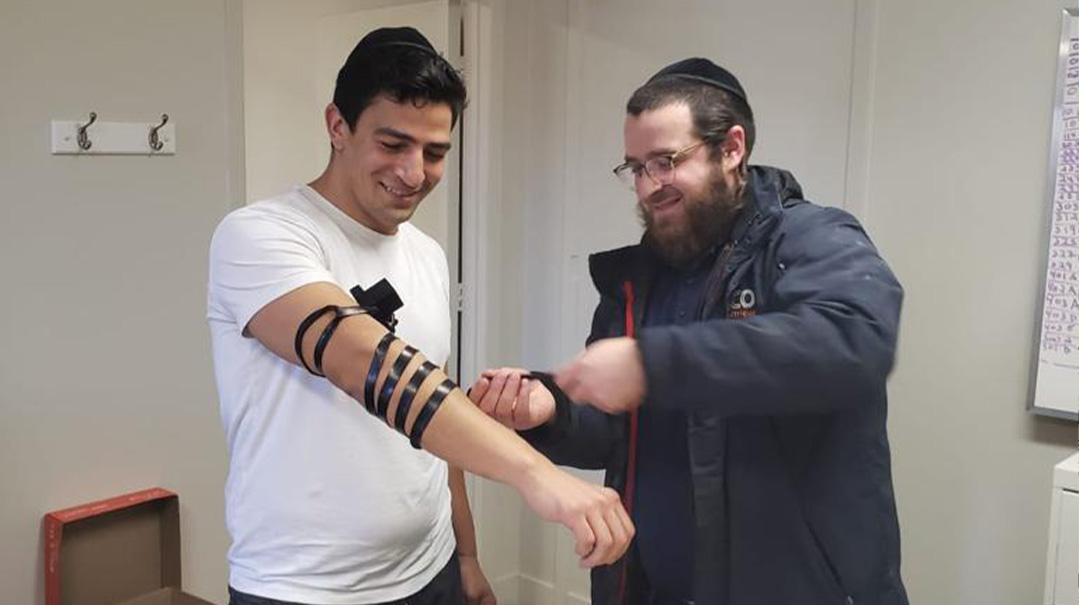
We had Len in our home — he was well over 70 at the time — and he said he always carried a certain guilt that he’d never kept Shabbos. He said he didn’t want to leave the world without keeping Shabbos properly at least once. That Shabbos in Monsey was the one Shabbos. We got to know him, and after Shabbos he confessed to more guilt: He didn’t wear tefillin.
“We’ll do something about that,” I said.
He was interested in learning more; semi-retired, he had the time. He started listening to shiurim. We bought him tefillin and made a bar mitzvah for the 74-year-old man. I called over my friends, there was food, music, a full-on, chassidish-style simchah. The Nikolsburger Rebbe of Monsey laid the tefillin on him. It was very special, really beautiful.
Len continued to lay tefillin each day. I’d send him a text every Erev Shabbos to check in and wish him a Gut Shabbos. He’d also drive down a couple of hours from his home in Pennsylvania for our Chanukah lighting, and sometimes for a Sunday BBQ. In later years, when he was completely retired, although he wasn’t fully observant, he learned Torah virtually all day long. He listened to shiurim online and had a chavrusa. That one “Shabbos in the Shtetl” changed the trajectory of the next decade of his life.
At one point I took Len to the Nikolsburger Rebbe’s home, and I found out that Len had once been Yosef Leib. The Rebbe and the Rebbetzin regularly mekarev Yidden, and when the Rebbetzin served cheese blintzes, they reminded Len of his bubby’s cheese blintzes fun der heim, from Chernobyl, he told us. Then he started speaking Yiddish. Food is a great connector, and the blintzes had triggered a deluge of memories. Soon I started calling Yosef Leib “Yossel” as a joke, but it was really because we grew so close. He passed away a couple of months ago, and I spoke at his levayah, recounting his dramatic turn toward Yiddishkeit in the last decade of his life.

What We Thought
Yiddishkeit is about the dos and don’ts — that’s what baalei teshuvah need to know.
What We’ve Learned
We did a shabbaton in Staten Island, and someone came in, someone who’d driven over to shul. The rabbi placed him at my table and said, “Hope he’s okay with it because you’re pretty Steved, and I’m not sure he’ll appreciate it.”
Despite the rabbi’s reservations, we hit it off on Friday night. For Shabbos lunch, which is usually much quieter, we generally eat just with the rabbi and a few others. We decided to invite Ryan, his wife Sherry, and their kids.
Friday night, we chassidim are pretty much the stars of the show, but Shabbos lunch is calmer, less of a show, more personal. Ryan sat next to me again, and over the course of the meal, he asked me if we could learn something together.
I took his number after Shabbos and called him and texted him repeatedly, but he didn’t respond. It seemed that he was inspired, yet quickly lost interest.
A year later we went back to the same community — we often do annual return visits — and the week before the shabbaton, I got a surprising call. It was Ryan. He apologized for not picking up before, and we decided right then that we’d learn hilchos Shabbos together.
We started after the shabbaton. He thought I was going to tell him everything you weren’t allowed to do — like not to drive his car on Shabbos.
But I started by asking him what his Shabbos looks like. He said his wife lights some tea lights on the window sill, he sings a traditional song or two, and then they drift over to the sofa and watch TV.
I had an inspiration. “Let me teach you about candles,” I said. “Instead of tea lights, you should use five-inch-tall candles in seven-inch tall candlesticks. And on a windowsill? That confuses Shabbos with Chanukah. They should be on the table, a fully cleared table, upon which there’s a white tablecloth. All the family should shower or bathe before Shabbos and wear their best clothing. Oh, and if she can, your wife should bake challah on Friday morning.”
“What about the challah rolls in the bakery?” he tried.
“No, they’re for Shalosh Seudos…” I said evenly.
I was pushing it, maybe taking a gamble. But it paid off. Within a few months Ryan wanted Shabbos. And why not? He was getting the geshmak of Shabbos in his own home. He came home from work and the place was smelling of fresh loaves, his wife and children were wearing their best, there was a gleaming tablecloth, a cleared table, beautiful candles. Now they weren’t running to the TV. They’d worked for Shabbos, and they were going to enjoy it.
I was following Reb Noach’s teaching: Show them the beauty of our Jewish life, don’t make it about halachah, but I’d gone roundabout with it — with Ryan, I started with supposed halachah so he could see the beauty for himself.
The next year, the shabbaton in Staten Island was rolling around again, and Ryan invited my family to stay at his home.
I said, “You’re quite far from shul, like a 35-minute walk, no?”
And he said, “Excuse me, because of you I do this every week.”
“You got me,” I said. “We’re absolutely doing this. But your home, it’s got to be kashered.”
I went down to his house on the Sunday before the shabbaton, and we kashered the place.
That Shabbos we stayed at his newly-kosher home, and the joke was on me: On Friday night my wife lit tea lights on Ryan’s windowsill.
Ryan and his family were doing Shabbos and kashrus for a while, but they’d reached an impasse: They couldn’t seem to move forward. And then, just like that, they took another leap. They sold their house and moved to a frum community.
We’re family friends now. They come to us, and we’ve been to them for Shabbos as well. The last time we went, Ryan’s son, Stuart, who was in public school three years prior, had a question for me on the Gemara he was learning.

Double Pidyon haben
What We Thought
There’s a specific window for mitzvos.
What We’ve Learned
Sometime before Covid we started a kollel, where a group of secular people and a group of yungeleit get together in a shul in Monsey one evening a week to learn b’chavrusa. My brother Yisroel, who’s also part of the Traveling Chassidim, runs the kollel, and he kept it going on Zoom through Covid.
Nir is an older person who attended the kollel and at one point expressed interest in tefillin.
“If you commit to putting them on every day, we’ll buy you tefillin,” we told him.
And so he had a bar mitzvah at around age 70.
But the story doesn’t end there. One week, Nir turned up to the kollel and said he wanted to learn what’s inside the tefillin. He and his chavrusa started with the first two chapters of Shema and then learned the segment of “Kadeish li kol bechor,” about pidyon haben.
The next week he came back to us. “Hey,” he said, “I’m a firstborn.”
He’d done the research; he hadn’t had a pidyon haben. Jeff, the guy on the next table, asked him, “What are you so busy with?”
Nir and his chavrusa explained about pidyon haben, the mitzvah to redeem the firstborn.
The next week, Jeff came back saying he’s also a firstborn, also never “pidyoned.” One thing led to another, and we held a double pidyon haben in a big shul in Monsey for 70-year-old Nir and 40-year-old Jeff. This was the real deal, a halachic pidyon haben with a Kohein and all. We had a beautiful meal, singing, joy. The Nikolsburger Rebbe came and bentshed them both.

What We Thought
We come across as archaic in our shtreimels and beketshes. There’s no way we can reach them like this.
What We’ve Learned
There was a couple in their 60s at a shabbaton in Denver, Colorado. They had little to do with the community but came for Shabbos because they were intrigued by the ad: “A Shabbos with the Chassidim.” They’d long been cynical about chassidim and wanted to see who we were.
The two of them were engaged to be married shortly. They sat at the meals, partook of the food, listened to the conversation, and joined in the singing. Suffice it to say that at the end of Shabbos, the bride was begging us to come to the wedding. “Come along and dance up a storm,” she said. “Give it a chassidish touch.”
We made a deal with her, that if she took upon herself to have a kosher home and keep certain halachos, we’d come. We didn’t know then that they’d schedule the wedding for a week before Pesach. But when we got the invite, we couldn’t back out. I took a group of chassidim, and we flew off to Denver. We danced and rocked that place, and filled it with lebedigkeit and ruach.
It meant so much to them that we came out all the way, and in short order, they became close with the rabbi, with the shul, and with the community, and now they’re regulars.
When we tear down barriers and show up in unexpected places and give people our authenticity, we all learn that we have so much more in common than what divides us. And we’re able to build bridges and break age-old stereotypes.
One of the people I got to know through Traveling Chassidim told me after the New York Times article against chassidim came out, “I’m telling my colleagues, my friends, to stop beating chassidim. I know them, they’re my friends. Before you nod your head and agree with the article, go on, meet them, too.”
We often get called to go to college campuses. Students can be a difficult clientele, but they’re also in this space where they’re open to change. The rabbi on campus does his work, we come for a Shabbos, we come again, and in some cases, those college kids sign up for yeshivah, go to Eretz Yisrael. One time, I went into Aish HaTorah and I saw a yungerman learning Rishonim of Bava Basra. We recognized each other — I’d met him on a college Shabbos in Buffalo five years ago — and now he was plumbing the Gemara and was even the gabbai in the beis medrash.
(Originally featured in Mishpacha, Issue 956)
Oops! We could not locate your form.
RELATED CONTENT

Jewish Panama may be known for wealth, but its real treasure is a Torah revival

Rav Yitzchak Biton and his wife, Tamar, have become powerful symbols of faith for a nation under fire

A former financial wiz bridges the gap between virtual reality and eternal content

The Pnei Menachem's youngest child opens a rare window into his father’s mesirus nefesh for his chassidim — and for every Yid


