
My Brother’s Keeper

A best friend is revealed as a long-lost sibling

Photos: Elchanan Kotler, Family archives
Imagine having a dream where you discover that your best friend is really a long-lost sibling you never even knew existed.
That your chavrusa and best buddy from yeshivah, the one who sat with you at every meal and shared your dorm room and late-night DMCs, turns out to be your big brother. It sounds like a plot so far-fetched that only the Supreme Author could have thought it up — but for two fellows named Ofer Shushan and Lior Alhanati, it was a dream come true.
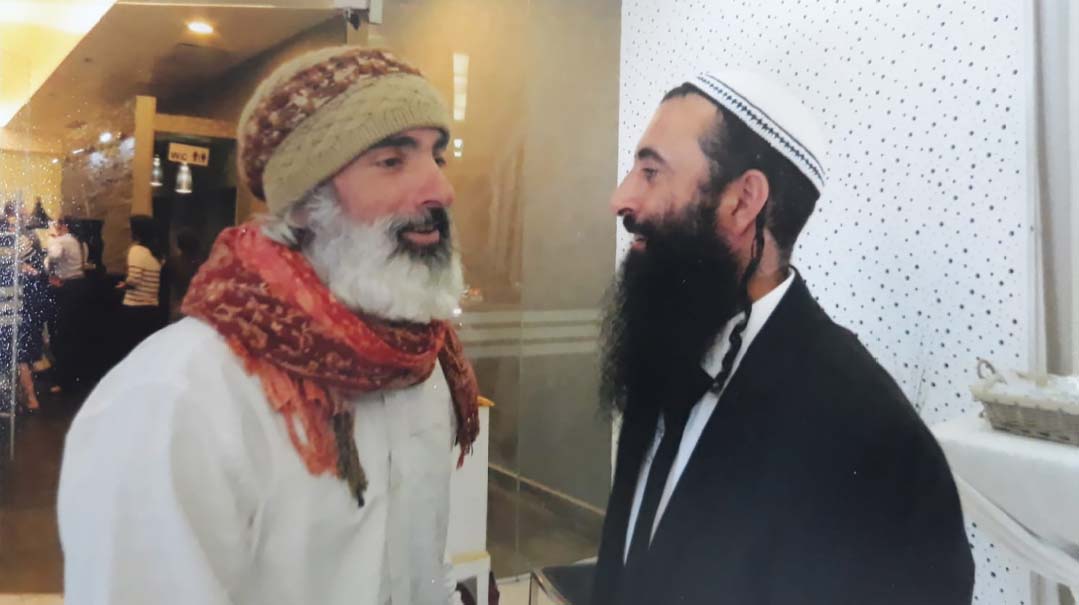
Lior Alhanati’s unconventional attire — a flowing Tanach-inspired tunic and a tarboosh crowning long, twisted locks, sparkling eyes, a grey-streaked beard and spiraling peyos — testifies to a life of searching for connection. Indeed, he’s been many things over the years: farmer, shepherd, equestrian therapist, landscaper. But his most profound self-definition, he says, is one that eluded him for 30 years: Brother.
Lior’s personal odyssey began 48 years ago, as an underweight, chronically-ill baby (he’s now a broad, strapping six-footer), whose emotionally-depleted and financially-destitute parents couldn’t cope with this third child in as many years. When he was two years old, the Social Services Office in Teveria, where the family lived, was alerted to the difficulty, swooped in and, with the father’s permission, took Lior away and placed him in a children’s home.
While Lior’s father was glad to be relieved of the burden, Lior’s mother was less certain, although she assumed that any new arrangement would be a type of foster care, where she would be able to visit her toddler son on a regular basis until the family situation stabilized. But little Lior was put up for adoption and the door to his family was slammed shut and locked.
Lior lived in the orphanage for two years, until he was adopted by the Alhanati family, a devoted and loving childless couple from the Galilee town of Carmiel.
Eventually Lior’s biological parents reestablished themselves and had another five children, but Lior was permanently out of their lives — and no one in the immediate family, except for his parents, even knew of his existence.
“I can still sense the horror, the devastation of the separation and abandonment,” recalls Lior close to five decades later, sitting in his sun-drenched living room in Elad, where he works as a landscaper in non-shemittah years and is currently busy tending to permissible work in the olive groves of nearby yishuvim. “I grew up knowing that I was adopted, that somewhere there are other parents, brothers and sisters. It was an awful feeling that accompanied me through my years growing up.”
Lior praises the parents who raised him, referring to his father as “one of the 36 tzaddikim in the world” with his deep, unswerving faith, and his mother who took in a strange child and raised him as her own.
In the Alhanati household, Lior was raised mitzvah-observant. He would go to shul with his adoptive father, and recalls as a seven-year-old being in shul and reading the perek L’David Hashem during Chodesh Elul. When he reached the words, “Although my father and mother have forsaken me, G-d will gather me in,” it shook him up.
“I went up to this old man and said, ‘Who wrote this prayer? Does he not have parents either?’ The man explained that I was 3,000 years late, that we were talking about David Hamelech. Yet I’ve always felt connected to those words, even in the most rebellious times that would lie ahead for me.”

Not the Right Time
Although he grew up in a nurturing environment, Lior could never shake the feelings of bitterness, resentment and abandonment. He was angry, at the world, at life, at G-d.
“I was pretty angry with Hashem, but even so, I always still felt that I’m His child, and just like a son can do anything and his father will always be there, I knew that even if I’d kick and scream and rebel, at the end of the road, Hashem would still be waiting for me.”
In the army, Lior discarded his kippah and left religion. “I committed many transgressions, and yet I would feel lousy because I knew that G-d was watching. But I had so much anger, I just wanted to kick. I couldn’t express it any other way. Yet I had this deep-seated knowledge in the back of my mind that I could always come back. I never stopped believing.”
And, he says, G-d always had his back. One time during his army service, Lior was waiting to hitch a ride from his base to Carmiel. Just then, terrorists in a stolen car were on the lookout for a soldier to kidnap, and the car pulled up next to Lior and offered him a ride.
“There were three of them in the car, and maybe it was a little suspicious, but I was so tired I decided to get in anyway. Just then my legs locked, as if an outside Hand was holding me back and preventing me from getting in. They saw my hesitation, and immediately sped off.”
Several minutes later an army jeep pulled up and asked if he’d seen this particular car, since they were chasing a gang of terrorists. Later, Lior heard on the news that the car was found torched in an Arab village.
“Hashem never let me totally fall,” Lior says. “Even if I was on the brink, He wouldn’t let me step over the boundaries to total disaster. He always pulled me out at the last minute.”
After the army, Lior did a typical Israeli tour abroad to “find himself,” came back, worked some odd jobs (security guard, advertising model), and played the darabukka.
Then, something inside propelled him to open his adoption file.
“It’s not that my life was missing any material comfort,” Lior says. “My adoptive parents gave me everything, yet deep inside there was still this feeling of abandonment that never went away. I suffered from a strong sense of detachment. Who was I really? What family did I belong to? Who were my parents and why did they abandon me? I think that’s what made me into a searcher. Maybe my journey to the east was rooted in a subconscious desire to find my parents. Sometimes I’d see a person on the street and wonder if it could be my brother or sister.”
The Alhanatis took it hard. “Maybe they had some underlying fear that I would reject them, and leave them for my natural parents. But I explained that it had nothing to do with my relationship with them, it was just this internal need to know where I came from.
“At the same time,” he admits, “I wasn’t even sure I wanted to meet my mom. I was 22 years old, but I still had so much anger. She threw me out of the house. How could a mother do that? Let her live and die with her guilt! But the social worker arranged it, and there I was in Haifa, walking into the room where my mother was waiting, together with her sister and their social worker. I told myself I’m just going for curiosity’s sake, that I just want to see who this woman is.
“I approached her, and she started to cry. I thought to myself, why are you crying, you were the one who abandoned me! But then I really opened my eyes and saw that she was crying from the heart. I sat with her for an hour, while she explained how she tried to find me, but how all the doors were closed to her. ‘I never stopped thinking about you for a moment,’ she told me. ‘At every stage in your life, I wondered where you were and what you were going through. I thought of you when you started first grade, I thought of you when you reached bar mitzvah age, and I thought of you joining the army at 18. But I knew you’d been taken in by a good family and that wherever you were, your life was going well.’ She told me that she lit a Shabbat candle for me every week — it was the only mitzvah she kept. She said she prayed that if she didn’t find me in her lifetime, one of her children would.”
When the meeting was over, Lior’s mother asked if they could maintain contact. “I told her that I have other parents and that I can’t betray them. I said maybe later on, when I’m more settled, when I get married. Truth was, as much as I was obsessed with who they were, I was scared to meet the rest of the family. My heart tore as I said goodbye, as if I was being sent away for a second time. But I returned to my life and she to hers. It was too complicated for me emotionally to retain the relationship. It just wasn’t the right time.”

Inseparable
Lior continued to work and travel, hoping to quiet the inner conflicts and find meaning and peace. He played his darabukka, practiced yoga and meditation, and even had a stint herding sheep. He was renting a room in Jerusalem at the time, and having heard about a music festival near Eilat, he made his way to the central bus station, sat down on the last platform, and waited for the bus.
And that’s when he met Ofer Shushan for the first time. Ofer, about three years Lior’s senior, was working as a security guard at the bus station, inspecting the benches and keeping an eye out for suspicious characters. Suddenly, under Ofer’s cap and ponytail, their gazes locked.
“I had this fleeting, yet overpowering, feeling that I knew him from somewhere. Maybe we had a childhood friendship? Maybe he’d been in my class in school? Maybe I knew him from the army? It was mystifying, because I have a pretty good memory, and yet I couldn’t place it.”
The two of them chatted a bit, the bus came, and within a few minutes, each of them went back to their own lives. Yet it was a little strange: It’s true that Jerusalem isn’t that big, but over the next year, they’d keep bumping into each other.
Around this time, Lior knew he had to do something concrete with his life — traveling to music festivals was just not doing it for him. And so, at age 25, he decided to take a few tentative steps back to the Torah he’d left years before, started attending shiurim, and eventually enrolled in Machon Meir, the beginner’s yeshivah affiliated with Mercaz Harav in Jerusalem.
“I was at the yeshivah for a few weeks,” Lior remembers, “and then in comes Ofer, the security guard from the bus station. I recognized him immediately, with that cap and ponytail. Again, our eyes locked.”
“Ahalan, Ofer!” Lior greeted the newcomer. “So we meet again…”
Ofer looked at him in amazement. The last person he had expected to run into here was the music festival traveler with whom he’d shared a few fleeting encounters. Was he also doing teshuvah?
It wasn’t long before the two became fast friends. In fact, for the next three years, Lior and Ofer were inseparable, like magnets. They studied together every day, shared a table in the beis medrash, ate their meals together, roomed together, spoke about the meaning of life together, and played music together in late-night dorm-room jamming.
Yet despite their closeness, Lior never spoke about his background, about his challenges growing up with adoptive parents and all the inner conflicts that resulted. Maybe now that life was on a true spiritual trajectory and his head was being filled with Torah, he could put those other feelings away for good.
“I’d heard a rumor that Lior had grown up in an adoptive family,” Ofer remembers. “I think that’s why I steered clear of family matters with him. He never brought it up, and I knew it must bother him and I didn’t want to cause him pain.”
At Lior’s wedding three years later, Ofer took center stage, just like a brother.
Time to Find
As life goes on, the two friends moved in different directions. Ofer continued in yeshivah, while Lior moved to the town of Mitzpeh Yericho, where he worked as a renovations contractor and began to study horseback-riding therapy for kids.
The following year, Ofer got married and moved to Kiryat Gat, where he still lives. He initially worked as a sofer sta”m, and is today a ram in a yeshivah high school. And as so often happens even with the best of yeshivah friends, the pressures of daily life led them on further diverging paths. Lior hadn’t even been able to attend Ofer’s wedding — that night he was expected at a family event up north in Carmiel.
Around that time, Lior’s wife encouraged him to reestablish contact with his biological family, to reopen the file. It was time to put the demons to rest, to finally be free of the dreams and fantasies that had disturbed him for as long as he could remember.
“I was already 30, with a wife and child. It was eight years after I’d first met my biological mother, and with my wife’s support, I felt ready,” Lior remembers. “The family was living in Acco, but the social worker set up the meeting in Tel Aviv, ‘neutral territory.’ I was quite excited, and nervous too. Perhaps my mother was angry with me for leaving after our first meeting? I hoped not. Now I felt healthy enough to have a relationship.”
Lior was given a report about the family and a list of siblings: two brothers and five sisters. He hung the list on his refrigerator, but didn’t do anything with it for two weeks except look at it. Finally, his biological family has stopped being an abstraction. They were real people, with concrete names and their own personal stories. It was finally time for a meeting.
Lior’s siblings, for their part, didn’t even know he existed until the social worker arranged the meeting. Many years before, one sister noticed an additional child’s name on one of her mother’s documents, but the mystery started and ended there.
Lior met a warm, enthusiastic group of siblings. They were together for the first time in 30 years, and between sharing the outlines of their lives and comparing who looked like whom, his mother mentioned that there was another brother who wasn’t able to make it to the meeting. His name was Ofer.

Shocking Reunion
Ofer’s mother had called him that morning, telling him that later in the day they’d be meeting someone very close to them. Ofer didn’t understand. “Who exactly are we meeting?” he asked his mother to clarify.
His mother stammered something but then choked on her words, handing the phone to her sister — Ofer’s aunt — instead. She told him, “Ofer, today we’re going to meet your brother.”
“I meet my brothers all the time,” he told her. “What’s the big deal?”
“It’s a brother you never knew existed,” his aunt revealed. “He was given up for adoption at a young age… and now we’re going to meet him.”
Ofer’s head began to spin. “I just couldn’t digest it,” Ofer recalls. “I told her to give my apologies to this unknown brother, but I wouldn’t be able to make it. I had to process this shocking piece of information.”
Meanwhile, at the family meeting, Lior began to open up about his life, his biological siblings curious about this brother who’d been out of their lives for nearly three decades. But as he continued, he felt his equilibrium begin to shake.
“I worked for a while as a security guard,” he mentioned, and his mother interjected, “Oh, Ofer was also a security guard.”
“I was chozer b’teshuvah.”
“Baruch Hashem,” she replied, “so was Ofer.”
It’s nearly two decades later, but as Lior reflects on those earth-shaking moments, he still can’t quite get over the shock. “Suddenly the pieces started fitting together,” he says. “The family’s name is Shushan. Could it be my Ofer Shushan? Impossible! It doesn’t make sense — what are the odds?’
“And then the past few years flashed before my eyes: the spark that passed between us in our first encounter, the way I was transfixed when I saw him, knowing that we were somehow connected, how we’d share our plates of rice for supper, the music, the wedding… And suddenly it all became clear to me — I felt like a part of Ofer’s life because I really was.
“And then I asked, ‘Did he study at Machon Meir in Jerusalem?’ Affirmative. I thought I was going to faint. ‘Does he have a long beard and play guitar?’ ‘Uh, yes — but how do you know?’
“’Ofer is my best friend!!’ I shouted as the room began to spin.”
Somebody needed to call Ofer, but everyone was too much in shock. Finally, his aunt made the call.
“Ofer,” she said, her second call of the day to him, “we’re here at the meeting with your long-lost brother. He wants to talk to you. Hold on.”
“Ofer, shalom. This is Lior, your brother.”
“Shalom,” said Ofer cooly, trying to place the voice.
“Ofer,” said Lior again, “this is LIOR, from yeshivah!”
No response. Ofer had dropped the phone.
Rebuilding Myself
The next day the two men met. They hadn’t seen each other in a while. “How do you greet your best friend who suddenly turns into your brother?” Lior still asks incredulously, like it was last week.
Lior never made the family connection with his friend’s last name, even though he knew for eight years that his mother’s name was Esther Shushan. Firstly, he never told Ofer that he was adopted, and even if he had, Ofer had no idea there was another brother in the family. It was still too painful a subject to discuss. And second, even though he’d once randomly asked, Ofer told him he didn’t have family in Haifa, where Lior assumed the Shushans had moved to, as Lior’s first meeting with his mother was in Haifa. He didn’t know that the family, in fact, lived in Acco, where Ofer had grown up.
Lior notes the added Hashgachah: Had he attended Ofer’s wedding the year before, the revelation could have been catastrophic. Lior would have seen their common biological mother, whom Lior had met years earlier. The shock would have turned the event upside-down.
It was only later that Lior met his biological father. The Shushans had been divorced for many years.
“It was hard for me to meet him,” says Lior. “He was really the one responsible for sending me away. I was still so full of anger toward him. Then, when I went to visit my mother in Acco, I saw a man on the street, speaking to another family member. I knew it was him. Sometimes you just know. I went over to him and said, ‘Do you know who I am?’ He did know. He’d heard that I had come back into their lives.
“I always pictured him as a huge ogre, the incarnation of evil. But he was actually a thin, frail, broken human being. We hugged each other, but it took me a long time to figure out how to relate to him without deep resentments.”
Mr. Shushan passed away four years ago, and when he died, Lior says gratefully, “so did the bad feelings. That’s how it is. He’s in the World of Truth – and so I don’t have to hold onto this stuff anymore.”
Lior’s adoptive parents, the Alhanatis, now in their nineties, never met the Shushans. “They knew in general terms that I’d initiated contact, but I never talked about the specifics with them,” Lior says. “It would be too painful, and I owe them so much. They gave me everything and I never wanted to make them feel uncomfortable.”
The reality of a new family hasn’t only been complicated for Lior’s adoptive parents, but for Lior himself. “In a way,” he confides, “life actually became more of a challenge. Before the discovery of my family, my entire internal world was about finding out who I was, who my parents were — I could never shake it off, and it sort of hitchhiked onto my internal identity. So I’ve been spending the last 18 years rebuilding myself. Let’s say for years you’re looking to buy a house, you’re obsessed with the idea, and then finally, you actually buy it. Now you have to furnish it and take care of it. L’havdil, it’s like davening for the Beis Hamikdash. We’re praying for it for two thousand years, but what would happen if we’d actually get it? How will we make sure it doesn’t get destroyed again? My inner world was once all about the search. Now it’s about living with reality and finding my real place within my personal challenges, not the fantasy place of ‘what would it be like if…’”
Everyone’s Story
Although close to 20 years have passed since what Lior still refers to as “the gilui” (“the revelation”), he’s still telling the story.
“It’s something everyone needs to hear,” he says. “This isn’t my personal story – it’s the story of Hashgachah pratis that continues in all our lives. Ofer and I were just the pawns in this particular episode.”
For years, like back in the old yeshivah days, Ofer and Lior again teamed up with their music, reminiscent of their late-night dorm-room jamming. Their two-man show, which they appropriately titled “We Are All Brothers,” reached thousands around Israel, as Ofer, strumming on his guitar, would tell of his route to Jewish observance, and Lior, thumping on his darabukka, shared about his adoption, the army, his spiritual fallout and subsequent search. Then the stories converged when their lives become intertwined. It’s dramatic, beautiful music, with lots of crying.
Ofer and Lior put their show on hold a few years ago — “life gets busy, our children grow up,” says Ofer — yet say they’ve still been able to sustain that feeling of amazement, that suddenly your eyes are opened to something you’ve been looking for that’s been there all along.
“It’s really everyone’s story,” says Ofer. “We go through hard times, on a personal level and on a Klal Yisrael level, and at the end we see that hakol l’tovah — that a person can go through so many hard things, and at the end sees that it’s all for the good. Sometimes the good is hidden, and sometimes Hashem opens our eyes and let us see it. It’s like the galut. We don’t understand the full picture, but once we do, all the sorrow will turn to joy — az yimaleh sechok pinu. It means that life can turn upside down in the most unexpected ways and bring us to a reality we never expected.”
—Eliezer Shulman contributed to this report
(Originally featured in Mishpacha, Issue 882)
Oops! We could not locate your form.
RELATED CONTENT


Two years locked in tunnels taught freed hostage Bar Kuperstein Who holds the keys

Community-conscious grassroots initiatives are quietly breaking the shidduch bottleneck

Yitzchak Pindrus was headed for Anglo advocacy until the Knesset called him back

Dissidents who survived Iran’s most feared prisons tell Mishpacha about torture, interrogations, and the obsession with Israel

A massive nurse walkout leaves hospitals and patients scrambling for solutions
