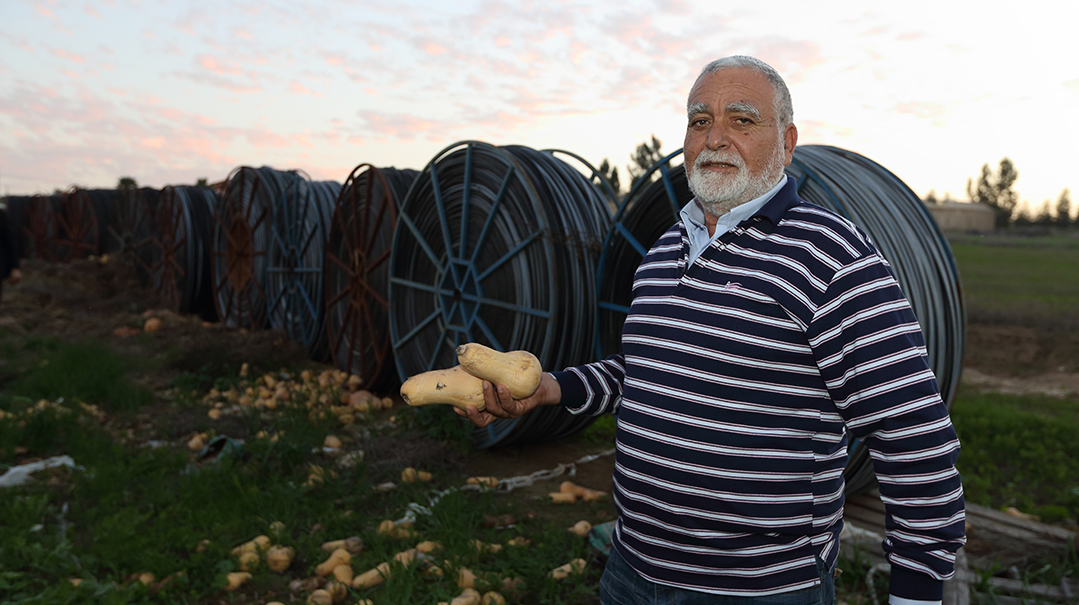
Veteran askanim Rabbi Shia Markowitz and Rabbi Shmuel Bloom join forces for shemittah
Photos: Naftoli Goldgrab
Before Shia Markowitz, a decades-long communal activist whose stamp is on some of the most important communal initiatives in recent years, took over the international shemittah umbrella, he admits that he didn’t have much emotional connection to Eretz Yisrael. Today, joining forces with former Agudah executive Rabbi Shmuel Bloom, the two American askanim are working tirelessly so that the Holy Land can have its rest
Reb Shia Markowitz might just be the most famous askan you never heard of.
Although he’s managed to stay well below the radar, the Monsey resident’s fingerprints are on some of the frum community’s most important initiatives, from decades ago through the present. Reb Shia’s first claim to fame came early on, as a celebrated summertime hoopster, a magician on the courts who helped bring many a victory to Camp Torah Vodaath (CTV) in the frum sleepaway camp basketball leagues of the late 1960s and early 1970s.
A Boro Park native and Yeshiva Torah Vodaath alumnus, Shia was a learning rebbi in CTV for several years, and the summer after what he thought would be his final year there, the camp asked him to return in the middle of camp season to take over for the mashgiach of Torah Vodaath, Rav Moshe Wolfson. Rav Wolfson gave shiur to the oldest campers but had developed laryngitis.
“I was all of 21 at the time,” he recalls, “and I said, ‘Take over for the Mashgiach? Are you kidding me?’ They said, ‘Shia, due to your basketball fame there’s no one the campers respect more than you. No matter who else we give them, these kids are not going to learn. You can get them into it.’ So I spent a few weeks giving the shiur, and when it was over the kids got together and bought me a watch.”
A common “urban legend” in yeshivos is that of the rebbi whose sports talent almost got him drafted to play pro ball, but in Shia Markowitz’s case, it’s true. “At the schoolyard on 18th Avenue and 56th Street, I used to play pickup games against guys who were on the Rutgers University basketball team, and eventually they schlepped a coach down there, telling him, ‘You gotta see this Jewish guy play.’ He came down and after watching me for a while, on the spot he offered me a scholarship to Rutgers. I asked him, ‘When does the team play?’ ‘Saturdays.’ Pointing to my yarmulke, I said, ‘This doesn’t play on Saturday,’ and that was that.”
Shia’s mother had been ill for nearly two decades, and not wanting to further burden his family’s already stretched budget, he went into business while still in his early twenties, starting a printing/graphics art and marketing firm. Soon afterward, he partnered with Nuta Goldbrenner, an old friend from his CTV days. The two were partners for 43 years, until the business was sold in 2017.
Up, Down, Up
His formal introduction to klal endeavors came in the early 1980s, when an emissary of Rav Avrohom Yehoshua Heschel Bick asked him to attend a meeting convened by Satmar’s Rav Tov organization regarding the then-dire situation of Iranian Jews. “I left the meeting feeling that something far more needed to be done,” says Reb Shia, “and being more aligned with the Agudah, I called Rabbi Moshe Sherer and said, ‘I know Rabbi Neuberger is doing things with Iranians in Baltimore but this sounds pretty urgent.’ He told me he’d check on the matter and get back to me.
“Two months later, I received a call informing me that the Iranian Rescue Committee was being formed. It was chaired by Rabbi Mechel Gruss, with Shloimy Berger, Dr. Moshe Ruzhorsky, Dovid Weldler and me as its core members. Over the course of eight years, we raised eight million dollars to smuggle kids out of Iran who would otherwise have been used as cannon fodder in the killing fields of the then-raging Iran-Iraq War.
“We sent many young couples as teachers to Vienna, where the refugee children awaited admittance to their country of destination, rented a refurbished apartment building to house the girls, and developed various activities to keep them entertained and educated for the many months of their stay. We helped bring many of these children to this country, placing them in frum homes and schools and eventually helping them find jobs.
“For at least five of those years, the work was very intense, all-consuming. We worked nonstop, and we succeeded in saving thousands of lives and helping to establish thousands of wonderful Jewish families. Of anything I’ve ever been involved in, I’d have to say this is the thing I’m the most fortunate to have been part of. It was a great group of guys, and the bonds of affection we developed back then haven’t waned.”
Reb Shia is candid about the tradeoffs that a life of askanus can entail. “We all had families with small kids, and I have to say there was a heavy price to pay in terms of family life. Our wives paid a price and our children paid a price. Remember, I was running a business full-time at the same time that I was devoting scores of hours a week to this project, and so I was up until all hours of the night. There were no weekends and vacation days off.”
He remembers his wife saying to him one spring day, “Memorial Day is coming. You haven’t been around much. Please, take off a day and take our children to the park.” So the Markowitz boys stayed home from yeshivah and their father spent a part of the day learning with them, and the greater portion of the day at the park. Upon coming to yeshivah the next day, however, the boys were promptly suspended for missing school. “I came down to see the principal and said, ‘Is this chinuch? Do I have a pattern of doing such things, and don’t you think it would have made sense to speak with me first about the background of this?’ Right there, I decided I would be switching schools. I needed a partner in the education of my children, not an adversary.”
Another communal endeavor to which Reb Shia devoted time, energy and ingenuity was Dor Yeshorim, the organization that promotes and performs premarital genetic disease testing in the frum community. Joining its board a mere six months after it launched, he remained involved for another 28 years.
The secret of Dor Yeshorim’s early success, Reb Shia notes, was that it was able to go into the yeshivos and girls’ schools to do testing rather than wait for volunteers to come in and be tested. More recently, he was behind an effort called Matnas Chaim, aiming to institute a similar testing program for high-school-age boys and girls to find potential matches for patients in need of bone marrow. The advent of COVID-19 interrupted those efforts temporarily, but he’s hopeful that Matnas Chaim may yet become a reality.
There was also Ride to Freedom, a little-known initiative that accomplished big things through a group of askanim that included Shia Markowitz and Shloimy Berger. Operating in the Soviet Union just before the fall of Communism there, it took advantage of the power vacuum that existed during the three-year gap between the Boris Yeltsin and Mikhael Gorbachev regimes, and was instrumental in spiriting thousands of Russian Jews to Eretz Yisrael.
Not all of Shia Markowitz’s communal undertakings, however, have met with success. Decades ago, he was the driving force behind the ill-fated “Simcha Guidelines.” These were rabbinically-sanctioned guidelines that called upon community members to voluntarily limit the cost and size of simchahs of various sorts, and to do away with some of them — such as vorts — entirely.
Although the initiative never really succeeded, Shia is proud of the effort, recalling his strenuous efforts to get 29 rabbanim to sign the initial kol korei. And besides, he says, “it did achieve some of its goals, albeit only after the initial effort seemed to fail. For example, before that time, it wasn’t unheard of for a very wealthy balabatim to celebrate their simchahs in mega-expensive venues like the New York Hilton, but that virtually doesn’t happen nowadays. In addition, the initiative of ‘takanah halls’ offering cut-rate wedding packages started to proliferate.”
The most public face Reb Shia had ever given to his askanus was his recent stint as CEO of Agudath Israel of America, from which he stepped down to take the helm of this year’s Keren Hashviis shemittah campaign. He joined the chareidi community’s flagship organization when Agudah’s financial stability was in question and some were wondering about its continuing relevance. During his brief time there, however, he succeeded in restructuring, hiring key personnel, and raising several million dollars to put it on solid footing, and used his marketing skills to help burnish the Agudah’s image as an indispensable, multifaceted communal resource.
Now, however, after decades of dedicated klal activism, Shia Markowitz has taken on perhaps the greatest challenge of all, a labor of love on behalf of shemittah. Today, he exudes passionate commitment to this mitzvah, but it wasn’t always that way.
“To be honest,” Reb Shia concedes, “shemittah didn’t speak to me. In fact, I had very little emotional connection to Eretz Yisrael itself, and I got involved during Shemittah 5768 (2007–08) only because a dear friend of mine, Dovid Yaniv, asked me to. Yaniv is the CEO of a company that was owned by Reb Avrohom Halpern a”h — a very special, aristocratic Jew who throughout the years was a stalwart askan for the cause of shemittah — and Reb Avrohom asked him to take over the Monsey-area fundraising operation for Keren Hashviis, which for decades has provided financial support for farmers keeping shemittah.” At that point, the entire Keren Hashviis budget was less than $7 million, and Reb Shia helped Dovid raise $400,000 of it.
Rabbi Shmuel Bloom, formerly executive vice-president of Agudath Israel of America and faithful lieutenant of Rabbi Moshe Sherer a”h, has been very active in the cause of shemittah for over 40 years, even serving as its CEO for several cycles. It started in 1979, when Rav Menachem Mendel Mendelson, son and successor of Rav Binyamin Mendelson, the legendary rav of Moshav Komemiyus, approached Agudah President Rabbi Moshe Sherer for help in meeting Keren Hashviis’s budget. Rabbi Sherer turned to Reb Shmuel at the time and said quietly, “The type of Eretz Yisrael we will have — will it be HaKadosh Baruch Hu’s land or a country like any other? — hangs on what these farmers are doing. This is something where we can’t stay on the sidelines. We’ve got to get involved.”
Reb Shmuel has been an integral part of Keren Hashviis ever since, and when Shemittah 5775 came around, he asked Reb Shia to again handle the Monsey region as well as the marketing for the general campaign.
“We upped our marketing campaign significantly,” Reb Shia recalls of the last shemittah, “and baruch Hashem, we saw hatzlachah. When the shemittah year 5775 started, Reb Shmuel passed the CEO torch to me as well. And it was during that year, as I crisscrossed Eretz Yisrael to meet with maybe 35, 40 farmers, that the light switch clicked on for me. I couldn’t believe what I was seeing, the mesirus nefesh for this mitzvah. And I thought to myself: Who are these people? I know how to learn far better than they do, and yet, standing next to them, I felt my emunah completely inadequate in comparison.
“I came back transformed. I revved up and threw myself into creating a structure and a plan for raising the huge amounts we still needed. I worked 15, 17-hour days, doing whatever I had to. I made over one hundred appeals, here, in Canada, in England, and in Eretz Yisrael.”
Keeping the Promise
Summer 1952. With the shemittah year of 5712 coming to an end, the struggling two-year-old moshav of Komemiyus, led by the venerated Rav Binyamin Mendelson, had been among the very few settlements to observe the laws of shemittah. Somehow, they survived, concentrating on building permanent structures (they’d been living in tents for two years) instead of farming, and as the next Rosh Hashanah approached, they prepared to renew their farming activities. But to do that, they needed good quality seeds from the sixth year’s harvest; from all the agricultural settlements in the area, however, there were none to be had. All they could find were some wormy, moldy seeds in a storage shed in nearby Kibbutz Gat that no sane farmer would consider planting.
Rav Mendelson, however, encouraged the farmers to take the inferior offering: “The One who tells wheat to sprout from good seed can also order it to grow from wormy leftover seeds as well.” The farmers took the old infested seeds, but they couldn’t yet plant. They had to wait until after Rosh Hashanah to turn the soil over, and it was only about two months later that they could actually put the seeds in the ground. That year, the rains were late in coming, as all the farmers who’d planted earlier looked desperately to the clear blue sky. Finally, the rains came, as soon as Komemiyus completed planting a thousand dunams of wormy seeds. Soon it was clear for all to see: the wheat fields that had been planted during the seventh year, months before the first rain, gave weak, inferior crops, while the infested seeds produced a mind-boggling healthy yield of wheat.
The story had become a legend among the farmers of Israel, but yet, in the summer of 1979, four shemittah cycles later, Rav Menachem Mendelson, the son and successor of Rav Binyamin, who had passed away that year, was still having a hard time convincing local farmers to join with his own moshav in letting their land lie fallow for an entire year, as the Torah commands. But with a heart aflame with love of this exalted mitzvah, Rav Mendelson managed to get a small group of farmers to take the plunge, among them a young fellow named Rafi Mor-Yosef of moshav Sdei Tzvi.
Then October came, and the banks started calling the Mor-Yosef home about their overdue loans. By the time November arrived, there was no longer much food to put on the table to feed the family’s little ones. Unable to withstand the pressure, Rafi annulled his neder to keep shemittah and instead availed himself of a heter mechirah, a “sale” of his land to a non-Jew, to plant a full crop of potatoes. He checked on the crop’s progress periodically during the growing season and everything seemed to be proceeding just fine.
But when it was harvest time, Rafi discovered to his horror that his hundreds of dunams’ worth of potatoes were all coal-black. And right then he said to himself, “HaKadosh Baruch Hu is sending me a message.” He’s never looked back, with this coming Tishrei set to usher in the seventh consecutive shemittah he will be observing fully.
Rav Binyamin Mendelson’s tireless one-man campaign to spread shemittah observance led him to found an organization called Keren Hashviis. Over the decades, it’s become synonymous in the minds of frum Jews worldwide with the mitzvah of shemittah, and rightly so, since it remains the only organization that enables Eretz Yisrael’s farmland to lay fallow by providing substantial, livable stipends to farmers.
Over the ensuing years, those few pioneering farmers Rav Mendelson convinced to keep this mitzvah continues to grow. The few die-hards turned into a hard-to-believe 3,452 tillers of the soil who kept shemittah seven years ago. This coming year, the number of farmers who will lay down their plowshares and pitchforks as the year 5782 arrives is projected to rise to 3,900.
Seven years ago, the stipends Keren Hashviis paid to shemittah-observant farmers to replace their lost income ensured that the mitzvah was kept on 333,000 dunams of farmland and 1,700 dunams of hothouses (with a dunam equaling approximately a quarter-acre). During the approaching shemittah of 5782, those figures are expected to skyrocket to between 500,000 – 700,000 dunam of land and over 10,000 dunam of hothouses.
How did this exponential growth come about?
Rabbi Bloom says the huge surge in shemittah-observant farmers is largely due to Keren Hashviis having kept its commitments to farmers during past shemittah years. “Word of that has spread within the agricultural community, and they trust us to come through for them.”
Eera Zimmerman, who oversees the eight coordinators who meet with farmers before shemittah, says that it’s no longer a battle to get farmers to keep shemittah, while that wasn’t always so; farmers used to think it was simply impossible. But over the years, they’ve watched as their friends and neighbors surmounted the obstacles and prevailed, and they too are ready to take the leap.
Yet even with government subsidies and incentives and Keren Hashviis’ millions of dollars of help, the test of faith for farmers is a significant one. The organization, after all, only commits to funding a certain percentage of lost income, which it calculates for each individual farmer based on a set of criteria, but never exceeding 50%. And even then, it’s not a guarantee, just a promise to work hard to raise the money it has determined a farmer should receive.
Meanwhile, the farmer stands by watching crops grow that he knows he will never harvest. Rafi Mor-Yosef told Rabbi Bloom how one shemittah, he had many dunams of lemon trees, and an Arab walked by one day and offered to buy his entire crop. He responded, “I’m sorry, but it’s shemittah. They don’t belong to me so I can’t sell them.”
The fellow returned hours later, this time with a suitcase in hand, from which he proceeded to remove a wad of bills totaling 10,000 shekels. He then took out another one and yet another, until Rafi was facing 300,000 shekels on the table, his for the taking in exchange for his lemon crop.
“Rafi said to me,” Rabbi Bloom remembers, “‘Do you know what I could do with three hundred thousand shekels?!’ But he turned to the man and said quietly, ‘Zeh lo sheli. They aren’t mine to sell.’”
It’s only natural that as the shemittah year approaches, a farmer who has committed to keeping this mitzvah for the first time begins to wonder: Can Keren Hashviis keep its word to give me the support it says it will? Rabbi Bloom mentions a farmer by the name of Avichai Koch, who kept shemittah for the first time seven years ago. He received a call from a friend and colleague who has 750 dunams of hothouses — that’s a very substantial business, since hothouses are far more lucrative than regular crop-growing — and he asked him point-blank, “Can I trust Keren Hashviis to come through for me?” Avichai told him, “Listen, I’m not part of Keren Hashviis, but my own experience is that what they said, they delivered on.” In fact, Avichai says that the year after last shemittah was his best year ever.
The organization has eight coordinators, most of them farmers themselves, who circulate throughout Eretz Yisrael during the year preceding shemittah, meeting with farmers to convince them to keep this mitzvah, teaching them what it entails and helping them prepare for it beforehand.
When a farmer is first starting out, the Israeli government gives him a 99-year lease on 40 to 50 dunam, which also enables him to avail himself of a pension plan the government established for shemittah-observant farmers. Many farmers, of course, then expand their homestead by leasing additional farmland from others.
But there have been cases of farmers who called themselves shomrei shemittah because they stopped working that government-provided plot of land while continuing to grow crops on the rest of their farmland. Since Keren Hashviis will only provide support to farmers who are entirely shemittah-observant without using the heter mechirah, its coordinators make the rounds of the farms during the shemittah year as well to ensure farmers are in fact keeping shemittah l’mehadrin and are thus entitled to their stipends.
While the ranks of farmers keeping shemittah swells with each successive cycle, other numbers are ballooning too. In the run-up to the last shemittah seven years ago, the projected budget for Keren Hashviis had been $14 million, but the actual budget ended up nearly double — a whopping $27 million — because so many more farmers came aboard as shemittah approached.
This year, the projected budget for the Keren stands at a figure that ranks it with the frum community’s very largest institutions: $35 million. A daunting and daring challenge, but one Shia Markowitz, as the new CEO, believes can be raised, with siyata d’Shmaya.
Lease on Life
As the countdown to shemittah begins in earnest, what is Reb Shia and Reb Shmuel’s game plan for the huge challenge awaiting them?
“This time around,” Reb Shia says, “we have one exclusive focus, involving just two numbers: 680,000 and $35 million. That is, we need to raise $35 million to enable us to bring 680,000 dunam of Eretz Yisrael farmland to rest in fulfillment of the pasuk of ‘V’shavsa ha’aretz Shabbos La’Hashem.’”
Rabbi Bloom explains: “In the past, the model has been that we tell a farmer, ‘This is the stipend you’re entitled to. We don’t guarantee it, but we’re going to go out and work very hard to raise money in the hope we can pay it all, and if we can’t we’ll give you the highest percentage of it that we can.’”
But because of the duality of the mitzvah — for the landowner to desist from working the land, and that the land of Eretz Yisrael itself must rest — this year, there’s a whole new objective. In past shemittah years, a farmer who was planning on keeping shemittah would give up the leases he had on farmland in order not to pay rent for land that would not be bringing in income. After shemittah was over, he would lease land anew — if it was available, since oftentimes it had already been leased to Arabs or others and the farmer could not get it back. This shemittah year, however, we’re telling farmers outright to renew their leases and that we will guarantee their lease payments. In this way, we keep that land under shemittah-observant ownership.
“Take, for example, a farmer named Yechiel Kadosh,” Rabbi Bloom relates. He owns a farm in a settlement called Adirim, where he owns 40 dunam and leases another 960 dunam, at an annual rental cost of 475,000NIS. In order to keep that lease, Yechiel wants to know we will be there for him on those lease payments, and we’ve told him we will be. This is no longer a best effort offer, but rather a guarantee that Keren Hashviis will cover the lease.”
To understand the ambitious nature of what Rabbi Bloom is describing, consider that Eretz Yisrael encompasses 22 million dunam of land, of which a little over four million dunam are farmable. Of that total, nearly 1.2 million dunam belong to Keren Kayemet L’Yisrael, and rabbanim are currently working with that organization to try to get it to observe some of the halachos of shemittah on that land.
Another 662,000 dunam are owned or leased by Arabs, and 925,000 dunam are owned or leased by secular kibbutzim and others who are highly unlikely to start keeping shemittah anytime soon.
“So let’s do the math,” says Reb Shia. “There are around 1.35 million dunam that are up for grabs, so to speak, because they’re in moshavim populated by traditional and frum Jews whom we think we can convince to keep shemittah. Last time around, we brought shemittah to 333,000 dunam out of that 1.35 million.
Our goal now is to see to it that the mitzvah of shemittah is observed on a full 51 percent of that land — 680,000 dunam. We want to be able to come to the Ribbono Shel Olam and say, ‘We’ve done all we can do. We can’t get every last farmer in Your land to keep this mitzvah, but we’ve worked hard to see to it that a majority of Your Holy Land is at rest during this shemittah year.’ And we hope this will pave the way for Mashiach ben David, whom Chazal tell us is destined to come in the year following shemittah.” —
As generous as the Keren Hashviis stipend is, it can only go so far. “As I went around Eretz Yisrael visiting farmers, there was one incident in particular that made an indelible impression on me,” Reb Shia Markowitz explains. “Together with Rabbi Bentzion Kugler and Binyomin Cohen, the CEO and COO, respectively, of Keren Hashviis in Eretz Yisrael, I went to visit the Mosesons*, a family living on a farm about a half hour outside of Tzfas, who were keeping shemittah that year. When we drove up, Mrs. Moseson was outside the house, engaged in what seemed to be a heated phone conversation with her husband, who was away.
“She hung up and apologized, explaining that because they were unable to make ends meet during this year, her husband had taken a job with an hourly wage at a police station some two hours away. Seven months pregnant and with six children in tow, she was overwhelmed, and had called her husband to ask that he come home that evening. He had told her that he couldn’t make the two-hour trip just to make it again back to work early the next morning. Having lost the argument, she was on the verge of tears.
“She invited us inside and as we looked around, we saw a scene of stark privation. The kids were running around half-dressed and the cupboards were mostly bare. Taped to the refrigerator were two overdue bills, one from the electric company, the other for the family’s cell phone and both threatened imminent termination for failure to pay. I asked how much was owed and she said, ‘$1,600 for the electric and $250 for the phone.’ And then I did what any human being with a Yiddishe hartz would have done in that circumstance: I took out my checkbook, wrote a check for $1,850 to Keren Hashviis and asked Rabbi Kugler to write Mrs. Moseson a check for that amount.”
That moment, Reb Shia says, is when he saw first-hand that the Keren Hashviis stipend, generous as it is, can’t solve everything. What it can’t do is provide the mother of a family with the extra money she needs to take care of the smaller, everyday expenses that can allow her to breathe easier and run her home free of stress — money for things like a new pair of shoes to replace the torn ones or for an unexpected medical appointment.
That experience became the impetus for the organization to launch a division run by women aimed toward women and children, raising money to give to the wives of farmers for household expenses during the shemittah year. “Why, after all,” he says, “shouldn’t the women of Klal Yisrael take an active role in helping make sure their sisters, the wives of the farmers, have what they need to make it through the shemittah year with pride?”
Shia Markowitz is a savvy businessman and a veteran of the American frum communal arena, which is why the very emotional side of him that emerges as he talks about the significance of shemittah comes as a surprise.
“It’s such a nisayon, such a difficult challenge to let every inch of Eretz Yisrael lie fallow for an entire year. Why, then, does Hashem decree that for failing to keep this mitzvah the Jewish people will be ejected from their land?” he asks. “And why is all of Klal Yisrael — even those who aren’t farmers — included in that tragic fate of exile from the land? What did they do wrong?
“I had these questions and began searching for an approach to understand the essential nature of shemittah. That’s when I came across the words of Rav Chaim Berlin, son of the Netziv, and Rav Yitzchok Yerucham Diskin, son of the Maharil Diskin, who write that the Torah’s words, ‘V’shavsa ha’aretz Shabbos l’Hashem,’ constitute a mitzvas aseh, a positive commandment that is addressed to the Land itself, telling it to rest, apart from the negative commandments requiring individual farmers to desist from agricultural activities.
“That’s why it’s incumbent on all of Klal Yisrael — no matter where they reside — not just farmers, to see to it that the Land rests. And that’s why when we don’t allow the Land its sacred respite, it comes with a legitimate complaint and is unwilling to allow us to remain there anymore. The kedushas ha’aretz itself is what forces us out.”
Moreover, he explains, in parshas Behar, shemittah is juxtaposed with Har Sinai, conveying the idea that it’s meant to recreate what the Jews had at Matan Torah. It was the apex of Jewish unity — k’ish echad b’leiv echad, and that’s what shemittah is ideally intended to produce — Jews helping other Jews with their parnassah, so that jointly, they’re all helping the Land to rest. It’s no coincidence that the mitzvah of Hakhel, when the entire nation gathers in the Beis Hamikdash on every eighth year, is after the shemittah year. After all, Jews coming together is the very point of shemittah. And once we’ve all pulled together, as the Gemara tells us, Mashiach ben David will arrive, following the shemittah year.
“This very special mitzvah is about nothing less than Geulah itself,” he says. “If people would understand the depth of shemittah, they would see the farmer in a different, heroic light. They would live it, like I’m living it.”
For more information go to kerenhashviis.org and n’sheikerenhashviis.org