White House Wisdom
| October 23, 2013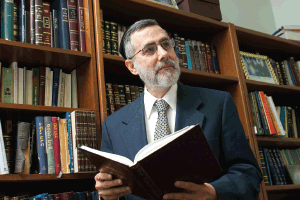 When Bill Clinton took the podium atMadisonSquareGarden in July 1992 to accept the Democratic nomination for president the entire nation was talking about “change” and a new era of political leadership.
Clintonhad risen from the South as a little-known governor ofArkansas exciting crowds with his charisma his oratorical skills and his pledge that he would invigorate anAmericathat some felt had grown moribund under the leadership of President George H.W. Bush.
Still from time to time Clinton who many consider to be the greatest political speechmaker since President Kennedy needed a little help for his addresses. And on this occasion standing before the waving masses inNew York he looked to a pulpit rabbi inNew Jerseywho he had met just months prior.
Clinton’s speech that night touched on many themes: the end of the Cold War unemployment taxes and creating opportunity for all Americans. Then toward the end of the address he turned his rhetorical knife on Bush attacking the Republican incumbent for his lack of “vision.”
Of all the things that George Bush has ever said that I disagree with perhaps the thing that bothers me most is how he derides and degrades the American tradition of seeing and seeking a better future. He mocks it as the “vision thing.”
But just remember what the Scripture says: “Where there is no vision the people perish.”
I hope nobody in this great hall tonight or in our beloved country has to go through tomorrow without a vision. I hope no one ever tries to raise a child without a vision. I hope nobody ever starts a business or plants a crop in the ground without a vision. For where there is no vision the people perish.
Few of Clinton’s listeners that night were aware that the inspiration for these lines came from a rabbi in Englewood New Jersey Rabbi Menachem Genack. The rav of Englewood’s Shomrei Emunah synagogue and head of the Orthodox Union’s kashrus division Genack had been called upon several months prior to introduce Clinton at a local fundraising event. Since Bush had recently been criticized for his lack of interest in formulating a broad vision for the American people Rabbi Genack decided to touch on the theme of vision in his remarks quoting from Mishlei “Where there is no vision the people perish.”
“Clintontold me he really liked my remarks and planned to use them in his acceptance speech” Rabbi Genack recounts from his modest corner office at the OU headquarters in Lower Manhattan where he spoke with Mishpacha. “I didn’t take him seriously but in the end he did use my remarks as a central phrase and asked me for more for his inaugural address.”
Thus began a 20-year correspondence between the president from Arkansasand the rabbi from Forest Hills. To Rabbi Genack’s surprise Clintoncontinued to seek him out when he needed biblically based material. Then Rabbi Genack began sending letters to Clintonfrom time to time of his own initiative. As he explains in his newly released book Letters to President Clinton: Biblical Lessons on Faith and Leadership (Sterling Press) “I would prepare in advance a brief essay containing insights from the Bible I felt would help navigate whatever national issues he was facing and pass it along to him.”
To read the rest of this story please buy this issue of Mishpacha or sign up for a weekly subscription
Oops! We could not locate your form.
