Together We Stand
| July 13, 2021Six women offer their insights and personal experiences on encountering and navigating diversity within the frum community

It’s been nearly three months since Lag B’omer, when 45 people tragically died while celebrating Rabi Shimon bar Yochai’s yahrtzeit in Meron. Numb with shock and grief, Jewish communities across mourned both the personal and collective facets of the disaster.
Of particular importance was honoring the 45 kedoshim as individuals, underscoring the singularity and distinctness of each person we lost. While encountering the kedoshim on a more intimate basis, countless people shared an observation: The victims of the Meron tragedy represent a nearly complete cross-section of the Jewish religious demographic: Chassidic, Litvish, Dati-Leumi, Modern Orthodox, Israeli, chutznik, Brisker, yeshivish. All are tragically accounted for.
The convergence of so many religious shades in Klal Yisrael under these excruciating circumstances gives us pause for thought. Although we share so many fundamental values, the lines in the sand dividing our communities frequently seem more prominent than our commonalities.
Where do the fault lines between our divergent communities lie? Are we only capable of uniting under circumstances of loss, or can we cultivate relationships across the religious spectrum during tranquil times as well? Do we see value in pursuing connections with religious Jews who are unlike us? And if not, why?
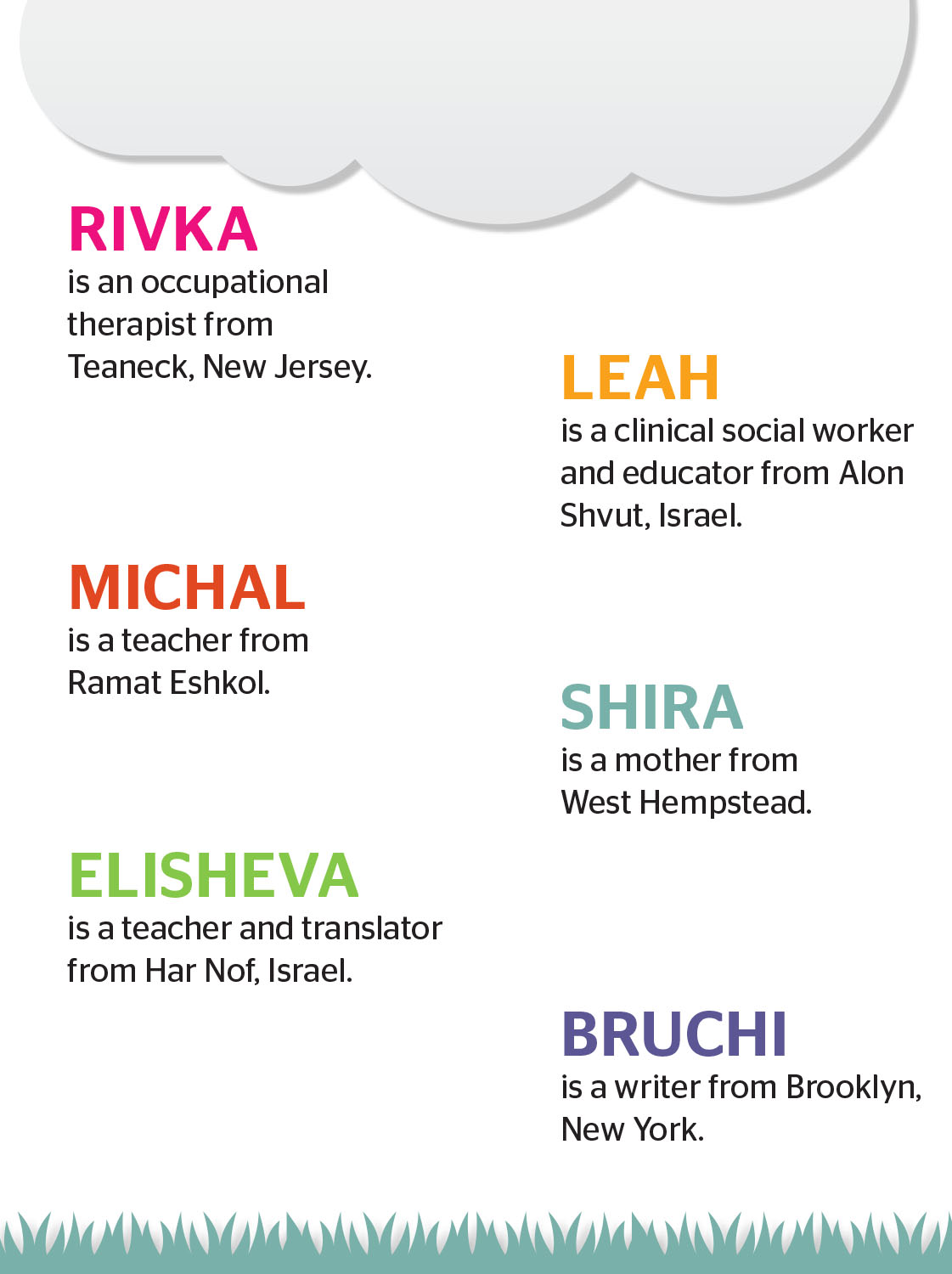
Six women offer their insights and personal experiences on encountering and navigating diversity within the frum community.

How would you describe the hashkafos of your closest friends?
Shira: I have a lot of friends with many different hashkafos. My closest friends are mostly YU machmir. I do have some close friends who are more modern and we don’t share the same standards in certain areas.
Elisheva: They’re what you’d call classic chareidi or yeshivish.
Rivka: My closest friends range from formal hashkafah to loosely religious, to classic modern Orthodox, to right YU, and further right.
Michal: My close friends are hashkafically very similar to me, Anglos who have moved to Israel and are living a chareidi lifestyle.
Leah: Dati Leumi or Dati Leumi Torani, living a life firmly rooted in halachah with avodat Hashem as the top priority and recognizing that the modern State of Israel is a gift and opportunity from Hashem.
Bruchi: We’re what’s called American chassidish. This is different, and more mellow, than more Hungarian chassidim who maintain a closer identity to how they lived in Europe. For example, my friends and I wear a sheitel without an extra covering, speak and read English, and in general are more involved in the outside world. At the same time, we speak Yiddish to our children.
Do you find it challenging to tolerate religious Jews who are different from you?
Rivka: My parents each come from a very different culture. I identified with one side of the family for a good part of my childhood, and as a teen found it difficult to tolerate differences, but I’ve made progress since then. Initially, I was under the impression that there’s only one correct way to serve Hashem. I realized that it wasn’t possible for only one community to “get it right” and for everybody else to be wrong. I’ve had the opportunity to learn that there are many beautiful ways to serve Him and each community/hashkafah has something to offer.
Bruchi: Differences are hard to tolerate in all areas, be it religious or personality. We instinctively view differences as dangerous, as a challenge to our personal status quo. That said, the more similar we are to someone else, the more we fight. Think about the way siblings fight... When we expect people to be like us but they’re not, it rankles. That’s why I find it hardest to be tolerant of chassidim who are further to the right than me.
Truthfully, intolerance is rooted in the fact that I’m feeling judged — whether or not someone is actually judging me. When I see chassidish women with more external chumros in tzniyus than me, I feel judged by them, because they won’t do things that I feel there’s no problem doing. I have to remember that this is my issue, and has nothing to do with them.
I also think it’s easier to refrain from judging someone who’s doing less than you in frumkeit, because they inspire your higher self. Someone who does more than you will trigger your more childish, insecure self, so you’ll naturally judge. In both cases, it takes a highly developed person to bridge the sensitive balance between accepting the person without accepting the person’s standards as acceptable/right for me.
Leah: I believe religious Jews who are different than me are also plugging into truths; we’re just choosing to emphasize different aspects of that truth. I don’t have a problem with disagreeing — there’s such a thing as machloket l’Sheim Shamayim — but that doesn’t take away from my fundamental acceptance and appreciation of other Jews as my brothers and sisters, to be valued, appreciated, and loved.
Elisheva: I come from a hashkafically diverse family, so tolerance is part of my reality. However, I find it challenging when I’m in a hashkafically diverse situation and feel under attack: “Why is your husband in kollel? Why don’t your boys learn secular studies?” I’m not questioning your lifestyle, why do I have to defend my life’s choices? If people are genuinely interested in understanding my lifestyle, then I’m happy to engage in respectful dialogue, but too many times I’ve found myself unwittingly on the defensive and it’s very uncomfortable.
I also question what “accepting” really means. I don’t think everyone has to be like me, there are definitely different paths in avodas Hashem, but they all have to be consistent with halachah to be considered a derech. I think there’s a difference between loving a person and accepting their lifestyle. I look for good in every person but how can I approve of behavior that’s not in sync with Torah values?
Shira: I find it difficult to tolerate religious Jews who look down on me for not being as religious or as modern as they are. I’ve found that all religious people are sometimes judgmental toward others unlike them. I know I’m guilty of thinking “I can’t believe so-and-so let their child go to that camp!” and if a parent lets their child dress in a way I find inappropriate, I’ll comment. My more modern friends call their more religious friends “religs” and I’ll say about them, “oh, they’re more modern” but it’s not a negative statement, it’s just labels we give each other.
As I get older and more comfortable in my own skin I’m trying not to look at what other people do in terms of religion and just do my personal best. I learn from my more modern and my more yeshivish friends; they all value being Jewish, even if it looks outwardly different.
Michal: I made a significant hashkafic shift in seminary and for the first decade or so afterwards I wasn’t comfortable enough with my new identity to tolerate hashkafic differences in a healthy way. I wish someone would have explained to me that being secure in who I am doesn’t mean being afraid of who I’m not. At this point I’ve learned to be “colorblind” and relate less to a hashkafah and more to a person. This allows me to enjoy the beauty of each individual and to learn from so many types of people. Additionally, I teach in a hashkafically diverse environment and in that capacity I pride myself in relating to my students through the lens of what’s best for each of them, hashkafic orientation notwithstanding.
Have you ever gotten into an argument about religious differences?
Leah: Everyone has! I’ve gotten into heated discussions with people who think differently than me, I’ve also defended those who think differently to members of my own community when they’ve expressed frustration with different communities.
Rivka: Yes, I’ve been told that it’s too dangerous for people with stricter gedarim to feel comfortable accepting those with a more flexible hashkafah — that there’s too much to lose by exposing children to people who may be more modern. While I appreciate and respect that perspective, I still firmly believe that we all ultimately want the same things.
Elisheva: I’m very nonconfrontational. I never get into arguments about religious differences. Instead I change the subject or brush it off. I don’t maintain there’s toeles in debate; if a person wants to hear information about my lifestyle, I’ll tell them. I don’t believe I’m perfect, so instead of arguing about why I think you’re wrong, let me work on myself.
Michal: I’m a funny breed in that on the one hand I enjoy a good argument, but at the same time I have a strong people-pleasing element that precludes arguing with people I care about. Nonetheless, I’ve found myself frequently in the position of defending the chareidi lifestyle — whether it be the insularity of the community, kollel, the army, or — my personal favorite — that chareidim eschew modernity (“That’s right, we still use outhouses and kerosene lamps.”).
Bruchi: B”H I’m not dumb enough to do that anymore, but my younger self did it all the time. I don’t think arguing will change a person, because their identity issues from a very deep place and if they change it will never be because I want them to, but because they came to it themselves.
In general, I don’t believe I have to fix people. They are who they are and will grow from the point they’re at. Everyone has bechirah and I’m neither capable of, nor do I want, to control their choices.
What’s a religious lifestyle you wish you understood better? How could you achieve better understanding?
Shira: I wish I knew more about chassidim, the way they live their daily lives. What does their Shabbos table look like? How do the siblings and siblings-in-law interact? I’d love to see how a chassidish woman my age conducts her day and week. But I have no idea how to achieve this. I think if I followed a random Bobov 40-something around she might find me creepy and ask for a restraining order.
Rivka: Neturei Karta. My husband thinks I’m crazy for thinking that we need everyone on board, committed to achdus to bring Mashiach. I’m convinced, though, that one day I’ll have an opportunity to speak with someone from Neturei Karta and learn more about them.
Elisheva: Chassidim. But truthfully, it’s because I’m on the outside and simply don’t have enough information to understand the lifestyle.
Bruchi: I have a hard time with “the far right”: chassidim who are very focused on wearing an even shorter sheitel, or only a tichel, or a double head covering. But I came to the recognition that if I understand their values, I’ll understand them better as well. They view certain things as the “neshamah” of Yiddishkeit, and will go to great lengths to preserve them. And when it comes down to it, I value the same things they value, it’s just expressed differently in the things I choose to emphasize.
Have you ever caught yourself stereotyping another Jew?
Elisheva: Anyone you don’t know intimately, and associate with a particular group, is someone you’ll automatically stereotype. When I know someone as an individual, I’m much less likely to stereotype them.
Bruchi: Sure, just like we all have! Nonetheless, I think it’s supremely important to separate between my values and the individual person. This is heavy prefrontal cortex work that’s only developed when a person is an adult. Being judgmental (of which stereotyping is an outgrowth) is a person’s default mode until at least age 12. After that, a person has bechirah whether they’ll make the effort to outgrow this mindset, but everyone is naturally judgmental unless they work on it. Being able to get beyond judgment is indicative of a sophisticated, developed mode of thinking.
Rivka: Chassidim. But truthfully, it’s because I’m on the outside and simply don’t have enough information to understand the lifestyle.
Michal: Yes, and when I did, I was greatly disappointed in myself. However, it gave me greater insight into how other people stereotype me and helped me be more understanding of them in this context as well.
Shira: All the time! I find I’m much more judgmental toward people who are more yeshivish than me. I often need to stop and remind myself that I know nothing about their life. I think I’ve gotten better over the years.
Name a religious difference that used to grate on your nerves but you’ve since come to appreciate.
Leah: Members of the chareidi community who express very extreme views against people who call on them to serve in the Israeli army. I’ve come to understand that in addition to the classic hashkafic differences of opinion on this issue, there are members of the chareidi community who view the army as an existential threat to their way of life. This helps me understand why their reaction is so strong.
Shira: When I was younger, I judged women who didn’t cover their hair, and I was annoyed with friends who I perceived as overly rigid, almost OCD, about religion as well. Now I’m at a place in life where I’m working on myself to be better, so I spend more time looking inward and less time looking at what my friends do that’s different from me.
Michal: I can’t think of a specific difference. However I’ve learned to appreciate where people come from and their religious struggles, and to understand that for some people doing what I consider to be baseline is for them a herculean struggle. So for example, someone may not be covering her hair the way I do, but is doing more than is accepted in her community — and for her that’s really hard. How can I not appreciate and respect the effort she’s putting in for avodas Hashem?
How do you imagine you could impart the value of religious unity to your kids without denying your principles and convictions?
Rivka: My siblings, in-laws, and extended family span the range of the religious spectrum. While my husband and I make our own hashkafic choices, they have no bearing on our feelings of love for our family members. We’ve spoken many times about how families with mixed hashkafos are a metaphor for Klal Yisrael. Each group must make choices about what’s right for them in serving Hashem, but hopefully that doesn’t impact their ability to love and respect each other.
Michal: I try to foster pride in my kids for who we are and what we do, without putting down anyone else. When my younger kids ask about specific things we do that others don’t, I’ll frequently answer, “Because they didn’t go to the cheder/Beis Yaakov that you did and learn what you learned.” In general, I think the model my husband and I provide, both in the way we truly love our religiously diverse family members, and the way they see us treat Shabbos guests who are different than our family, speaks for itself.
Leah: I do this by teaching my children my values and convictions clearly, strongly, and unapologetically. I’m very shalem with my beliefs and therefore don’t feel insecure about them. This allows me to be open minded and open hearted toward other perspectives and beliefs, to want to learn from them, be enriched by them, and be willing to adjust my own perspectives by wisdom imparted by them.
Bruchi: I actually believe that when my children are little it’s important to imbue them with a natural aversion for lower religious standards. Kids are very black and white, so when they’re young they need the world explained to them in similar terms.
Take for example a smartphone. I can teach the subtlety of appropriate use to an older child, but if my kid is exposed to destructive sights on a smartphone when he’s ten, then I’m done! The only way I can teach nuance is if I instill the dangers when the child is young.
That’s the complexity of teaching children. I want to teach instinctive antipathy for a life that’s inconsistent with my values while they’re young, and still perceive things in absolute terms. Only when they’re old enough to process more, will I teach concepts of acceptance and degrees of subtlety. I’ll do this during those “magical moments” when we have time together, through discussion. But this demands the higher level of thinking only older child have.
Shira: I hope the way I live my life every day is an example for my kids in appreciating unity. Although they have friends whose homes are run with a different hashkafic emphasis than ours, I don’t feel threatened by that at all. Let them see how other families run their homes and realize there are other ways to experience frum Judaism.
Elisheva: Living within a diverse extended family, this value is naturally built in. I’m very against purposelessly putting down other religious lifestyles. I’ll never tell my kids, “Look at them, they’re wrong!” just for the sake of reinforcing our hashkafah, and I don’t discuss hashkafic differences unless they’re truly relevant. I confidently explain to my kids why we do or don’t do something when it’s necessary, but I also make a point of delineating the positive aspects of hashkafos that are different from ours.
During the Covid outbreak in Israel, my boys had a very achdus-affirming experience. They were in a coronavirus hotel that was mostly populated by yeshivah boys, but from yeshivos that span the hashkafic spectrum. The main lobby was transformed into a beis medrash with tables piled high with Gemaras. The boys had the opportunity to share in the experience of limud haTorah and even organized a joint kumzitz. I think that helped them recognize that at the end of the day, we have more in common than we think.
(Originally featured in Family First, Issue 751)
Oops! We could not locate your form.
RECOMMENDED


RELATED CONTENT

What happens when classroom support for struggling students creates new problems?


Four women use junk to create a magical experience for a frum audience

A collection of very strong opinions about very small things

When a husband travels regularly for work, what’s it like for the family?

