Thermostat Wars
| July 18, 2012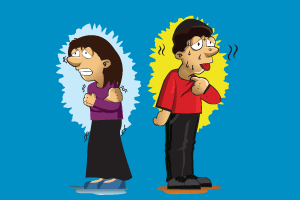 In the dead of winter Ruti only needs a simple sweater to stay warm. “I’m always running on hot ” she says. Her husband Yaniv on the other hand wears a padded full-body suit the kind that gas station attendants sport in frigid weather.
“My husband is like a lizard — cold-blooded” jokes Ruti who lives in Tiveria. “In the winter he hibernates; in the summer he basks in the heat of the sun.”
As soon as the long hot sticky months of summer hit Ruti starts davening for them to be over. “I have to continually be wet — I take three or four cold showers a day and put on a layer of wet clothes under my other clothes. I try not to leave the house but if I have to I carry around a spray bottle that I never go anywhere without. I can’t be more than half a minute from a fan — it’s the only way I can function.”
When Yaniv and Ruti spend time outside he sits in the sun she in the shade. “Inside the house I’ll crank up the air conditioning and he pulls on a sweater ” Ruti says. “We make sure cold things are pointing in my direction and hot things towards him!”
How can the exact same temperature make two people feel so dramatically different? Is it a biological phenomenon — or a psychological one? Does it depend on what you’re used to or whether you grew up inEnglandorMexico? Is it genetic? Turns out there are quite a few theories.
Medically Speaking
This extreme-temperature experience actually has a name: heat intolerance — or cold intolerance at the opposite end of the spectrum.
From a medical standpoint this condition which is characterized by an abnormal sensitivity to hot (or cold) environments or temperature could be masking a more serious issue.
Heat intolerance for instance can be caused by various diseases particularly multiple sclerosis and mitochondrial disease. It’s also a common symptom of hypothyroidism a condition where the thyroid gland doesn’t produce the hormones necessary to regulate temperature. Hormonal fluctuations (whether during pregnancy or menopause) might also cause feelings of overheating as can certain medications.
If you take out your heavy winter clothes on the first day of fall it could likewise signal a health issue. Cold intolerance is often reported by sufferers of fibromyalgia a disorder characterized by muscle and tissue pain and as with heat intolerance thyroid problems play a big role. Raynaud’s disease which affects blood circulation causes people to suffer acutely from the cold and people who suffer from Sensory Integration Disorder (SID) may react unusually to temperature too.
You might also feel the cold more intensely if any of these are on your health record: Vitamin B-12 deficiency anemia low body weight general poor health lack of exercise and smoking. Age can be a factor too. For Shani who lives inJerusalem low blood pressure is likely the culprit: “Every evening when it gets dark and I’m tired I get really cold ” she says. “I get shivery and I’m really miserable if I can’t warm up.”
Curiously in theory we should feel the cold more than the heat. Ourbiological temperature sensors located just under the skin include four times as many cold nerve cell receptors as hot. (These are the nerves that warn us to pull back our hand from a flame or to put on our gloves in frosty weather.)
Apparently as scientists recently discovered deep in the body are a different set of nerve cell receptors ones that react not to external temperature but to other stimuli such as hormones proteins and other compounds within the body. According to researchers from theUniversityofFlorida these nerve cell receptors might be present in one person but not in another. “This could explain why you and I can sit in the same space and you feel comfortable and I feel cold even though the external stimuli are the same ” noted researcher Jianguo Gu.
To read the rest of this story please buy this issue of Mishpacha or sign up for a weekly subscription.
Oops! We could not locate your form.
