The People’s Rav
| April 25, 2012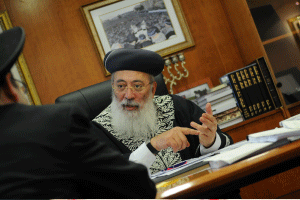 In Eretz Yisrael the Chief Rabbinate consists of both an Ashkenazic and Sephardic chief rabbi who are both elected for ten-year terms. Although the job requires frequent public appearances and entails other ceremonial aspects the rav who occupies the position is not a powerless figurehead. The two chief rabbis assisted by members of the Chief Rabbinate Council have jurisdiction over many aspects of Jewish life in the country including Jewish marriages and divorces Jewish burials kashrus conversions supervising holy sites and overseeing mikvaos yeshivos and batei din.
The offices of the Chief Rabbinate are located in central Jerusalem. Before I am admitted inside I am asked for my passport and ushered through a metal detector. When I enter Rav Amar’s spacious and attractive office I can’t help but think: It’s a long way from Casablanca.
The rav who gives an immediate impression of youthfulness and vigor welcomes me with a broad smile. His large soulful black eyes sparkle with life and enthusiasm. His beard is graying but his step and demeanor are energetic.
The pomp and ceremony of the outer office belies the simplicity of the occupant inside. The road from the tarmac at Lod to his prestigious office wasn’t always smooth a fact that he hasn’t forgotten. Though he no longer has to sell seforim to “make Shabbos” little else about him has changed.
“Look lo she’ani pashtan — it’s not that I try to be pashut” says the rav shrugging his impressively draped shoulders. “Ani b’emet pashut! Our mesorah Yahadut Morocco is that of temimut to be simple and trusting. Ironically it was here in Artzeinu HaKedoshah that we became cynical.”
The Rav gives a poignant mashal to explain the unfortunate decline in observance by the children of the immigrant generation. Families that had maintained a glorious mesorah throughout generations of exile suddenly found that their own children were apathetic about the sacred traditions.
“There is a tale about an elderly man with a beautiful flowing white beard. One day some youngsters started to mock him asking him where he positions the long beard when he sleeps at night: under the blanket or over it?
“The old man ignored them but that night after he got comfortable in bed he found himself unable to relax. He turned this way and that trying valiantly to remember how his beard rested the previous night but he couldn’t remember. He never before paid attention to it and suddenly it’s ruining his night.
“That” concludes the Rav sadly “is what happened to so many of the Sephardic immigrants people who had possessed a tangible faith. It rested on simple acceptance unsophisticated allegiance to the words of the Torah and its scholars. Then they came here and suddenly there were mocking questions: Where do you rest that beard? Many of them couldn’t handle it. Questions that had never occurred to them gave them no rest. They allowed the scoffers to get to them and it eventually cost them their children.”
The Rav reminisces about his own father who embodied the best attributes of Sephardic Jewry: sincerity temimus and emunas chachamim — values with which he imbued his son.
“Our first year in this country we lived in Ofakim where Abba worked in the fields. Whatever work he was given he did with a smile saying ‘How fortunate we are to do this on holy soil!’ ”
The new immigrant spoke no Hebrew when they arrived but there was a word he used frequently.
“When he would walk down the street he would nod humbly to whomever we saw and say shalom. I asked him why he greeted people he didn’t know and he was astonished. ‘Did I curse those people? All I said was shalom. What’s wrong with that?’ ”
Mussar works were fluent on Eliyahu Amar’s tongue but rather than rebuke he told stories. “He loved to read about tzaddikim. If he saw me behaving in a way he disapproved of he would smile and share a story about one of his beloved gedolim.
“He lived the Jewish calendar. His emotions aligned with the Yamim Tovim. He would sit at the Yom Tov table with a book of piyutim in his hands singing praise of his Creator with great joy. During the period of bein hameitzarim he would sit and read the kinnos each evening his eyes wet with tears.
“Once in Chodesh Elul he seemed weaker than usual. I was with him in the field and I realized that he was fasting. ‘Abba ’ I said ‘it’s not a fast day and it’s not Erev Rosh Chodesh.’ He replied ‘My son it’s Elul.’
“I suggested that he was too weak to fast. It was a sh’eilah if he was permitted to fast on a taanis tzibbur let alone a taanis nedavah. He said ‘Listen it’s almost evening. Let’s go to Minchah and Maariv the day is over regardless.’ Immediately after Maariv I brought him a cup of tea. When he avoided drinking it I understood that he had accepted a taanis of two days upon himself.
“I told him that I believed it was forbidden by halachah and he looked at me. ‘Are you worried that I will die? Do you consider a person who goes through Chodesh Elul without any fasting even a little bit to be alive?’ ”
To read the rest of this story please buy this issue of Mishpacha or sign up for a weekly subscription.
Oops! We could not locate your form.
