Supreme Values

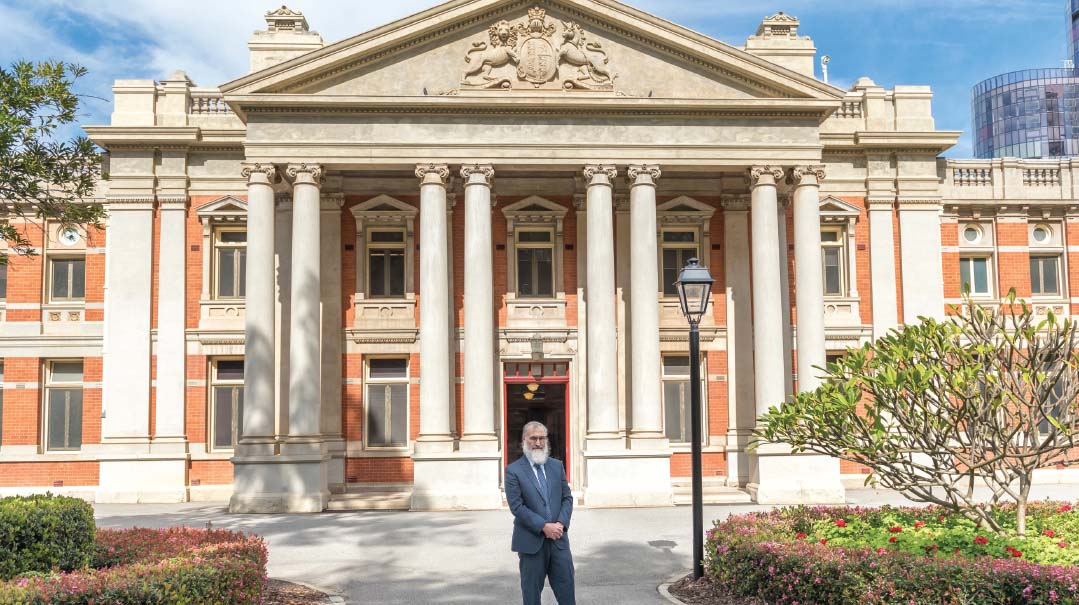
Rabbi Marcus Solomon, appointed to the Supreme Court of Western Australia, looks to bridge the worlds of Torah and Western legal tradition

Photos: Danny Zolberg
When the news broke that a rabbi had been appointed for the first time to the Supreme Court of Western Australia, it was the first that most of the international audience had heard of the Australian state, never mind its highest legal body.
But one glance at the solemn swearing-in ceremony was enough to explain what caught the eye of outlets as far afield as Israel and the US. Beneath the state emblem of a black swan and kangaroos, and flanked by his gowned colleagues, sat Rabbi Marcus Solomon. Judicial-looking in long robes and imposing, full-length beard, he proceeded to share an “old Jewish custom” with the court.
“At moments of importance in one’s life,” he said softly in his Australian accent, “we ought humbly to acknowledge life itself and the good fortune we share in having been sustained.
“And if the chief justice can use the Hebrew,” he continued, his fellow justices looking on poker-faced, “then I am not going to be outdone. Shehecheyanu v’kiyemanu v’higiyanu lazman hazeh!” he proclaimed, the paneled walls ringing with the unfamiliar sound, and then the court adjourned.
That address — part rabbinic sermon, part legal scholar, part dry humor — neatly encapsulates the world of Rabbi Marcus Solomon.
As founder of Perth’s Beit Midrash of Western Australia, popularly known as the Dianella Shule, he’s a bona fide pulpit rabbi. He’s also a man who has reached an eminence likely unprecedented in the modern world. And he’s done so in a way that visibly proclaims the harmony of both dimensions.
Even without a glimpse of his face, it would come as no surprise that Rabbi Solomon’s dual methods of reaching out to the world — professional and rabbinic — originated with the Lubavitcher Rebbe.
“When I sent a letter asking the Rebbe which path to devote myself to,” Rabbi Solomon recalls of the correspondence back in the ‘90s, “he replied that I should pursue my legal studies, but at the same time, devote my free time to education.”
It’s been decades since Western Australia (or WA as the state is known) required its justices to wear the wigs that the country’s British founders bequeathed, so the metaphor of wearing two hats doesn’t work. Nonetheless, Rabbi Justice Solomon’s sense of ease in both roles derives from his view of the liberalism that allowed him to rise to the top as an opportunity, not a threat.
That attitude informs his approach to Australia’s draconian Covid lockdowns, as well as the militant liberalism sweeping across the Western world that challenges Torah values on end-of-life issues.
“In the last few decades,” he says, “there’s been an assumption that Orthodox Judaism aligns itself with American conservatism, but that’s nonsense as a cursory glance through the Torah shows.”

Growing Up Down Under
It was actually Marcus Solomon’s distant relative — a man of Orthodox Jewish extraction named Sir Albert Asher Wolff — who put the family on the Australian legal map, serving as Western Australia’s chief justice from 1959. But for Rabbi Solomon’s closest competitor in the supreme-court-rabbi stakes, you probably need to look to Yitzchak Kister, a 1960s-era judge on Israel’s highest court who was close to the Chazon Ish and sent his sons to learn in Ponevezh.
Unlike Justice Kister, who emerged from the thriving Jewish world of prewar Ukraine, young Marcus Solomon began life with fewer opportunities for Torah learning.
“I was born in Newcastle, New South Wales [in southeast Australia], to parents who were children of British immigrants,” he says. “My father a”h was very involved in building Jewish community life in the city, and my childhood, as a whole, was full of Yiddishkeit. But as my siblings and I grew up, the lack of Jewish schools in the city became a problem. So when I was seven, my parents decided to move to Perth, the capital of Western Australia, where there were more established community institutions.”
Marcus concluded his studies at the elementary school in Perth, and then, under the influence of the local Chabad shaliach, Rabbi Yitzchak Dovid Groner a”h (brother of the Lubavitcher Rebbe’s legendary mazkir Rabbi Leibel Groner), he was sent to the Chabad yeshivah in Melbourne, Victoria.
“It’s a journey of 3,500 kilometers, and it wasn’t easy as a young boy to leave home and travel so far, nor was it easy for my parents to send me. But for them, the importance of a full Jewish education outweighed all other considerations.”
That experience was the genesis of Rabbi Solomon’s lifelong affinity for Chabad. From Australia he traveled to Israel to continue learning in Yeshivas Tomchei Temimim in Kfar Chabad, and from there to the Lubavitcher Rebbe’s yeshivah at 770 Eastern Parkway, New York.
“What captivated me at the time was the Rebbe’s commitment to Klal Yisrael. I would see him coming to his room at 770 each night, where he spent hours answering people’s questions. His sense of responsibility for every Jew amazed me, and that’s a lesson that I try to carry with me.”
But at the end of the 1980s, that foundational period in New York drew to a close and Marcus Solomon returned to his native Australia. “I wanted to influence young people where I’d grown up, and I knew clearly that Jewish education was what I wanted to do in the coming years. I signed up to study education so that I could realize my calling in the best way possible.”
Had it not been for his father-in-law, teaching would doubtless have become Marcus Solomon’s sole career. But Joe Berinson’s own legal background pushed his son-in-law in a different direction. Berinson himself was no ordinary person: Born to a father who immigrated to Australia from Tzfas, he rose to become a government minister and then Western Australia’s attorney general.
“He was a man of extraordinary talents, especially in the legal field,” says Rabbi Solomon. “Throughout his personal and professional life, he was uncompromising in his Jewish observance.”
Sensing Marcus’s legal talents, Joe Berinson began to pressure his son-in-law to switch careers. “‘You’re analytical and have a sharp mind,’ he said. ‘You can go far as a lawyer.’
“I was very confused,” says Rabbi Solomon of that fork in the road. “As a lawyer, I knew that I would be financially secure, but the world of education called to me as well and I didn’t know what to decide.”
Two-Track-Minded
It was the Lubavitcher Rebbe who set Marcus Solomon on both tracks simultaneously. “Close friends advised me to ask the Rebbe for advice, but I hesitated. I told myself, ‘The Rebbe is such a great leader, why should he care about the personal question of a Jew in far-off Australia?’
“Fortunately, I remembered my personal experience while learning at 770. I remembered the devotion and love with which the Rebbe dedicated so many hours of his day for personal questions. ‘Why should I not do the same?’ I asked myself.”
The question took the form of a letter detailing the young man’s desire to pursue Jewish education as a well as his talents in the legal field, and his father-in-law’s urgings. The wait for a response was agonizing, and when the answer came, it was completely unexpected: Pursue legal studies, instructed the Rebbe, but in parallel, devote free time to education.
“I get emotional each time that I remember the message,” says Rabbi Solomon, “because I see it as a very detailed response to my personal dilemma, and at the same time, a message for each one of us. The Rebbe was basically saying: You don’t appreciate your strengths. You think that you are only able to do one or the other? The truth is that you can do both.”
The brachah that Rabbi Solomon received for success in both fields bore fruit. Graduating in 1991, he worked as a lawyer in a private practice, then became a senior partner in two prestigious firms specializing in complex commercial issues. His rising stature was confirmed in 2013 when he was appointed senior counsel, a title given to top lawyers in countries once part of the British Empire, and a stepping-stone to high judicial office.
Alongside his practice as a litigator, which he worked at until his recent Supreme Court appointment, Rabbi Solomon was able to break new ground in Jewish education and community building.
Twenty-five years ago, he launched a framework for expanded limudei kodesh for the Perth community and was appointed to serve as the rabbi of the Beit Midrash of Western Australia, or as it is known locally, the Dianella Shule.
“Even during the busiest times, such as my internship as a lawyer, I made sure to ‘generate’ that free time that the Rebbe had referred to. I literally divided the day in two, spending one part at the law firm and the other half teaching Torah at the community school, which offered a pretty basic Jewish education.
“I initiated a Shabbos and Sunday school program, teaching Chumash and Rashi, Mishnayos, Gemara, and halachos there. Over the past 30 years, it’s given thousands of students real knowledge.”
Return to the Fold
“Religious discrimination!” shouted the 40-page indictment filed in the district court in Perth, against a Jewish school in the city, for refusing to accept a student whose mother had undergone a non-Orthodox conversion.
The year was 1999, and on the teaching staff of the Carmel School was Rabbi Solomon, already practicing as a lawyer and acutely aware of the threat that the case represented to Orthodox life in Australia.
“Those were difficult days for the school’s administration and the Jewish community leadership,” he recalls from the vantage point of two decades.
But the upshot was vindication for the halachic position, and a recognition of the power of teshuvah, in an Australian court, no less.
“Australian law discerns between ‘malicious’ discrimination, intention to discriminate against nonadherents of a religion, and ‘good faith’ discrimination in favor of adherents of a particular religion,” he says. “We faced a complex legal challenge: to try and clearly convey our value system to the judges, and persuade them that it was not a forbidden form of discrimination.”
At issue was the fact that the school admitted halachic though nonobservant Jews.
“Can it be said that the school was acting in good faith in favoring ‘adherents of that religion,’” wondered the presiding judge, “if it was willing to give precedence to those sons and daughters of Jewish mothers who do not in fact participate in religious forms over and above an outwardly Jewish student (but not the son or daughter of a Jewish mother) who devoutly observes all the Jewish forms?”
The court’s conclusion was dramatic, and left a strong impression on Rabbi Solomon. It completely sided with the Jewish school’s position, reasoning that as an Orthodox Jewish institution, it was entitled to determine acceptance criteria based on Orthodox criteria.
As for the definition of an “adherent” of Judaism — when the school accepted students from nonobservant homes — Justice Nicholas Hasluck wrote the following: “The Tribunal finds that adherents extends to all those regarded as Orthodox Jews by those in authority, irrespective of their current level of commitment, because the teachings of the Torah allow for the possibility of redemption.”
It was those last words that left a profound impression on Rabbi Solomon. “I will never forget what this non-Jewish judge had said,” he notes. “It was the Aseres Yemei Teshuvah, and in my role as an educator, I took full advantage of the practical effect of the verdict. ‘Look,’ I told my students, ‘the judge understands that Hashem is waiting for each and every one of us to return to His outstretched Arms.’”
Two decades later, those events came full circle at Rabbi Solomon’s inauguration to the Supreme Court. Among the legal luminaries in attendance, Justice Solomon identified the judge who presided over the crucial verdict 20 years before.
“Do you remember me?” the new judge asked the veteran justice — by then retired.
“Certainly,” he replied. “You’re Rabbi Solomon, and I just came to tell you how impactful I found your case.”

Valuing Values
It’s perhaps symbolic that the school discrimination case raised its head in Rabbi Solomon’s swearing-in ceremony, because the underlying issues it exposed — the problems of drawing sectarian lines in an open, liberal society — could end up challenging WA’s new justice going forward.
As Australia, along with much of the Western world, becomes increasingly secular, would a decision like Justice Hasluck’s stand today, when it seemingly clashes with the zeitgeist of ever-greater openness?
“The decision has never been challenged,” says Rabbi Solomon “and I don’t think it would be, because liberalism also protects religious freedom. Indigenous cultures would unquestionably be allowed to set standards protecting their heritage, and Jews as a minority are no different.”
Those few words contain the distilled essence of his judicial approach: a belief that Western liberalism, despite its flaws, continues to provide a framework that protects religious self-expression.
For a start, Rabbi Solomon points out, it’s that very liberalism that paved the way for his professional rise. “Australia has always been friendly to Jews, and there’s historically been very low anti-Semitism. In 1931, a Jew named Isaac Isaacs was appointed the governor general of the country.”
That traditional tolerance has been augmented by the modern insistence on diversity — a setting in which being a bearded Orthodox rabbi with impeccable credentials was no hindrance.
“More than that, in the halls of government and the judiciary here, there’s a yearning for a deeper value, a mosar ha’adam, what sets humanity apart,if you will,” says Rabbi Solomon. “Even the most secular person feels deep inside him some admiration for loyalty to values and traditions, especially when those don’t detract from professional standards.”
Limits of Liberalism
But the benign environment that Justice Solomon sees has its limits. Everywhere across the Western world, there is a growing trend of secular militancy seeking to enforce progressive precepts even at the expense of religious rights. Across Europe, milah and shechitah are under threat from human and animal rights activists. In the UK — which bequeathed its common law system to former colonies like Australia — Jewish schools recently came under sustained pressure to teach lifestyles at odds with the Torah. And then there are end-of-life issues such as the recent Alta Fixsler case, which pitted a secular understanding of a child’s best interests against a religious position held by the parents.
In that growing clash of values, and with self-styled “muscular liberals” rampant, where does that leave Orthodox Jews?
“Liberalism brings both challenges and opportunities for minorities like Jews,” says Rabbi Solomon. “And while I’m not familiar with the details of the Fixsler case, I believe that even within the framework of liberalism, a strong pro-life case can be made, from a secular point of view prioritizing the nobility and sanctity of life. In other words, the decision the judge made was a value-based one, and a different judge could conceivably have ruled differently.”
Turning to Covid, where his country has become an outlier for its draconian lockdowns in pursuit of zero cases — a policy labeled “Fortress Australia” — Rabbi Solomon says that the allegations about infringements on individual rights are misplaced.
“There’s a range of opinions about how to balance public health and economic considerations. Some people consider the government’s actions draconian, and some people consider them to be heroes. But here in WA — the most radical, zero-Covid state in Australia — we just had an election, and the government won the biggest victory in history. So the idea that it’s somehow the end of democracy seems far-fetched.”
Amused by the conservative voices — most prominently in America — insisting on total freedom even in the middle of a public health emergency, Rabbi Solomon resorts to the Rambam to make his case.
“From a frum Jew’s perspective, this whole idea of total autonomy is inconsistent with what you see in Hilchos Sanhedrin, where it’s clear that the executive has tremendous power to curb freedom,” he says drily. “Australia doesn’t even come close.”
Judicial Kiddush
In practice, says the new justice, there’ll be cases where personal beliefs will mean that he has to recuse himself.
“That’s really a minority of cases, since most civil law operates on dina d’malchusa principles. As part of my consultations before accepting the appointment, it became clear to me that the Australian legal system, which is based on British Mandatory Law, is viewed in a complimentary light — if it can be thus called — with regard to halachah, because it is considered a fair judicial regime.”
And the supreme court’s rabbi will be in good company if he has to recuse himself. “The chief justice is a committed Catholic who will cover Shabbos for me, and has had to recuse himself from some cases himself.”
In fact, the friendship that’s developed between the two brought Western Australia’s highest legal authority to Rabbi Solomon’s siyum.
“The shul that I lead held a festive kiddush in honor of my new position on a recent Shabbos,” he laughs. “One of the guests who came to extend his good wishes was none other than the president of the state’s Supreme Court. He came into the shul hall just as I was making a siyum on Maseches Sanhedrin. He sat down and listened attentively with such a humble and respectful demeanor. That is typical of the attitude I’ve encountered in the legal world.”
And from the judicial kiddush, Rabbi Solomon refers back to the underlying motivation of what he does; the reason that decades after he was told to pursue both Torah teaching and legal excellence, these two worlds converge for him in the everyday realm of kiddush Hashem.
“If even one Jewish student with a weak Jewish identity says to himself, ‘Look how far this Jew got with his beard and yarmulke,’” says Australia’s rabbi-cum-justice, “it will all have been worth it.”
The Stubborn Rancher
If a person’s desk says a lot about his personality, in Marcus Solomon’s case, the tzedakah box on his table in court speaks for itself. Less obvious is the panoramic photo of an Australian ranch that was at the heart of one of his cases.
“One day, many years ago, the ranch owner came to me,” Rabbi Solomon remembers. “He had gotten into financial trouble, and he was in danger of losing ownership of his land. He knocked at my office door and asked me to represent him in court.
“After studying the relevant materials, I concluded that his chances of retaining the property were minute, and urged him to accept the relatively generous settlement that had been offered by the other party. I thought it would be best for him to save at least part of the land, instead of continuing the legal path, which contained a risk of losing everything.
“But the farmer refused to even consider the compromise. ‘Look, Mr. Solomon,’ he said to me, ‘I’m not interested in salvaging part of it; it’s all or nothing. The money is not the issue here — this land is my life. This is where I grew up, this is where I have spent my life, and where I have raised my family. If I lose even one inch of my land, there is nothing for me to live for! I ask you to fight for my land to the end!’
“His determination impressed me, and I agreed to represent him on the case. When the court ruled in our favor, I was stunned — and honestly, rather abashed at the skepticism I had earlier expressed.
“A few days later, I was in my office, and the secretary informed me that an entire family was waiting for me in the lobby of the building. I was moved to see the stubborn rancher march into my office with all his children and grandchildren.
“‘I wanted my family to meet the person who saved my life’s work,’ he said. And he gave me this panoramic photo of his ranch, an aerial photo that had been taken specially for me.
“This special picture stands on my desk, and reminds me each day anew that there are still people in the world whose top priorities include family, lifework, tradition, and ancestral land, not only accumulating a fortune.”
(Originally featured in Mishpacha, Issue 878)
Oops! We could not locate your form.
RELATED CONTENT

Community-conscious grassroots initiatives are quietly breaking the shidduch bottleneck

Yitzchak Pindrus was headed for Anglo advocacy until the Knesset called him back

Dissidents who survived Iran’s most feared prisons tell Mishpacha about torture, interrogations, and the obsession with Israel

A massive nurse walkout leaves hospitals and patients scrambling for solutions

Do the Pentagon’s fast-food orders really predict strikes on Iran and other foreign flare-ups?

Keeping pace with the times, this outreach model is accruing spiritual returns
