Say It Straight

On simchah burnout, sticky scenarios, and being the fall guy

Lucky for me, I live on an amazing cul-de-sac where all the neighbors have become like family. We are there for each other in a very real way. When, baruch Hashem, one of us makes a chasunah, we do a neighborhood sheva brachos.
My neighbor just announced the engagement of her third child in a year and a half. And, yeah, everyone is thrilled for her, but we’re also a little tired. I am the cruise director of the block, and while I’m generally happy to organize these simchahs, this time, I’m coming up against some burnout. No one is volunteering to do anything. I feel so bad for this kallah; I don’t want her to feel like no one cares.
Simchos by Klal Yisrael!
WE say it, we mean it, and sometimes, we’re a little overwhelmed along with the gratitude. The reaction of the block is totally understandable. At the risk of sounding like a broken record, I want to remind us all that we’re capable of holding several emotions simultaneously. I used to say two emotions, but sometimes, it’s many emotions all at once.
I am sure that the neighbors are thrilled for your friend. I assume that each of them is juggling a complicated life, and that it’s not always possible to participate the way they’d like. I am also going to go out on a limb and wonder if this is painful for some of them.
Whatever the case may be, the people have spoken. It’s time to call in the professionals. They say the cheapest way to pay for anything is with money. It may be time to post on the group chat that for this particular simchah, you will be purchasing the food… or better yet, reserving the restaurant. You may even enlist the services of a party planner. Post a budget that itemizes the expenses with a per-person fee at the end. If that doesn’t get your chat pinging with offers to bring angel hair pasta with pistachio salmon, then you will know everyone is really fried and it’s time to go a new route.
As for the kallah, perhaps you can enlist someone to add some personal touches like menu cards, a themed gift for the couple, or a poem/grammen to show that this simchah actually did matter to the hosts. And, of course, warm memories of the kallah as a child and moving divrei brachah can make her feel as special as your homemade three-tier mousse.
Simchos by everyone!
I'm in a bit of a sticky situation. My husband is one of six siblings who all live pretty close to each other. My mother-in-law’s health is seriously deteriorating and my oldest sister-in-law, who is her primary caretaker, created a rotation for all the siblings so that no one is saddled with all the responsibility. Lately, I’ve been getting vibes from my sisters-in-law that they feel we aren’t holding up our end, and they’ve been dropping not-so-subtle hints that they believe the resistance is coming from me.
The reality is that I often encourage my husband to become more involved. He believes that one of his sisters is controlling and that she’s making unnecessary demands that he doesn’t feel he needs to acquiesce to. I feel really stuck. I don’t think it’s fair that we aren’t doing our part, but I also don’t want to throw my husband under the bus. Should I continue to be the fall guy?
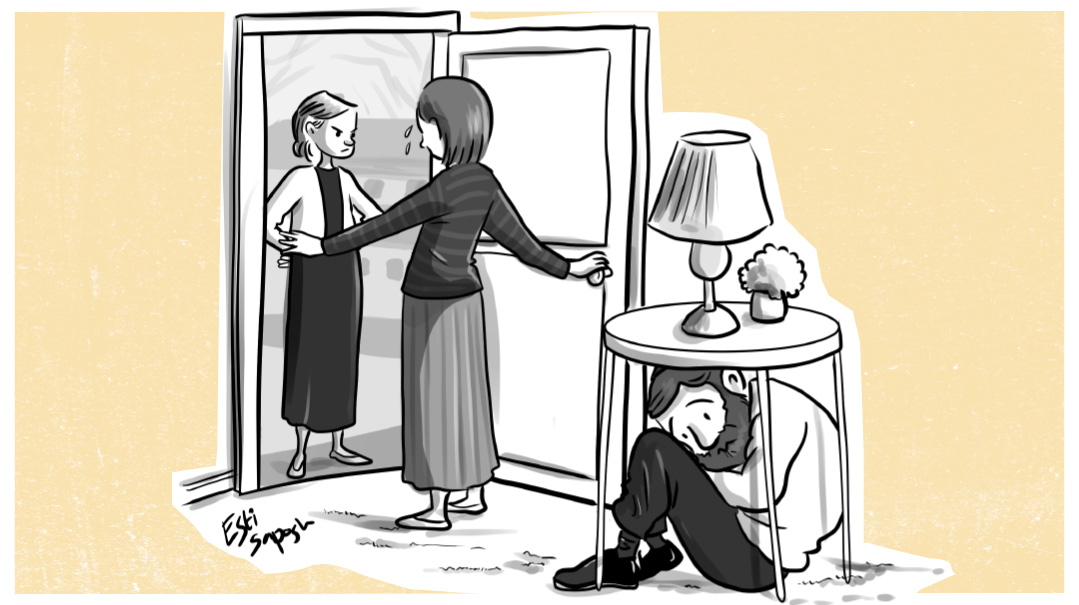
I’m going to say something that may shock some of my readers and may even cost me this column. Enabling avoidant behavior does not make you an eishes chayil. I said what I said.
This is not a sibling issue. This is a marital issue. You’re trying to protect your husband from his siblings’ judgment and are doing so at the expense of your relationship with them. Your husband is allowing you to do so, and he’s hiding behind you to avoid having an honest conversation with his siblings (or at least his oldest sister).
If your husband were harboring a private struggle that he didn’t reveal to his siblings, I could see your dilemma more strongly. But what’s really happening here is that he is allowing you to take the rap for him because he doesn’t want a confrontation.
I don’t know what the family dynamics were prior to this situation. I do know that your husband has differing views from his sister on how much involvement is necessary here and, for some reason, feels uncomfortable voicing his opinion. What is holding him back from challenging this sister? Is it guilt that she’s doing more than her share? Is she always the boss that no one dares cross? Does she “punish” him or others when they disagree?
It’s important to understand what is holding him back from being upfront and direct. Could you have a gentle and curious conversation with him about this? Can you help your husband understand that he is actually throwing you under the bus when he allows his siblings to judge you for sins you never committed?
I don’t believe it’s healthy for you, for your husband, and for your relationship for you to be the fall guy. This is not eishes chayil material. A true eizer k’negdo challenges her husband to step into his power and unleash his best self. In this particular scenario, that means having him take responsibility for his opinions and do the hard work of having an open conversation with his sister. It means that your husband should protect you from their negative thoughts and judgments by owning his choices and not letting them blame you by default.
Codependence is not chesed. Owning blame for your husband’s choices is not tzidkus and does not make you a great wife. Authentic honesty, with its accompanying consequences, is the cleanest way to clear the resentment from both parties and to create a path that everyone can walk on honestly and realistically.
Hatzlachah! May you all be zocheh to fulfill this mitzvah from a place of ratzon.
My husband and I couldn’t have more different ideas about money if we tried. I belong to the “rainy-day fund” camp and he is firmly rooted in the “live now” camp. How terrible is it if I create a retirement plan or a savings account for the kids without telling my husband?
I guess that depends on how terrible you think it is to lie to a spouse.
While this may not be a lie of commission, it certainly qualifies as a lie of omission.
Money means different things to different people, but it always means something. Control, freedom, power, security — it’s a loaded topic. So when you play with something this explosive, you can expect to engender a fiery reaction.
What I’m saying is: You’re playing with trust, which is foundational to any relationship, and then adding the freighted topic of money to the mix. Don’t be surprised if your husband feels deeply betrayed, hurt, and angry when he finds out.
I’m a big believer in staying in one’s lane, so I’ll leave the halachic ramifications of your question for qualified rabbanim to answer. I’d rather address the breach of trust that is inherent in this dilemma, as well as the glaring question of why you cannot communicate openly about this issue.
Here’s a radical proposal — have a real conversation with your husband and explain to him why this is important to you. Don’t be afraid to go deep and to both discover and share which of these big feelings money evokes for you. If you grew up financially unstable and felt scarred by the instability it fostered, share that vulnerability with your husband. If he cannot make space for your most profound needs, you might have a bigger issue that needs professional intervention. But to go behind his back feels like a lack of respect and a breach of trust that might create serious damage to the very fabric of your relationship.
My own personal bias is that it’s perfectly okay for each spouse to have their own “knippel,” some discretionary money that is exactly that — used or saved at their discretion. And every couple can make their own arrangements as far as handling their finances. The important piece is that their agreement is mindful of the meaning each partner attaches to money. While saving money may represent security to you, it might feel restrictive and inhibiting to your husband. What matters is that you communicate honestly and create a plan that respects both of your needs.
I’m wondering if readers are sensing a pattern in today’s answers. Talk to each other. Let’s all talk to each other. Let’s stop being afraid of hard conversations and learn to have them safely and gently. Let’s stop labeling manipulative behavior as wisdom and take the long, clean road back to honest communication. Put your mouth where your money is.
(Originally featured in Family First, Issue 963)
Oops! We could not locate your form.
RELATED CONTENT


“When we start at Chapter 26, we have no idea what happened in the 25 previous chapters”

“Ahh, the life of a frum woman. The needs of everyone around us are pressing and relentless”

How do I respect her deeply held beliefs while maintaining my dignity and the dignity of my food?

Seems to me that you and your husband need to have a conversation
