Partners in Peace
| November 9, 2014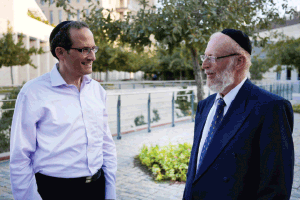 If opposites really do attract then Rabbi Moshe Speiser and Morris (Moshe) Smith offer empirical evidence of that age-old axiom. In the 1980s and early 1990s their career paths were orbiting in different universes. Morris Smith had skyrocketed to fame in the 1990s managing Wall Street’s largest mutual fund to market-beating gains before calling it a career at age 34 to devote all his time to learning Torah supporting charitable causes and to his family. In those years Rabbi Speiser was pounding Jerusalem’s pavement day and night trying to beat back the at-risk youth crisis. The personalities of the two Moshes differ in much the same way their careers diverged. Rabbi Speiser is soft-spoken and self-effacing. Smith is effusive and passionate. The duo first crossed paths in Israel more than 15 years ago after Smith moved to Israel following his “early retirement.” Rabbi Speiser developed a relationship with Smith’s older son and the two learned Gemara together before his bar mitzvah. The same sixth sense that launched Morris Smith as one of the world’s top stock pickers enabled him to scope out Rabbi Speiser’s long-term potential. Together they initiated an English-speaking crisis intervention and counseling service for religious teens and parents. Named in memory of Smith’s father Kav Baruch operated from 1999 to 2004 and logged some 4 500 calls worldwide and arranged more than 500 follow-up meetings with both teens and parents. Serious behavior problems substance abuse lack of motivation problems with yeshivah placement poor choice of friends aliyah adjustment and depression even suicide threats were just some of the topics that poured in at all hours of the day and night from desperate callers. Put in abeyance for the last ten years while Rabbi Speiser worked full-time as a case manager at Chai Lifeline where he provided services and emotional support to young cancer patients and their families he and Smith recently decided to team up again and restart Kav Baruch. “In the last year or two I have seen more cases of shalom bayis issues and seen how the lack of shalom bayis can destroy families ”RabbiSpeiser says. “I decided this is what I wanted to put my focus on right now.”
To read the rest of this story please buy this issue of Mishpacha or sign up for a weekly subscription
Oops! We could not locate your form.
