
(Not) Yours to Decide

On gift etiquette, shidduch fatigue, and letting go
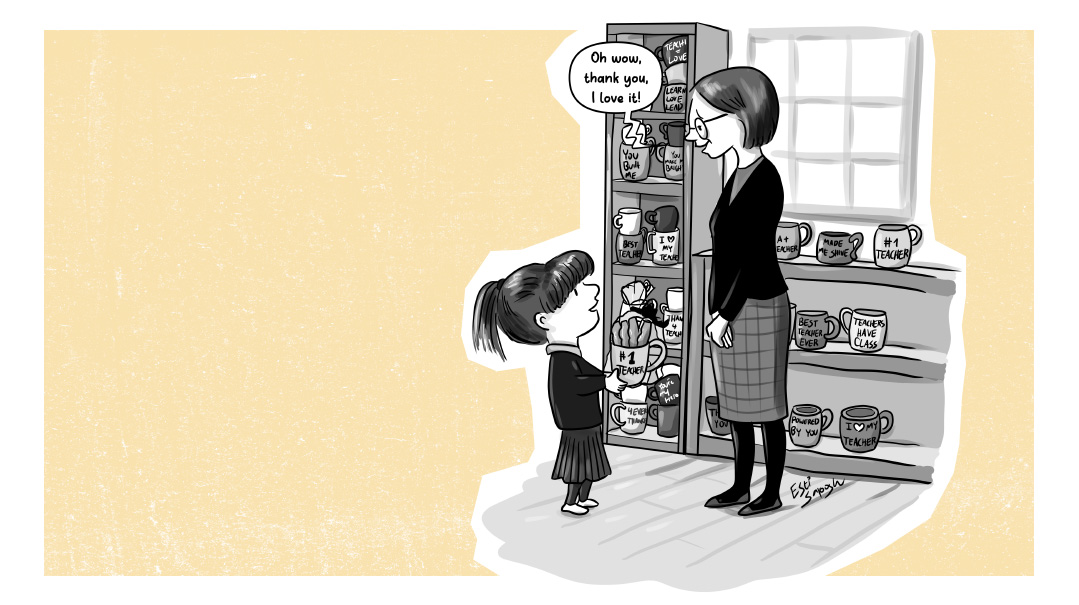

I’ve been a third-grade teacher for 27 years now and have celebrated as many Chanukahs with my students in that time. When you multiply that by an average class of 30 students, you come up with a lot of mugs. A LOT of mugs.
Don’t misunderstand me — I’m as grateful as the next gal. And I chuckle each time I get a “Teachers Have Class” one (that would be 14 chuckles so far this year). I really do appreciate the time, the thought, the wrapping, and the biscotti that go into them, it’s just that… it’s a LOT of mugs.
I’m wondering if you can help me figure out a way to let the parents know that I can host an entire third-world country for coffee, and I’d really rather have a gift card to somewhere fun.
Here’s one clever way to do that: Write your request into an advice column and couch it as a question so that it doesn’t sound like you’re complaining, but you still make your point.
A veteran teacher once said to me, “If I can’t eat it up or use it up, I don’t want it.” I don’t know that everyone would agree with that, but it’s not a terrible place to start. Yes, parents, the teachers do appreciate every gesture of gratitude. And they mostly appreciate the note that goes with it. No matter what you do, they’re gonna love it. But chances are, they’ve got enough mugs.
You know how sometimes you meet people who’ve been dating for a long time and they say, “I’ve been around the block?” Well, I’ve been around the whole city. Suffice it to say I’ve drunk more Diet Coke past 9 p.m. than any human should, and I’m really tired.
Here’s my question. At what point (if any) do I get to say no to suggestions for superficial reasons, because I know that they just don’t work for me? How many short guys do I have to go out with before I can say no to a short guy I haven’t met? How many times do I have to convince myself (or be convinced by others) that it’s okay if a guy isn’t a professional, even though it means a lot to me to marry a professional? I have no problem keeping an open mind, but not so open that my brain falls out. When can I say, “Been there, done that. It doesn’t work for me.” When can I say no?
IF you’re asking when you can say it to others, the answer is “now” and “whenever you want.” No one gets to decide for you what’s important and what’s not, what’s superficial and what’s real. This is your life, and ultimately you’re the one who has to drink the Diet Coke.
I’m sensing, however, that this isn’t about other people. This is about answering yourself. It sounds like you’re questioning your right to refuse a date because there is always the chance that this will be the right one, and you might miss it because of something inconsequential.
My guess is that you really want to get married. So when you say no, you’re not taking that decision lightly. You’ve learned a thing or two about yourself in this process, and you’re bringing that into this decision. When you’ve been making shidduch calls long enough there are key words, a cadence, or a pattern that create a sense within you, telling you that you’ve been down this road and you just want to get off. You’re allowed to trust that voice.
Here’s where it can get tricky: Sometimes the dynamic gets confused with the manifestation. For example, you might think you really don’t want a short boy. And that’s entirely possible. It can be as simple as that. But it might also be that what you really want is masculine energy and to feel protected — and there are plenty of short boys who exude real masculinity and make their wives feel protected physically, emotionally, and financially. You may want a professional because you grew up in a family of professionals, but maybe what you really need is someone who provides you with a certain amount of status or stability.
Do the next step of research. Get in touch with your real needs and wants and ask yourself the questions about them. Figure out what you’re really looking for and try to determine if this potential date has it, even if it looks different than you imagined. It’s okay to say no. Just make sure it’s for the right reason. And may that Diet Coke quickly turn into a l’chayim.
My daughter is back from seminary and I’ve been patient. Everyone said to give her till Chanukah to come back down to earth. But it’s Chanukah and she’s still talking like she lives in the clouds. She wants to marry a forever learner and she wants to be a teacher. I asked her, “Which is it? Do you want to teach or do you want to support a family? Because, you know, you can’t do both.”
I feel so blessed, because I didn’t need to spend $32,000 to go to seminary, and yet I’m receiving in-depth shiurim on emunah and bitachon from my daughter. It’s like getting two for one.
I get it. She’s inspired. But inspiration doesn’t pay the rent. My husband and I are in no position to support a couple, not that she is expecting us to, but we believe it’s reasonable hishtadlus to train for a financially stable job. How do we have this conversation without sounding like kofrim? Or do we? Do we just let her do her thing?
Let me take this on a different path than you’re expecting.
Rather than answer this question directly, I’m going to channel my inner Jewishness, and answer it with a question (or several) instead.
What are you afraid of?
Let’s assume your daughter goes ahead and pursues her passion in teaching. And let’s assume (okay, this is probably a fair assumption) that she doesn’t earn enough to support a family singlehandedly with this career. What might happen after that? She might get a second job. Her husband (may he come at the right time and be a yerei Shamayim and a mensch and it wouldn’t hurt if he was good looking too) might take on a side job. Or they might start a home business. Or he might leave learning and start working. Or they might learn to manage with very little. Or they might really struggle.
All of these options are about your daughter, her future husband, and their life together. Are you concerned about a scenario in which they come to you for financial assistance? Are you concerned that you won’t be able to tolerate their struggle?
What I’m trying to say is maybe we need to let our children choose their own path. And maybe we need to recognize that some of our concerns have less to do with them and more to do with our discomfort when we see them struggle and our sense of responsibility to rescue them. If you and your husband can relieve yourselves of this self-imposed responsibility, you might find that letting your daughter pursue her passion is much simpler than you thought.
At this stage of your daughter’s development, you’re moving to the role of consultant. You can have an even-keeled conversation with her, where you help her think through the probable outcomes of several paths, and she comes to her own conclusions
Please know that life isn’t sealed at age 19. It seems to me that as a culture we get locked in to this notion that you have to have it all figured out and preferably be on the path by the time you hit 20 for girls and 23 for boys. Please Hashem, may everyone be healthy — there is time. Sometimes we try one thing and then decide to try another. Kol zeman she’haneir dolek… As long as we’re alive, there is time to reinvent ourselves. And if we’re growing, living beings, hopefully we’re constantly evolving and becoming better versions of ourselves.
So ask yourself: What is panicking you? Can you exhale and let the process unfold? Can you trust that your daughter has a good head on her shoulders and that she can live with and adapt to the consequences of her choices? Or that she might come to see life more like you and your husband do? And finally, can you trust yourself enough to tolerate your own discomfort as you watch this process unfold? Giving your child the opportunity to pursue a dream, however it ends, is an enormous gift. Depriving them of the opportunity can sometimes lead to a lifetime of regret.
In the meantime, pull out a pen and your trusty notebook and enjoy the high caliber mussar schmooze your daughter is sharing with you.
(Originally featured in Family First, Issue 973)
Oops! We could not locate your form.
RELATED CONTENT


“When we start at Chapter 26, we have no idea what happened in the 25 previous chapters”

“Ahh, the life of a frum woman. The needs of everyone around us are pressing and relentless”

How do I respect her deeply held beliefs while maintaining my dignity and the dignity of my food?

Seems to me that you and your husband need to have a conversation
