No Slim-Fast Solutions
| October 10, 2012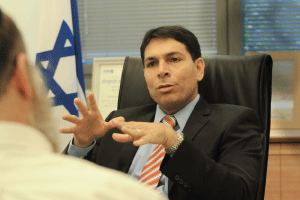 If Deputy Knesset Speaker Danny Danon tells someone to take a hike he’s not violating diplomatic protocol. His words are worth heeding especially if you don’t want to get lost inIsrael.
Danon’s father Joseph z”l made certain that his son Danny would never lose sight of the value of theLand ofIsrael. Joseph Danon who lost his hearing from a severe battle wound sustained while hunting terrorists in the treacherous parched terrain of theJordan RiverValley in 1969 encouraged Danny on the path toward becoming a walking GPS of sorts.
The Danons’ many family tiyulim were more than just pleasure trips; they were aimed at developing Danny’s proficiency inIsrael’s variegated topography and geography.
“I can tell you which road to take to get from point “a” to any point “b” inIsraelbecause my father forced me in a nice way to know the land” says Danon.
It is his connection to and love for the land that has made Danny Danon (Likud) first elected to the Knesset in 2009 into one of the staunchest opponents of a two-state solution to the Arab-Israeli conflict. This opposition is a recurring theme in his new book Israel: The Will to Prevail in which he brings historical arguments biblical sources and pragmatic reasons why dividing this slender strip of territory between two dissimilar peoples is doomed to failure.
“I’m against giving our land to the Palestinians” says Danon in his characteristic straight and to the point manner as we sit for a formal interview in his Knesset office during the summer recess far removed from the normal high-tension hubbub that normally permeates the Knesset. “Many times people ask me why don’t you say it in a nicer way?”
It is a question he is asked often. As chairman of the Knesset Immigration Absorption and Diaspora Affairs committee Danon is the legislative point guard — often the first man to handle the ball for Israel’s hasbarah or public relations that chronically falls short of makingIsrael’s case effective in international arenas.
Danon is trying to change that. It’s not that he isn’t nice. In a legislative body known for being unruly and tolerating brusque and often rude behavior Danon is both gracious and diplomatic when sitting in the chairman’s seat.
Whether he is hosting the German ambassador for a discussion over the recent German court ruling clamping down on bris milah or the French ambassador to talk about violence against French Jews or giving a royal welcome to right-wing American talk show host Glenn Beck Danon always keeps his remarks brief ensures decorum is maintained and doesn’t make himself into the star of the hearings.
While diplomatic niceties may have a bearing on his tone it doesn’t mean Danon tones down his message.
In The Will to Prevail the 41-year old Danon writes: “I represent a new generation of leaders who seeIsrael taking a different and more autonomous path than it has over the past several decades.
“Throughout our history” he continues “Israel has conducted its affairs with the aim of pleasing — or at least not offending — its strongest partner and closest ally: the United States … however history shows that when we act on our own according to our own best interests the results are better not only for Israel but for world peace as a whole.”
The book’s title itself seems to suggest that somewhere along the way the nation has lost the will to prevail but Danon rejects that premise when offered.
“I don’t think we lost it” he says. “I think some Israelis are looking for an instant solution and they’re willing to compromise or sacrifice so there will be what I call the ‘slim-fast solution.’
“I’m not a believer in that. Next year we will be marking 20 years for theOsloagreements. After 20 years people have woken up and understood that it’s not about land for peace. It’s not about what we are willing to give. It’s about having a real partner or building a peace process from the ground up.”
And sometimes standing one’s ground is a prerequisite for peace says Danon.
“I do believe that in order to prevail we need to believe and we need to be aware of what belongs to us. After that we will have the courage to fight or to manage the conflict because I don’t believe that we can resolve the conflict in the near future.”
To read the rest of this story please buy this issue of Mishpacha. To sign up for a weekly subscription click here.
Oops! We could not locate your form.
