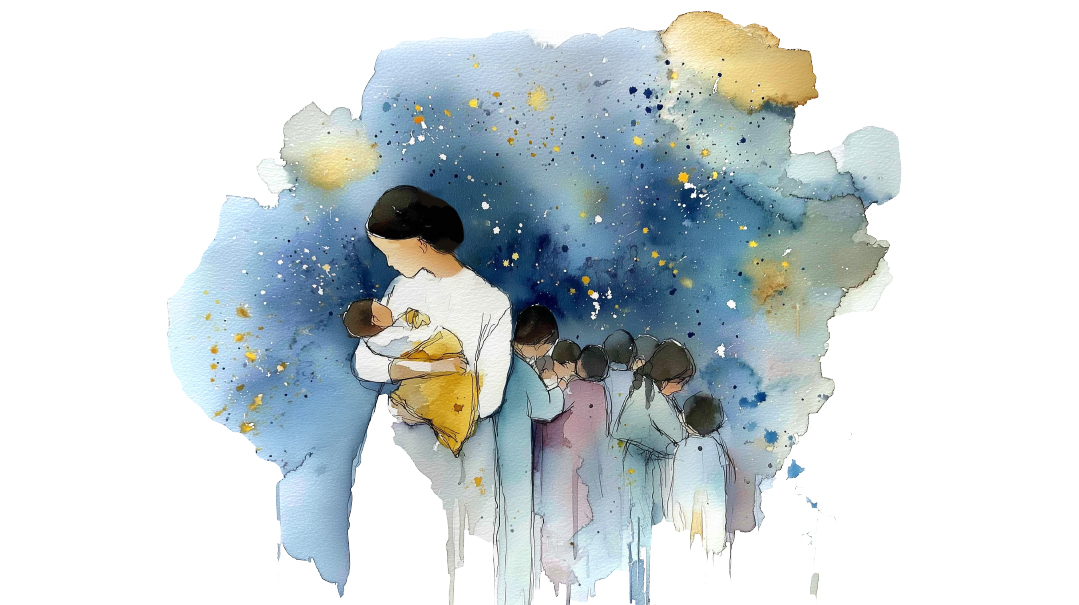
Three portraits of galus, three experiences that will evaporate when we emerge into the dawn of redemption
Someday we will all be together, Someday we’ll be sheltered and warm Never will we have to express any fear, Our scars and our wounds will disappear
(Mordechai Ben David, “Someday We Will All Be Together,” JEP 4, 1979)
When the Geulah comes, all we endured throughout our long years of exile will feel as though
It Were but a Dream
Here, three portraits of galus Three experiences that will evaporate when we emerge into the dawn of redemption.
Birth Pangs
Esther Mandel
In the bomb shelter’s stifling heat, amid blood and fear, I saw an inverted reality
N
othing prepared me for giving birth during war.
When I went into labor during the Israel-Iran War, my husband and I packed up, arranged care for our other kids, and drove to Hadassah Ein Kerem hospital. The hospital is a 40-minute drive from Beit Shemesh, through the most breathtakingly beautiful wooded mountains of Nes Harim. In war parlance, it’s a “shetach patuach,” land that hasn’t been built up, which means that if a missile was heading into the hills, the army wouldn’t try to intercept it.
We drove in silence along the winding dark mountain roads, switching from radio station to radio station to avoid any news updates, while I labored in the car, and we tried to stay calm.
We arrived safely, and initially everything proceeded as usual. Soon I was ready for delivery, prepped in a hospital gown, and installed in a delivery room.
Then the first hatra’ah, the incoming-missile warning from the Home Front Command, sounded from our phones and throughout the hospital loudspeakers.
Two orderlies burst into the room, and supported from both sides by nurses and doctors, I was brought out into the protected hallway.
The hallway was crammed with laboring women in hospital beds and their spouses. There was no privacy, nowhere to look, nowhere to put ourselves. Two midwives urgently tried to maneuver a bed through the crowded hallway into an operating room, an almost impossible task.
Eventually, we returned to the delivery room, but this rushing in and out to the hallway happened a few more times.
Then my labor stopped progressing, the baby’s heart rate dropped, and I was prepped for emergency surgery. (Later, I’d meet two other women who needed surgical intervention for the same reason. Iran, we don’t forgive you!)
It felt as though I was upside down at the bottom of a goldfish bowl, reality stretching itself into a concavity, so that when I looked it in the eye, all I saw was distorted glass staring back at me. I heard all the activity around me — the booms, the phones chirping their warnings from the Home Front Command, the doctors and midwives shouting instructions — through a morass of flickering fluorescent lights. The only real things were the things so small no one except me noticed them.
There was the midwife who saw that as the doctors were urgently performing surgery on me, my head, invisible to them behind a partition, was being pushed off the bed, and I was having trouble breathing with my head tipped back like that. She ran over to the sink and washed her gloved hands until they were freezing cold and then knelt behind my head, and cupped my face with cool, calming hands. She was wearing a mask so I will never know who she was, but I believe those supporting hands saved my life as much as the surgery did.
Another angel was the operating surgeon. He was a severe-looking older man with a five-o’clock shadow. Just before he began to operate, he came around to my side of the curtain and whispered in thick, Russian-accented Hebrew, “Neshamaleh, you’re in good hands! We care about you, we care about your baby. Breathe, neshamaleh, we’re going to get through this together.”
The doctor was right; I was in good Hands. Hashem pulled both me and Baby Girl through the ordeal, although it was a while until I knew which gender my child was — I kept asking, but no one answered, and I didn’t realize this was because they were busy trying to revive her.
Baruch Hashem for the things we don’t know!
I was lucky that all was quiet on the war front for the next few hours, when my body was totally paralyzed by the epidural. But before it had fully worn off, another hatra’ah sounded. I was slipping in and out of semiconsciousness, probably induced by all the pain killers, when it occurred to me that unlike the other babies in the ward who were with their mothers, my baby needed medical supervision and was in the nursery. The nurses couldn’t carry more than one or two babies at a time. How would they get my baby into the bomb shelter in time? So, catheterised, legs swollen to three times their size, I stumbled to the nursery to get my baby. Baby in my arms, I then staggered into the bomb shelter.
There weren’t enough chairs. The air-conditioning wasn’t strong enough for a room stuffed with people. Soon, the floor was slippery with fluids. I sat slumped on a chair, baby in one arm, catheter tucked under the chair, when I saw a woman swaying in front of me. I could hardly breathe in the heat, but I tugged at her top, and she squished up next to me on the chair.
The heat, the smell, the soft moaning of the women around me — it was surreal. Women sat on the floor, women who had run in their hospital gowns were holding their baby in one arm and trying to secure a bedsheet around themselves to preserve their dignity. It was the first time I truly felt how close a yoledet comes to death. And I wondered what was more dangerous: our constant running to the safe room so soon after birth or the threat of being vaporised by a ballistic missile?
One night, after a few back-to-back sirens, we gave up running back and forth to the ward and stayed out the night in the bomb shelter. We didn’t have the strength to get up and out of the chairs, back to our beds, only to have to run back again.
And I found that again, the only concrete moments were so small they evaporated as they happened — the way the men who were visiting in the ward helped the yoldot and their babies into the shelter, and seeing there was no space for them in there, remained outside, unprotected. The way a chassid maneuvered the wheelchair of a post-surgery Arab woman into the shelter. The way an Ethiopian Jew who ran to help the nurses bring the babies in from the nursery stood opposite me with a blonde newborn nuzzling one side of his neck, an Arab baby the other. His lips brushed the crowns of their heads, and he hummed to them softly, before handing them over to their mothers when they finally made it into the shelter.
Then there was the man who saw the fluids on the floor, and as soon as the all-clear sounded, told everyone to wait, and then used a sheet and a sponja-stick to clean the floor so that none of the women would slip on the way out.
Maybe when Hashem looked down, He saw an inverted world. Maybe He looked past the missiles sent by agents of darkness; the loud, angry headlines; the hateful words spouted by important world leaders; and instead, saw the suffering of His daughters as they labored to bring souls into the world while sirens sounded; saw the humanity no bombs can destroy in the way that so many helped the new mothers at a time of such vulnerability; saw that Am Yisrael are still and will always be rachmanim bnei rachmanim.
Maybe it’s not missiles, bombings, and noise that will herald Mashiach, but the minute kindnesses, the compassion, the love we showed to one another in the hallways of Hadassah Ein Kerem that will bring about his arrival.
The Gift of Fear
Toby Schorr
My capacity for feeling pain is clogged
IT
was late Friday morning and I was trudging up the hill, my toddler sitting in the stroller holding his knapsack and a bag of cheese puffs, when my phone rang. I’d been about to go into a store to buy a magazine, but I stopped and fished my phone out to answer.
It was a rebbi from my three-year old’s cheder, and he wanted to know why we hadn’t come to pick him up.
“He goes by bus,” I replied. “Is something wrong?”
“He does?” The caller sounded surprised. “Let me get back to you,” he said, and hung up.
I was mildly perturbed, but not too alarmed as I waited for him to call back.
Three minutes later the phone rang again. It was the same rebbi, calling to say that somehow my son hadn’t made it onto the bus, but he’d put him on the bus with the older boys.
Okaay. I shrugged, not thrilled, but not nervous either.
When I finally got up the hill, I checked in with my husband, but my son hadn’t gotten home yet. I’d been planning to run with my girls to buy shoes before the store closed, but I couldn’t leave without seeing that my yingele was back.
“Just go,” my husband urged. “I’ll wait for him.”
But my Yiddishe mama nerves, which had been hibernating for a long time now, were driving me into panic mode.
I started a frenzy of phone calls, trying unsuccessfully to figure out exactly which bus he was on, my mind rushing to doomsday scenarios of my little boy, he of the curly blond peyos, the sea-blue eyes, and the paci and blankie, riding a bus alone around Yerushalayim.
I stepped eagerly up to every van that passed my building, only to have them rush past me, and ran to the bus that stopped further up the street, only to find out it was from another cheder.
My tension was sky high when finally — finally! — a bus stopped and my little angel stepped off, his Fireman Sam knapsack on his back. He was unruffled, seeming not to have registered that he’d missed his own bus and ridden on another, and I grabbed him into a grateful hug.
Then, my nerves still jangling, I rushed my girls into the car and made a dash for the shoe store.
As I drove, I tried to regulate myself. I let myself feel the overwhelming relief that he’d come home safely, gave myself credit for having done whatever I could to track him down, and then acknowledged that the whole experience had been very scary.
And then, as I navigated the traffic to get to Rav Shefa mall on time, I felt a rush of gratefulness for the fear.
I thought of the medical consultation I’d attended just two days earlier with my husband and Aviva, our medically fragile, ventilated daughter. We’d been discussing different medication options with the neurologist when the orthopedist, who was also in attendance, said something about Aviva being stable.
I smiled wryly; while she doesn’t do this often, just a few days before her oxygen levels had dropped to 30 (normal levels should be close to 100), and her volunteer had walked her home from her Shabbos afternoon respite group bagging her all the way. I shared that with the good doctor, and she amended her earlier designation to “fragile-stable.” We agreed on that and moved on to happier topics, like why threatening the status quo with elective neurosurgery wasn’t a good idea.
Now, after panicking because my son’s bus had come late, I thought of that again. I’d been way more nervous about his late homecoming than Aviva’s serious oxygen drop. But then again, how many times can one dance with death and still fall apart each time?
L
ast Tishah B’Av, I’d tried my best to relate to the anguish of the Churban, and to try to feel Hashem’s pain. I’d read that participation in a simchah isn’t nearly as much of an indicator of someone’s closeness in a relationship as much as feeling another’s pain is. The author posited that someone who truly loves Hashem will shed tears on Tishah B’Av for His pain.
And I tried. I really did. But I couldn’t get myself to feel sad, let alone to cry.
I’m blocked, I realized. My capacity for feeling pain is clogged by now, a defense mechanism against things I don’t want to process, I guess. When breathing emergencies are minor hiccups and suction catheters are just something you stick in your bag like a pack of tissues, it can be hard to let yourself feel so much. I don’t remember where I read or heard the pshat on the pasuk in Yechezkel that says that Hashem will remove our hearts of stone and give us hearts of flesh, but it said that during the galus we needed to have hearts of stone, to enable us to bear the pain we endured, but once the Geulah comes, we’ll be able contain the emotions of a heart of flesh.
That explanation has become particularly meaningful to me.
I got my daughter’s shoes, and the next week, my son came off the bus right on time. Soon enough, the fear of that Friday afternoon faded, and most days, I relish the quiet pocket of time I have for myself before my little-guy-with-a-teenage-boy’s-appetite comes home, flings down his knapsack, and starts foraging through the pantry. But here and there, I step back to look at the angelic little boy who has brought me so much healing and joy and thank Hashem for bringing the feeling of Geulah that much closer.
A Potato Each
As told to Tehila Kahan
I don’t feel young. I feel like a wizened old woman, one who has lived through enough pain for generations
2025
The 12-piece band is playing some new music, a song that is far too young for me. I’m aching limbs and sensitive ears tonight, an artifact of another generation, and it only sounds like noise in the gleaming hall. But when I dance with my granddaughter, our arms around each other beneath the glittering chandeliers, the music fades into a gentle hum, a moment of perfection.
There are flowers everywhere, perfectly cultivated for today. They’re an array of hues, all within the approved summer pastels that match our gowns. Each gown has been custom-made, tailored to flatter me, my daughter, my granddaughters. We move through the hundreds of well-wishers, of friends and family and family business associates, like floating blossoms of simchah in the crowd, our ears and necks gleaming with diamonds.
The tables are full of food, as though anyone might still be hungry after the dozens of meat stations and floating hors d’oeuvres of the shmorg. There is the banquet of food on each plate, the waiters moving with trays of additional tasty bites with toothpicks poking out of them. Just in case a dancer might be hungry but unwilling to return all the way to their chair. Just in case a single pang of hunger might touch this room.
The dance floor shines beneath the 30-foot ceilings, custom-embossed with my granddaughter’s monogram. The mechitzah is made of elegant, frosted glass panels with floral insets. Each table bears embroidered satin linens, upon which sits the food. All that food.
My daughter and her husband have been blessed with the means to make this a wedding for the ages, the simchah and grandeur permeating the air of the hall. It’s beautiful, opulent, unforgettable. It’s the first wedding of the next generation, and I’m here to see it.
Yet I’m also very, very far away.
1945
I’m barely a teen, staring at barbed-wire fences and uniformed demons, walking with limbs too narrow to carry me. My vision is wavering, the hunger overwhelming, the pain too much to bear. Yet I bear it, because there is no choice. There is only a gaping chasm of oblivion opening beneath me, and I must stay steady or be swallowed.
There is only Rivka, her eyes shining with determination beside me, our whispers like a shaky bridge forming beneath us.
We’re 14, and we’re facing liberation. For a brief moment, something opens in front of us, something alien and unknowable.
Freedom. Future.
Ludicrous concepts in a world where each day is a struggle. But there they sit in front of us as we stumble to the DP camp.
It looks so much like a concentration camp that it’s hard, sometimes, to know the difference. That when we sit outside a building, there is no one who will slam the butt of a rifle against us, who will order us in harsh language to get up, who will remind us that our lives are expendable.
Rivka and I starve here, too. There is little food, but others have told us that it’s a blessing in disguise. That the ones who ate too much were sickened by it, were left writhing, to their deaths, their fragile bodies incapable of simple digestion.
At night, we’re crowded with a group of others who have no families, awakened by anguished screams and sobbing. We tug at clothing to make it fit, run to see every new arrival in case they might be someone we know. But mostly, it’s only Rivka and me.
“You’re young,” an older man says to us, the corners of his eyes crinkling with something like hope. “You still have a life ahead of you.”
It’s strange to imagine. You’re young. I don’t feel young. I feel like a wizened old woman, one who has lived through enough pain for generations. You still have a life ahead of you.
“We do,” Rivka says fiercely, and I feel it. “We’re going to live.” For the first time, I think of what that might mean, to be 14 and have decades to come. The Nazis stripped away our future, but now they’re gone. And us?
We will survive. We’ll walk from these camps with our destiny in hand, cross our own Yam Suf and enter the desert of our ravaged lives in Hashem’s embrace. We will make it to 15. To adulthood.
And in that moment, the two of us sitting together in the stale air of the camp in ill-fitting rags, I make a bold statement: “We’re not just going to live. We’re going to grow up. We’ll be married one day.”
“Yes!” Rivka seizes on this, a game that isn’t a game. A future that we clutch together. “We will make it to our weddings.”
“And what weddings they will be,” I pronounce, and I close my eyes and imagine it, the kind of elegance and opulence that I can conceive of right now.
The epitome of wealth and luxury in this dark world, the furthest stretches of my wildest dreams. In defiance, I’ll fantasize the brightest future.
“They will be so lavish,” I declare, “that every guest will get a whole potato each.”