
Guest of Honor

Each of us welcomes special guests — the Ushpizin who enter our succah every night — but what is it like to host a living gadol?

Project Coordinator: Rachel Bachrach
While they might have been young at the time, people who had gedolim in their homes retain impressions that remain forever — like the surprising comfort in being around a great Torah leader and basking in his sense of humor, his overarching gratitude, and the blessings he bestowed on their family.
Unforgettable experiences, from sitting together at the table, getting to serve a drink, or giving up their room for these giants of the generation continue to shape their lives as adults

Rav Moshe Feinstein
As told to Adina Lover by Rabbi Aaron Sochet
He was like a Zeidy
IN
1970, Rav Moshe Feinstein flew to California to raise money for his son Rav Reuven’s newly-opened yeshivah in Staten Island. Barney Hasden, who would fundraise for Mesivta Tifereth Jerusalem, had arranged for a dinner to support the yeshivah at the Ambassador Hotel in Los Angeles (where Robert Kennedy had been assassinated in 1968).
My father, Reb Yisroel Sochet, was part of the team arranging the dinner. We had recently moved to Los Angeles, and my father was very excited about the opportunity to welcome Rav Moshe.
Rav Moshe stayed in a hotel, but I’ll never forget when we got the news that we’d be zocheh to host royalty for a meal. The whole family got involved in the preparations, and it was all we talked about during the week we had to prepare. My mother consulted with her friends about what to serve, and my parents had long discussions about whom to invite.
Of course, my parents wanted Rav Moshe to be completely comfortable. They didn’t want to serve fleishigs in case Rav Moshe wouldn’t want to eat meat out of his home, and as there was no chalav Yisrael available in LA at the time, my parents decided to serve fish, which was pareve. Then, because we didn’t have nice milchig dishes, my mother went out and bought brand new china for the meal. (They became known in our house as “Rav Moshe’s dishes,” and we never used them again.)
My father took me to join the entourage that greeted the gadol hador at the airport. There were about 30 people who traveled to greet him — the community in Los Angeles was still very small at the time; not many people had an understanding of who Rav Moshe was. I was nine years old, and I remember going with my father, my maternal grandfather who was visiting us, two uncles who lived in town, and a cousin my age. Rav Simcha Wasserman, who lived in LA, was also there. A man whose five-year-old daughter was being treated at Los Angeles Children’s Hospital and whose family was staying in our house came as well.
In those days, we were able to walk right up to the plane where Rav Moshe disembarked. We met him on the tarmac where he was seated on a golf cart, and we surrounded him as he was transported to the waiting car that would take him to his hotel.
Rav Moshe was in Los Angeles for two days, and he visited for dinner that first night. He came along with his son Rav Reuven Feinstein, Barney Hasden, and Rabbi Moshe Rivlin. (Originally part of the hanhalah in Torah Vodaath, Rabbi Rivlin had become especially close to Rav Moshe and served as an executive director in MTJ.)
When the doorbell rang, my younger brother, Chaim Baruch, who was four at the time, ran to answer it.
Taking one look at the hadras panim of the gadol, my brother asked, “Are you Hashem?”
Laughing, Rav Moshe replied, “Nein, Hashem is in der himmel.”
My brother thought for a moment and then declared, “Well, then you must be His best friend.”
We sat down to the meal, an intimate gathering consisting only of Rav Moshe’s entourage and family. We were joined by my grandfather and the two uncles who lived in town, Rav Ozer Yonah Kushner and Rabbi Yossi Rubanowitz, along with another one of my mother’s cousins who was living in LA. There was also the family who was staying in our house. In the kitchen, my mother, sisters, and aunts prepared and served the meal. My mother also had some help with the setup from a couple of close friends.
My father seated Rav Moshe at the head of the table, with my grandfather on one side and himself on the other. During the three hours he spent in our home, my father asked Rav Moshe many sh’eilos. They discussed whether to bentsh gomel after flying; Rav Moshe has a teshuvah in which he paskens that one should. My mother had recently hired a housekeeper, and Rav Moshe guided my father on issues related to bishul akum. He suggested that my mother keep the meat freezer locked so Angelina, the housekeeper, could not access it. They also discussed the halachos of opening bottle caps on Shabbos.
My father wanted to bring a yeshivah gedolah to Los Angeles, but the roshei yeshivah of a small local yeshivah did not feel the city could support two similar institutions. Rav Moshe advised my father against starting a yeshivah that would compete with one that was already established.
“What about kinas sofrim?” Rabbi Rivlin asked, because more Torah in the community could be only a good thing.
However, Rav Moshe was concerned that the yeshivos would compete for limited funds. (In the end, my father was instrumental in bringing Rabbi Chaim Fasman and Kollel Bais Avrohom to the city.)
Although we were nervous at first, Rav Moshe put our discomfort to rest. He was like a zeidy, laughing with the children, encouraging us, all while holding my younger brother and the daughter of the bikur cholim family on his lap. Of course, we took pictures and home movies that we treasure to this day.
Even as he deliberated over matters of great import for my father and our family, Rav Moshe’s manner was entirely unassuming and relatable. We witnessed firsthand how greatness goes hand-in-hand with humility.
My little brother had it right: this was Hashem’s best friend.
Rav Aaron Sochet is a rav and moreh hora’ah in Los Angeles, California.
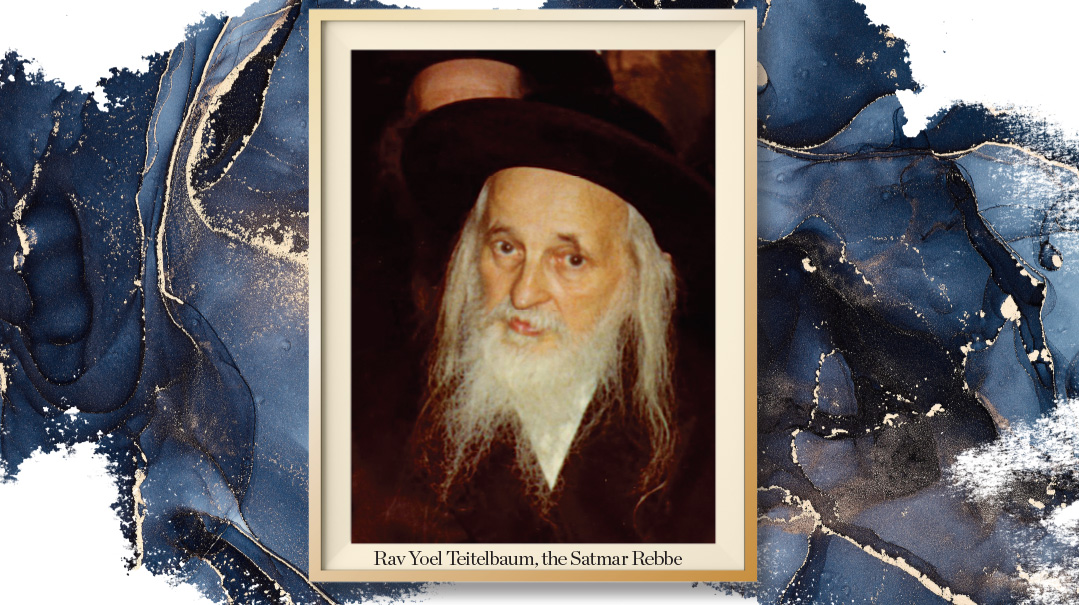

Rav Yoel Teitelbaum, the Satmar Rebbe
As told to Eli W. Schlossberg by Dorothy (Krausman) Bruckstein
A Place to Recuperate
ON
Chol Hamoed Pesach 1963, the doorbell rang.
“May I use your restroom?” a woman in a tichel asked my mother, Malka Krausman a”h.
That woman was the Satmar Rebbetzin, Rebbetzin Faige Teitelbaum. It seemed that she had been told that our neighborhood of Belle Harbor, New York, a beach town on the Rockaway Peninsula, would be a good location for her husband, the Satmar Rebbe, Rabbi Yoel Teitelbaum, to recuperate from a recent stroke.
The chassidim had provided a list of names and addresses of several local Orthodox Jews, and the Rebbetzin was canvassing the neighborhood, checking out the beach blocks bordering the Atlantic Ocean and taking note of the homes with mezuzahs on the doorposts to match them up with her list.
My mother offered the Rebbetzin not only the use of a bathroom, but a drink as well. This afforded the Rebbetzin the opportunity to sit for a few minutes. My sister Estie remembers my mother reminiscing about the interaction and how impressed the Rebbetzin was with how we covered the kitchen for Pesach.
As they sat, the Rebbetzin explained that she was searching for a place for the Rebbe to recuperate for six weeks. My mother responded immediately with a generous offer: “Absolutely no problem, you’ll stay in our home. Our bedroom is on the first floor, so you won’t have to worry about stairs.”
My mother added that they should come with several bochurim and assistants, as well, to ensure a minyan in the house.
And so it was. Right after Pesach, our family of five — my parents, 13-year-old me, my 11-year-old sister, and my three-year-old brother — packed up six weeks’ worth of clothing and toiletries. My mother worked hastily, as her main objective was to move out as soon as possible so our home could be available immediately for the Satmar Rebbe.
We moved into the basement of The Queen Esther, a senior center my parents owned a few blocks away. Our new quarters were small in comparison to our house, and our living situation was unusual. We ate with the senior center residents, as we had no private kitchen, and we helped out around the center, befriending residents and staff in the process. But we didn’t feel displaced. My parents were thrilled to be zocheh to share our house with the Rebbe and his wife, and that attitude made such a positive impression on us. How fortunate we were to offer this service to the Rebbe!
The six weeks stretched into almost 11 months, from after Pesach until the following Purim. Over the course of the year, Satmar chassidim visited regularly, and our house saw a lot of traffic — including from us. We visited often during the Rebbe’s stay in our home. He would give us brachos every time, and often he and the Rebbetzin gave us small silver items as presents. One time, the Rebbe took out two golden chains with gold lockets containing precious stones. He held them tightly in his hands, gave us a brachah, and had the Rebbetzin place the necklaces around my sister’s and my necks. How we cherished that gift.
There was a television in the bedroom of our home. The Rebbetzin made a cover for it out of some extra fabric my mother had from wall and window treatments in our home. Everything else was kept exactly the way we had kept it, and the Rebbetzin was comfortable using our pots, pans, and other utensils.
My father, Arthur Krausman a”h, would reminisce about the irreligious Jewish family that lived across the street. They were upset that my parents let the Rebbe live in our house, and they resented the additional frequent foot and vehicular traffic, lack of parking, and increase of chassidic Jews so close to their home.
One day, the irreligious father showed up at our door and asked the Rebbe’s gabbaim to let him in.
“Bless me, Rabbi,” he said emotionally. “My son is very sick. He has Tay Sachs disease.”
After this personal interaction with the Rebbe, the neighbors softened their position, and their little boy lived several years longer than expected, enjoying a better quality of life.
My parents had been successful financially, and after hosting the Satmar Rebbe in our home, they enjoyed even more financial success. We maintained close contact with the Rebbe and Rebbetzin, who even came to my wedding. For years after, my sister and I attended bikur cholim parties in the Rebbetzin’s home.
Indeed, our connection to the Satmar Rebbe runs deep — and we’re convinced that the Rebbe’s many brachos are still bestowing us with Hashem’s grace years later.
Dorothy Bruckstein is a licensed clinical and school psychologist from Lawrence, New York. She is the oldest daughter of Arthur and Malka Krausman a”h.

Rav Elchonon Wasserman
As told to Rivka Streicher by Rabbi Moshe Schwab
No Worries
W
hen I was six or seven, my father, Rav Shimon Schwab, came home from shul one Friday night with a tall figure with a big, round hat. The table was beautifully set, I noticed, and my father pointed to the seat at the head.
“The Rosh Yeshivah will sit here,” he announced.
We kids realized that this guest must be a really great person, because Father’s place was sacrosanct.
“Where will you sit?” countered the really great person, Rav Elchonon Wasserman, rosh yeshivah of Baranovich.
“I’ll sit on the side,” my father replied.
But Rav Elchonon wouldn’t hear of it, and the two men went back and forth like this for several minutes. Finally, my mother, with womanly intuition, pulled up a chair and placed another setting at the head of the table so they could both sit there, side by side.
It was 1938, and Rav Elchonon Wasserman was in America to raise money for his yeshivah in Belarus. From 1937 to 1939, Rav Elchonon traveled from community to community, speaking in shuls and soliciting funds.
He knew of my father, the famed Rav Shimon Schwab, because my father’s brother, Reb Moshe Schwab, was a talmid of his in Baranovich. When my father heard that Rav Elchonon was coming to Baltimore, he invited him to stay with us.
After the meal, members of the kehillah came over. Rav Elchonon regaled the crowd with stories from Europe. They were especially taken with stories of the Chofetz Chaim, of whom Rav Elchonon was a prime talmid.
My mother served tea and cake after the meal.
“Do you have any veise tei (white tea), Rebbetzin?” Rav Elchonon asked. He didn’t want to use tea essence on Shabbos, but he didn’t want to embarrass my mother by calling this out, so he jokingly asked for plain hot water by calling it “veise tei.”
On Shabbos morning, Rav Elchonon spoke in my father’s shul, Shearith Israel Congregation (known today as the Glen Avenue Shul). The people were deeply impressed by the gadol’s derashah, but he didn’t raise much money; America had not yet recovered from the Great Depression at the time.
Before Rav Elchonon left Baltimore, my grandfather and other local rabbanim asked him to sign a kol korei against mixed dancing at Jewish affairs in town, including shul dinners, a pervasive issue at the time. They were about to publish the kol korei, and Rav Elchonon signed it.
After Rav Elchonon left Baltimore, he went to Williamsburg, where he spent most of his time during his trip to America. Yeshiva Torah Vodaath was located there, and Rav Elchonon was impressed by the Torah of America and the yeshivah’s caliber of talmidim, including Rav Gedaliah Schorr. He was a great influence on Mike Tress, who was later very active in hatzalah efforts during the Holocaust.
Torah Vodaath offered Rav Elchonon to join as a rosh yeshivah, but he refused.
“I have to return to Baranovich,” he said. “My talmidim and family are waiting for me.”
They implored him to consider the precarious situation in Europe, the clouds of war gathering, but he held firm.
The talmidim of Torah Vodaath accompanied Rav Elchonon to the boat to see him off.
“Stay,” they begged one last time. “We’ll get you a visa; we’ll sort everything out. Don’t go back to the furnace of Europe.”
But he did, and in 1941 he was murdered at the Seventh Fort outside Kovno, where thousands of Jews were machine-gunned to death.
Upon his return to Europe, Rav Elchonon wrote my father a letter:
“If I had the time, I would write a sefer about the Ikvesa D’Meshicha. I think you would be the suitable person to write it…”
My father, who was all of 30 at the time, accepted the missive as a directive. He worked on that sefer at Rav Elchonon’s behest, gathering references to the coming of Mashiach from Tanach and the Gemara. He called his sefer Maayan Beis Hasho’eivah, alluding to the Simchas Beis Hashoeivah and the rebuilding of the Beis Hamikdash. “Hashoeivah” also has the letters of our last name “Schwab,” hinting to his identity. My father wrote the sefer anonymously, because he thought he was too young to put out a sefer, and he asked another rav to distribute it.
Unfortunately, Rav Elchonon did not live to see the completion of the sefer, but my father does quote him in it. He writes that Rav Elchonon told him that the Chofetz Chaim told him that when Mashiach comes, it will happen suddenly and unexpectedly. The Chofetz Chaim also told him he was convinced that all the conditions predicted by the chachamim before the coming of Mashiach had already been fulfilled.
As for me, I inherited the table at which Rav Elchonon sat. The table had originally come with my father from Germany, and in 2003, I brought it with me from my childhood home in Baltimore to my office in Boro Park. It reminds me of how, 84 years ago, the legendary Rosh Yeshivah held forth for a crowd of locals in my parents’ home in Baltimore.
It also reminds me of my father’s lasting impression of the Rosh Yeshivah. Our home was small; Rav Elchonon stayed with us, but there was no extra bedroom for him, and so he slept in my baby brother Meir’s room.
“I passed the room in the middle of the night and saw two people with complete bitachon sleeping there: the baby — and Rav Elchonon,” my father related. “Rav Elchonon, whose face in sleep was calm and tranquil, as though he had no worries in the world.”
Because he didn’t.
Rabbi Moshe Schwab was born in Germany and arrived in America in 1936. He owns an insurance agency and is still active in business at age 90.

Rav Mordechai Eliyahu
As told to Mindel Kassorla by Rabbi Yosef Kassorla
Majesty with a side of Humility
“B
e on your best behavior, boys,” my father said. “Hosting Rav Mordechai Eliyahu for Shabbat is a tremendous zechut.”
As he emphasized the last syllable, my heart jumped. We always had lots of guests, but we knew this was special because of the pep talk.
“And of course, you will kiss the Rav’s hand when you greet him!” Abba reminded us for the tenth time.
Kissing our father’s hand, something we had always done as a sign of kibbud av, would now be done to show respect for the tzaddik, kavod HaTorah. I was only 11 at the time, but this would be a Shabbat I would forever remember.
In 1995, Magen David Sephardic Congregation in Rockville, Maryland had the honor to welcome Israel’s former Chief Rabbi, Rav Mordechai Eliyahu z”tzl, for Shabbat. Aside from being a first-rate scholar and posek, Rav Eliyahu was also known to be a superior kabbalist. Since my father was the synagogue rabbi, it was only natural that Rav Eliyahu and his shamash stay in our house.
The preparation at shul was quite lively, and special consideration was made to ensure that it was immaculately clean. At home, my mother was busy preparing elegant meals for Shabbat. Amidst all the hectic activity, a sense of awe and serenity pervaded the atmosphere.
On Friday afternoon, a car pulled up to our driveway. Because I was familiar with pictures and paintings of Rav Eliyahu, it was surreal to see him emerge from the car and stand in front of our house.
My bedroom was at the far end of the hallway in our home, so it was chosen to accommodate the Rav to afford him the most privacy. I think back to my walls, posters of the Baba Sali and the Chacham Tzvi interspersed with sports stars Michael Jordan, Bo Jackson, and Will Clark. What could the tzaddik have thought about sleeping in such a place?
However, after spending time with the great gaon, it became clear that he never judged. Throughout that entire Shabbat, not one critical statement passed his holy lips. He spoke only words of Torah and kindness.
The Rav spent some time at the shul on Erev Shabbat, giving brachot to the congregants while the observers snapped pictures. I don’t recall the exact words of his brachah to me, but I do remember it was for Torah and yirat Shamayim. He showed such patience and respect to each individual who approached him and blessed both men and women, making every person feel spectacular.
On Shabbat, Rav Eliyahu was offered the seat at the head of the table, but he declined, insisting that my father receive that honor. Dressed in his gelimah, the traditional garb of the Sephardic chief rabbi, his royal presence was tangible. (While he did sometimes go out in regular rabbinic clothing, the entire visit I only saw him dressed in this majestic way.)
Rav Eliyahu explained to us the significance of the hat he was wearing. “You see this space in the front?” he pointed. “That gap is reminiscent of the old turbans we used to wear, which were made of a fabric that had to be folded back.”
Rav Eliyahu, who was talkative and relatable, discussed Torah matters effortlessly. At the Friday night seudah, he shared the following idea:
“Hashem uses the word ‘zeh’ in three instances when teaching Moshe Rabbeinu: concerning the chodesh, the menorah, and the shekel. What is the significance of these three items?” Rav Eliyahu asked. Then he continued, “The Torah is teaching the three duties of a rabbi. The chodesh represents the rabbi’s job to decide matters of halachah. The menorah, which was made of one piece of gold, signifies the duty of the rabbi to bring the entire community together. And the shekel denotes the rabbi’s role to inspire the community to give tzedakah plentifully.”
The gamut of poskim that Rav Eliyahu revered traversed the Sephardic and Ashkenazic worlds. He would quote the Ben Ish Chai and the Mishnah Berurah in the same breath, giving us a real education in the importance of being conversant with the range of cultures and halachot in Judaism.
Along with words of Torah, we joined together in zemirot — the usual Sephardic ones of my family’s tradition, along with some Ashkenazic tunes that Rav Eliyahu initiated. And thanks to my mother — the creative chef — the meals were spectacular. She has a talent for cooking food of every tradition, and we enjoyed a mix of Sephardic and Ashkenazic cuisine. But Rav Eliyahu was makpid to eat meat only if it was slaughtered by his personal shochet, so he ate from the challah, fish, and vegetables.
Rav Yisrael Salanter ztz”l teaches that the mark of a talmid chacham is organization. On Shabbat morning, Rav Eliyahu was up and ready early, dressed in his special clothing and radiating an elegant kedushah.
The year he visited was a leap year, and the parshiyot read in America and Eretz Yisrael were different. Rav Eliyahu was one week ahead of us, so at Shabbat Minchah my father read the entire following parshah to make sure he would not miss the reading.
The Rav stayed only for Shabbat, but his visit left an indelible impression. What stuck with me most is the majesty and dignity with which the Rav conducted himself, as well as his humility in all of his interactions. As a teenager, I attended yeshivah in Eretz Yisrael and once again, I had the opportunity to come face to face with Rav Mordechai Eliyahu. I mentioned that my family had hosted him several years earlier. He expressed his everlasting gratitude for our mitzvah of hachnasat orchim, something for which I am truly grateful. I will treasure it forever.
Rabbi Yosef Kassorla is a rebbi at Katz Hillel Day School of Boca Raton, Florida.

Rav Naftali Tzvi Halberstam, the Bobover Rebbe
As told to Sivi Sekula by Mrs. Tziporah Schlaff
A Link for Generations
B
eginning with my husband’s parents, our family has been privileged to host the Bobover rebbes on their visits to London, going all the way back to 1946, before my husband was born.
It was just after the war ended. The Bobover Ruv, Rav Shloime Halberstam ztz”l, had made it to Bari, Italy, with several members of his family and a small group of chassidim. The Ruv had lost his wife and two of his children in the horrors of the war; his eldest son, Naftali Tzvi, survived and made it safely to Eretz Yisrael. The Ruv’s father, Rav Benzion Hy”d (also known as the Kedushas Tzion), had been murdered alongside a son and three sons-in-law, leaving Rav Shloime to take over the leadership of the chassidus his grandfather had established. Rav Shloime decided to rebuild the chassidus in America.
En route to America, Rav Shloime stopped in London for his first visit to the city. My husband’s family had been Bobover chassidim in Poland before the war, so they were a natural choice to host the Rebbe. For two months, the Ruv stayed at the home of my parents-in-law, Reb Nuchem and Roiza Schlaff, in Stamford Hill. That marked the beginning of a lasting relationship between our family and the Bobover rebbes.
Rav Shloime next traveled to London in 1959. My husband was about eleven at the time, and he recalls leaving early in the morning to greet the ship in Southampton. The ship was massive and decorated in colorful bunting, and the atmosphere was festive. Hundreds of people had come to greet the Ruv and his entourage. My husband watched the dock workers lower the gangway, and as soon as it was down, he ran up and onto the ship. He raced around the deck searching for the Ruv. When my husband spotted the Ruv, he recognized him immediately from photographs. The Ruv saw the excited boy and proclaimed, “This is my chussid.” He took my husband’s hand and the two of them walked down the gangway together.
After our marriage, the Ruv visited London several times. During these visits, he stayed at the home of my husband’s first cousin, Reb Avrohom Schlaff a”h, but he ate breakfast at our home every day. Whenever the Ruv traveled from America, a large group of relatives, gabbaim, and chassidim accompanied him, and we always hosted many members of his entourage. His son, Rav Naftule, was our houseguest whenever he visited London.
In 1989, my husband was scheduled to have a serious operation. Out of the blue, there was a knock at the door and there stood Rav Naftule, who had come all the way to be mechazek him before the procedure.
In Av 5760, Rav Shloime was niftar, and Rav Naftule reluctantly accepted the title of Rebbe. Rav Naftule was humble in the extreme; he abhorred anything that wasn’t completely emes. He was already in his seventies and quite ill with Parkinson’s disease (he would be Rebbe for only five years), but that didn’t stop him from making his one and only visit to London as Rebbe in the summer of 2003.
Normally, the gabbaim would notify us of a visit two or three weeks beforehand. Sometimes, if the Rebbe was coming for a very short stay, we were given only a few days’ notice. For Rav Naftule’s visit, however, because of his illness, preparations began about two months before he was due to arrive.
First, gabbaim flew to London to check our accommodations. They told us that the Ruv had difficulty with stairs, and we would need to prepare a bedroom on the ground floor. There was a step leading down into the powder room that would have to be leveled, and we would need to add a shower on the ground floor as well. And so, we began extensive home renovations. We ripped out the powder room floor and had it raised so it was level with the rest of the ground floor. This also meant that the carpet in the foyer, study, hallway, and dining room needed to be replaced. We turned my husband’s study into a kvittel room for the Ruv and put a special hospital bed in there for him.
When my children heard the Ruv was coming to London, they all clamored to join. My married children were spread across Eretz Yisrael, America, and Manchester, and I had bochurim in yeshivah in Eretz Yisrael as well.
“Mummy, we don’t care where we sleep,” they told me. “We don’t need beds. We just need to be there!”
The married children came with their spouses, babies, and any child who was old enough to appreciate the Rebbe’s visit. We were able to make this work because we owned two houses: Our house adjoined my in-laws’ house, and after they passed away, we took over their home and opened a doorway on each floor into the neighboring attached house.
We usually used my in-laws’ home for guests and hosted a kollel in the dining room, but now, for the Rebbe’s visit, we moved into the guest house, giving ours to the Ruv and his Rebbetzin Hessy a”h, who came with their two daughters and sons-in-law and several grandchildren. Of course, there was a handful of gabbaim as well. Seven children slept in a room meant for two, and the upstairs hallway was lined with blankets and pillows. Even so, we couldn’t accommodate everyone, and several of my children stayed at neighbors. It was chaotic in the most wonderful way.
The day before the Rebbe’s arrival, the house was ready and waiting. We also found ourselves finalizing a shidduch for our daughter, and I suddenly realized that on top of everything else, I had a l’chayim to prepare! At the same time, we discovered that at some point during the day, we had been victims of a daytime robbery and all our silver had vanished. It was mere hours before their flight, but when Rebbetzin Hessy heard about the robbery, she found the time to purchase a new set of silver candlesticks, which she presented to us on arrival.
The Ruv stayed in our home for two weeks. The house was full of people from all walks of life, with the doors open from 7 a.m. until way past midnight. My day began by preparing a lavish breakfast for the Ruv and his family. I actually spent most of the day in the kitchen with my daughters, slicing up trays of cake and cutting up mountains of fruit and arranging everything on platters so visitors could have a bite to eat while they waited in the dining room. Every day there was another bris or siyum or sheva brachos, as everyone wanted to celebrate with the Rebbe, and I prepared the food for these events as well. There was an endless list of things to do, and all my children pitched in.
It was so special to watch how my children and grandchildren adopted the Ruv as their zeidy. Rav Naftule was so approachable and gentle-hearted that it was easy to feel comfortable around him. One time, when one of my grandsons was crying, the Ruv called, “Why are you crying?” He lay the toddler’s head on his lap and sang the famous Bobover niggun “Kol Rinu V’yshiyu.” The little one quickly calmed down.
Rav Naftule was known to be a tzaddik and a baal mofes. People would come from all over the world for his brachah, and thousands of people saw amazing yeshuos as a result. During his visit, mofsim were a regular occurrence, and we were zocheh to witness firsthand his spiritual powers. I can relate dozens of such stories, but I’ll share just a couple, including one I personally experienced.
One morning, I was preparing breakfast in the kitchen while the Ruv was davening Shacharis with a minyan in the dining room. I bent down to pick up something from the floor when I suddenly felt a terrible pain in my back. I remained on the floor for a long time because I simply couldn’t move. Eventually, someone helped me up, and I stood next to the counter in excruciating pain. How will I manage? I worried. Davening finished, and as he did every morning, the Ruv made his way to the kollel next door through the kitchen. As he passed, he turned and looked right at me. I was shocked — the Ruv had never looked directly at me before. Now he stared for a good ten seconds. He didn’t say a word, but I could feel his gaze penetrate, an eerie sensation. Then he abruptly turned away and continued on. In that moment, I realized that the terrible pain had simply disappeared, as though it hadn’t been there at all.
It was clear to everyone who met him that Rav Naftule was blessed with ruach hakodesh. One day, the Ruv was feeling weak and needed to rest. The gabbaim helped him upstairs to a bedroom we had prepared for him to escape the hustle and bustle on the ground floor. As they led him up, they heard him say, “L’uris v’arisu lehitakfu chalushin,” a line from one of the Shabbos zemiros loosely translated to mean that a chassan and kallah bring strength to the weak. The gabbaim looked at each other in bewilderment — it seemed like such a random comment. They settled the Ruv in the room and gave everyone strict instructions that he was not to be disturbed. A few minutes later, someone knocked on the front door and requested to see the Rebbe. He was a chassan who had traveled over an hour from Edgware for a brachah. The gabbaim explained that the Rebbe was not receiving guests, but the chassan was adamant that he must speak with the Rebbe. Reluctantly, a gabbai went upstairs and told the Ruv that a chassan wished to receive a brachah. “Nu, I told you already,” the Ruv said, “bring him upstairs.” And that’s when the gabbai understood that the Ruv’s earlier comment hadn’t been random at all; rather, he had been giving them instructions — before anyone knew a chassan would arrive.
Rav Naftule’s visit was such a zechus for us, one of the highlights of my life. When he left, we felt the same way one does after marrying off a child — exhausted but elated.
Years later, Rav Mordche Duvid Unger, Rav Naftule’s son-in-law and the Rebbe of Bobov-45, was scheduled to visit London on fairly short notice. Our own house was in no condition for hosting, as we were in middle of renovating. Our youngest daughter and her family had just moved into my in-laws’ former home. They moved in with us, and the Rebbe stayed in her new home — and another generation of the Schlaff family was zocheh to host the Bobover Rebbe!
Mrs. Tziporah Schlaff grew up in Shaarei Chesed, Jerusalem, and has lived in Stamford Hill for five decades.

Rav Eliezer Silver
By Rabbi Yosef Sorotzkin
Larger than Life
I
grew up in Cleveland, Ohio — not exactly the crossroads of frum civilization in the ‘50s. As the son of Rav Laizer Sorotzkin, one of the roshei yeshivah, I lived in close proximity to the Telshe yeshivah, and we hosted our fair share of prominent roshei yeshivah and rabbanim. None was more fascinating and intriguing than Rav Eliezer Silver, the rav of Cincinnati.
In Cincinnati, Rav Leizer’s Torah scholarship found no expression. The closest makom Torah was Telshe Yeshivah, four hours away. Rav Leizer would visit a few times a year to recharge his batteries by giving shiurim and talking in learning. He loved soaking in the atmosphere of the yeshivah and replenishing his soul. (In appreciation, he bequeathed his vast library to Telshe.)
Rav Leizer’s “achsanya” in Cleveland was our home, where he slept and ate his meals. During his visits, he usurped my father’s place at the head of the table, but my father didn’t seem to mind.
My father had an easygoing nature, and he came from a family where biting humor, or “shtochs” as they called it, was part of the culture. He had a particular appreciation for Rav Leizer’s conversation.
Rav Leizer was one of a kind. He was a gaon who had learned with the Rogatchover Gaon and Rav Chaim Ozer Grodzinski in Lithuania. His personality, too, was that of a genius: larger than life. Rav Leizer would say what was on his mind, without varnish or consideration for what was politically correct.
His manner could be blunt and gruff, but his heart beat for Klal Yisrael. Though by occupation a rav in Cincinnati, Rav Leizer was a historic figure on the world stage, the leader of Agudas Harabonim, Vaad Hatzalah, and more. He was one of the leaders of the Rabbis’ March in 1943, in which more than 400 rabbanim journeyed to the White House to demonstrate on behalf of their brethren in Europe. He went to the Kremlin, the Vatican, and other seats of power on behalf of Klal Yisrael. His efforts to alleviate the suffering of Yidden b’eis tzarah were legendary.
Rav Leizer’s foresight was astounding as well. I recall an observation he shared with us during one of his visits to our home. The UJA and the Federation were very successful in their fundraising efforts in Cincinnati, due in no small part to Reb Leizer’s assistance. Many in the Torah world criticized him for supporting secular organizations. But Reb Leizer explained, “Very few people give as much tzedakah as they can afford. You need to be mechanech people to give tzedakah. If I get someone to give $100,000 to the UJA, then he’s much more likely — not less — to give another $25,000 to a yeshivah. That is my intention.”
We children enjoyed Rav Leizer’s visits, especially spending time with him after the Friday night seudah. Rav Leizer sought out the younger company, sensing, I think, that we were more appreciative of his humor and whimsies. We would gather around him and listen with rapt attention to his perspectives and anecdotes, many with historic significance. Rav Leizer would tell stories about meetings with General Eisenhower and his friendship with Senator Taft of Ohio. He also shared insights about how his efforts to make noise about the Holocaust were hindered by the pacifist Reform and Conservative leaders. Particularly engaging were Rav Leizer’s acerbic observations about society at large.
The most powerful memory I retain from his visits was something my mother imparted to me. Rav Leizer’s visits were not easy on her. While he was generally a meikil, he would eat only food prepared by his wife, and he would come with his food and even his own little pot to heat it in.
My mother taught and was busy with chesed projects around the clock. On a tight schedule, she slept only the bare minimum, quoting the Kotzker who said, “There will be enough time in the grave for sleep.” When Rav Leizer came — always with his food and without his wife — my mother’s routine was completely rerouted, because she had to be available for his unique requests and chumros.
One day, my mother’s father, Rav Elya Meir Bloch, the Telsher rosh yeshivah, informed her that Rav Leizer was coming in a few days, and she should prepare his room. My mother didn’t say a word, but her expression conveyed some exasperation. My grandfather corrected her.
“Kavod haTorah demands of you to feel privileged to host a gaon in your home. Nothing else matters,” he said.
It was a concise and powerful lesson about how to welcome a gadol b’Torah into one’s home — as if one is hosting Hashem’s Torah itself. What an honor!
Rabbi Yosef Sorotzkin is the rosh yeshivah of Me’or Eliyohu in Kiryat Telz Stone, Israel, and the author of Meged Yosef Al Hatorah.

Rav Dovid Feinstein
As told to Sandy Eller by Stuart Rosenblum
Just One Shabbos
IT
goes without saying that I took off from work that very memorable Friday. After all, it isn’t every day that you get to host Rav Dovid Feinstein in your home, and I didn’t want to squander the opportunity to spend time with a gadol hador. Still, I don’t think I ever could have imagined that one weekend could ultimately lead to a friendship that lasted decades.
The year was 1995, and our rav and rebbetzin, Rabbi Aaron and Chana Winter, were marrying off their daughter on a Thursday night in the beginning of July. Rav Dovid was the rebbetzin’s uncle, and my wife, Susan and I were honored to have the opportunity to host the Rosh Yeshivah and Rebbetzin Malka in our Chesterfield, Missouri, home that weekend. I spent a glorious summer morning learning Gemara with Rav Dovid in my basement, and while I wish I could tell you that the masechta we learned engraved itself indelibly in my brain, I actually didn’t understand much of it, but I reveled in the reality of sitting in my basement with the Rosh Yeshivah.
While I thought of Rav Dovid as “the gadol hador,” it became clear that my esteemed guest saw himself in a different light. At one point, I stepped out of the room for a few moments. When I returned, I found my almost three-year-old twins nestled on his lap while my four-and-a-half-year-old had settled comfortably on top of the couch — and Rav Dovid was reading them Curious George.
Somehow, something just clicked over Shabbos. After Shabbos, Rav Dovid and his rebbetzin had a Melaveh Malkah to attend, but even though he had come for the simchah, the Rosh Yeshivah stayed with us until 11 p.m. It wasn’t just a beautiful Shabbos, it was an opportunity that sowed the seeds for a relationship that lasted a lifetime.
Rav Dovid and I stayed in touch, and we spoke often. When Susan and I were honored by our shul in 2000, I was touched that Rav Dovid and his wife attended the dinner. I assumed they were coming to take part in the celebration of the new mikveh I had built for the shul. It wasn’t until the dinner itself when Rav Dovid got up to speak — something he never did — that I realized he had come for me personally. The gesture left me incredibly touched.
During that visit, I took the Rav and Rebbetzin to St. Louis’s most famed attraction, the Gateway Arch. I figured I’d have the opportunity to play tour guide as we took the tram up to the top of the 630-foot-tall monument and visited the on-site museum. But Rav Dovid took me by surprise, telling me about Lewis and Clark’s travels down the Mississippi and the entire history and geography of the area. He seemed to know everything about everything in the museum, and when I asked where he thought the Indians who settled the area had originally come from, he didn’t hesitate before responding, “You don’t think they could have taken a boat across the Bering Strait?”
I could spend hours sharing stories about Rav Dovid, but the Hashgachah pratis of developing our relationship went far beyond just accumulating fascinating tidbits.
My twins were both born with heart issues. One resolved itself fairly quickly, while Jordan’s was more of a long-term concern; he had what is known as VSD — a ventricular septal defect, which is a hole between two chambers of the heart’s ventricles. We had been told that by the time Jordan was two or three years old, the VSD would likely repair itself, and shortly after Rav Dovid’s first visit, we took him for a checkup. The doctor told us that the VSD had closed on its own, but he discovered a previously undiagnosed issue: aortic stenosis, an extremely serious condition that would require a lifetime of surgeries.
We called Rav Dovid to ask him how to proceed, and he advised us to go for a second opinion. “Perhaps another doctor will offer a different diagnosis,” he said.
We had taken Jordan to a top cardiologist, but there was nothing to discuss — if Rav Dovid tells you to go for a second opinion, you go for a second opinion. A highly recommended Boston cardiologist diagnosed Jordan with supravalvular aortic stenosis. This diagnosis also required extremely serious surgery, but once repaired, Jordan would hopefully need only careful monitoring, not additional surgeries.
Now we found ourselves with two different diagnoses from two different experts. Obviously, we turned to Rav Dovid for guidance. The Rosh Yeshivah steered us to a doctor in Monsey who advised us to send Jordan’s echocardiogram to a physician in Maimonides. He agreed that the Boston cardiologist had made the right call. I still don’t know how Rav Dovid knew that the first doctor had missed the mark.
While finding out that Jordan had supravalvular aortic stenosis was good news compared to the initial diagnosis, we were still in for the long haul: Our son needed major surgery. We got the names of the top five surgeons in the world specializing in this area, one of whom was a frum cardiologist in Los Angeles. Much to our surprise, Rav Dovid advised us that a doctor’s religiosity shouldn’t factor into our choice. He explained that Hakadosh Baruch Hu could make any doctor his shaliach, and we should use a surgeon in New York, where we had family, as we’d need their support during this difficult time.
Rav Dovid also guided us on the timing of Jordan’s life-threatening surgery. It was the winter of 1996, and we wanted to wait until June (The doctor said it was okay to delay until then). There was a chance that Jordan wouldn’t pull through, and we wanted to have as much time with him as possible. But Rav Dovid wouldn’t hear of it — he told us to schedule the surgery for Adar, an auspicious month on the Jewish calendar. Of course, we followed his advice and, baruch Hashem, everything went well.
I’ll never forget Rav Dovid’s words when I called him after the seven-hour surgery.
“You’re lucky,” he said. “Hashem had rachmanus on you.”
Even all these years later, I can tell you those aren’t the words you want to hear under such circumstances! Still, they reminded me of the twins’ birth. My wife and I had both just lost our grandmothers. We obviously couldn’t use their names — Rivka and Liba — for our newborn sons, and instead, we decided to use the first letter of their names for Jordan, whom we named Refael Lev, not knowing he’d be diagnosed with a heart issue. Now, it became clear that Hashem had chosen Jordan’s name, not we. We will be forever grateful to Rav Dovid for guiding us through that entire situation and for his wisdom and friendship over the years.
I wish I could give you a formula to develop a relationship with a gadol the way I did with Rav Dovid. I can’t. All I can tell you is that what should have been a simple Shabbos in our home turned out to be life-altering experience for me and my entire family. Somehow, a regular guy from St. Louis had the privilege of being close to a gadol hador for 25 years.
Nothing is beyond the realm of possibility, and when you open not just your home, but your heart, to a Shabbos guest, you just never know what might happen.
Stuart Rosenblum is the president of American Mortgage Company and a longtime resident of Chesterfield, Missouri.

Rav Yosef Shlomo Kahaneman, the Ponevezher Rav
By Ahava Ehrenpreis
He Was Never Alone
“T
he Rav is coming!”
Even as a young child, I knew something significant was taking place, but my siblings and I weren’t anxious — because the Ponevezher Rav, the great Rav Yosef Shlomo Kahaneman ztz”l, visited our home often, and he was totally unintimidating.
In 1944, Rabbi Kahaneman set out to rebuild what Hitler thought he could destroy, and over the years, he would come to America at regular intervals to collect funds. On his trips to Detroit, Michigan, the Rav would stay nearby, stopping at our home frequently during his visits. My father, Rabbi Joshua Sperka, was a beloved rabbi for 50 years in the local Jewish community, and he helped the Rav gain entry to its various demographics. He and my mother were excited to do their part to help the Rav reestablish his Torah empire. They helped as well with the Batei Avos orphans’ homes he was building for children who lost their parents in the Holocaust.
My memories are of a serene, soft-spoken gentleman with a long white beard, a gentle gaze, and smiling eyes, one who always had an enthusiastic “Thank you!” for the little girl who brought him water. It was my job to serve the Rav these drinks; he had only one kidney, which he referred to as “my bas yechidah,” and he drank a great deal of hot water — not even tea. I was quite young, but the Rav’s expression of appreciation for this trivial act was so great, I still remember it today.
The Rav was perpetually positive, despite his tragic past. He had been in Eretz Yisrael when the Nazis invaded Ponevezh, murdering thousands of Jews who lived there, including the Rav’s wife, three of his children, and all his holy talmidim. Even though they destroyed the citadel of Torah he led in Lithuania, the Rav never exhibited bitterness. (Still, when my brother Rabbi Yoel Sperka went to pick up the Rav to drive him to our house on one of his visits, the Rav would not enter the vehicle until confirming the Renault was French-made, not German.)
The Rav’s visits to our home continued for many years; his determination to see his institutions flourish never seemed to diminish.
“Boiyen, boiyen — we need to build,” he’d repeat constantly. It seemed that his losses, rather than sap his strength, were the force that kept him going — in spite of the naysayers who doubted the Rav’s vision.
My brother remembers hearing of the Rav’s quick retort to someone who mocked him for his plan to build an empire on the bare hills of Bnei Brak: “I may be dreaming, but I’m not sleeping.”
I was only six or seven, too young to appreciate the Rav’s wit, but my brother, who would become a talmid in Bnei Brak, had us laughing with his stories. On one occasion, my brother recounted, a visitor from India bent to kiss the Rav’s hand as a sign of respect, following the custom of his community. The Rav responded, “MeiHodu v’ad Kush” as he accepted the gesture of honor. (A dual-language quip, as India is called “Hodu” in Hebrew and kush is kiss in Yiddish.)
Another time, my brother accompanied the Rav to an eye doctor to treat a blocked tear duct. When the procedure was over, the Rav was quite grateful, and he inquired about the doctor’s fee.
“No charge,” the doctor replied.
The Rav quoted to my brother, in Yiddish, from the Gemara in Bava Kamma: “A doctor who doesn’t charge anything isn’t worth anything.” Needless to say, my brother was hesitant to translate, but the Rav insisted that he relay the message to the doctor. The doctor laughed, accepted payment, and returned it as a donation to the yeshivah.
Over the course of his visits, our family became very close with the Rav, and his care extended beyond our home in America. When my brother arrived to learn in Eretz Yisrael, he went to greet the Rav.
“Do you have a pillow?” the Rav asked.
Without waiting for a reply, he disappeared into the back of his apartment and returned with one.
One Yom Tov, my brother was in Yerushalayim and he took ill, so he returned to Bnei Brak so he would not get anyone else sick. He was surprised to hear someone enter his room — after all, he was alone in the empty dormitory — but when he looked up, he saw the Rav at the door. Having heard that my brother was in the dorm and not well, the Rav came to make sure he had food and medicine and to oversee his recovery.
Years later, when my brother was back in America, the Rav’s concern was just as evident. We have a picture of my brother presenting his first child, my infant niece Elisheva — now Rebbetzin Henoch Plotnik — to the Rav. The Rav, who knew my sister-in-law had required surgery after the delivery, asked my brother, “Vos macht d’kind? (How is the child?) about his very young wife.
It would be many years before I went to Eretz Yisrael and saw for myself the domain erected by the Ponevezher Rav. I have felt over the decades, the impact of his humility, faith, and conviction, most notably as I wrote my book about dealing with life’s unexpected vicissitudes. In the section discussing the anxiety that accompanies the idea of living by oneself, I remembered an incident from one of the Rav’s visits. It was a cold winter day when my then-teenage brother heard a knock on the door. He was surprised to see the Rav standing alone at our front stoop on such a snowy morning.
“Der Rav kumt alein?” (The Rav came alone?), my brother asked, surprised.
The Rav answered, pointing skyward, “Ich gei kein mohl nisht a’lein (I never go alone!)”
Thus, inspired by the Ponevezher Rav himself, the title of my book, On My Own… But Not Alone.
Ahava Ehrenpreis is a writer who lives in Brooklyn, New York. Her latest books, More Than Special (ArtScroll, 2021) and My Special Uncle (Mosaica Press, 2022) are available in Jewish bookstores and websites.
(Originally featured in Mishpacha, Issue 931)
Oops! We could not locate your form.
RELATED CONTENT

Community-conscious grassroots initiatives are quietly breaking the shidduch bottleneck

Yitzchak Pindrus was headed for Anglo advocacy until the Knesset called him back

Dissidents who survived Iran’s most feared prisons tell Mishpacha about torture, interrogations, and the obsession with Israel

A massive nurse walkout leaves hospitals and patients scrambling for solutions

Do the Pentagon’s fast-food orders really predict strikes on Iran and other foreign flare-ups?

Keeping pace with the times, this outreach model is accruing spiritual returns
