Every Pinkas Tells a Story
| January 8, 2014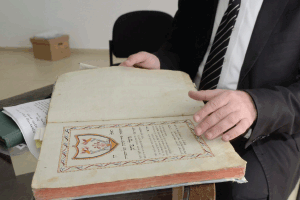 Who knew?
Certainly not Yossi Goldstein a resident of Kiryat Ono. All he knew was that his father had inherited an interesting record of their family’s history which was inscribed at the back of an old leather-bound book. He had no idea that the book itself might be worth tens of thousands of dollars.
The book had come from Bacau a city then located in Moldavia Romania in which Jews began to settle in the late 1700s. During the 1800s the time when Yossi’s great-great-grandfather a tailor was plying his needle the city had everything that a flourishing Jewish kehillah needed. In addition to shuls and a Talmud Torah there was a chevra kaddisha chevra Mishnayos and chevra gemilus chasadim. There were also artisans’ guilds such as the one that Yossi’s ancestor belonged to the Po’alei Tzedek Tailors’ Association.
Each of these groups recorded their rules and regulations in a book called a pinkas. In 1832 the year the Tailors’ Association was founded Yossi’s great-great-grandfather proudly signed his name in the impressive book along withBacau’s other tailors.
“His name is second on the list right after the gabbai” says Yossi. “Apparently he was in charge of taking care of the book which is why it stayed in our family’s possession. He gave the pinkas to his son the grandfather of my father.”
By the late 1800s anti-Semitism was on the rise in Romaniaand Yossi’s great-grandfather decided to move his family of eight children to Eretz Yisrael. He was 52 years old at the time and one of the things he brought to his new home in Petach Tikvah was a memento from the past: the pinkas.
“I didn’t know about it while I was growing up” says Yossi “because my uncle had the book in his house. But after my uncle passed away my father inherited it and he showed it to me. At the back of the book my relatives had written down records pertaining to our family — births and marriages and things like that. My great-grandfather also wrote his will on one of the pages. But I didn’t understand what the rest of the book was.”
That changed when a relative decided to write a family history.
To read the rest of this story please buy this issue of Mishpacha or sign up for a weekly subscription
Oops! We could not locate your form.
