
Changing of the Guard
| September 13, 2022Seventy years after she inherited the throne, Queen Elizabeth II’s passing has left millions in mourning

Photos: AP Images
With reporting by Y. Davis
A
few days after King George VI’s sudden passing in 1952, a young Queen Elizabeth met her prime minister, Winston Churchill, for the first time since inheriting the throne.
By then well into his eighth decade, Churchill had been returned to power the year before, on a wave of nostalgia for his wartime leadership.
The meeting between the old bulldog and the 25-year-old mother of two was a collision of worlds. On the one hand, a crusty old warrior, every inch the Victorian imperialist; on the other the fragile, inexperienced leader of a country groaning under the weight of its own decline.
Which is why, the story goes, when Churchill saw the new monarch for the first time, he broke down in tears.
“But she’s just a child,” he said.
Seven decades, 15 prime ministers, and 13 US presidents later, that “child queen” had become a global icon, perhaps the most famous face on Earth. The passing last week of a woman who’d witnessed the dismantling of her world empire left Britain — and many across the world — in genuine mourning.
Across Britain’s solidly middle-class Jewish community — including the chareidi sector — royalism and an accompanying sense of loss at the queen’s death run deep.
Although Britain is a liberal democracy, the monarchy is a part of everyday life, and the country will need to adapt to the practical changes, as well as the personal ones, that will now take effect.
Suddenly, anything relating to “Her Majesty” — the government, the tax department, passports, the national anthem — now changes to “His Majesty.” Instead of the queen opening Parliament, it will now be the “king and queen consort.” Barristers with the title QC (Queen’s Counsel) will now become KC. Facts of life that were taken for granted for 70 years have changed overnight.
As the world witnesses the somber pomp and ceremony that mark the changing of the guards at the pinnacle of the British state, with the ascent of King Charles III to the throne, many wonder what was the queen’s secret: a woman who personified regal distance, yet combined it with a sense of familiarity to become a mother figure to modern Britain.
It was left to former prime minister Boris Johnson — whose last meeting with the queen had been days before her death — to speak for many about the “familial” sense of loss experienced by so many.
“She’s always been there,” he said emotionally, “a changeless human reference point in British life.”

Rock of Stability
Had events run their natural course, Elizabeth would never have become queen. Born Princess Elizabeth of York in Mayfair on April 21, 1926, she had a quiet aristocratic upbringing. Her uncle, Edward VIII, occupied the throne, and for Elizabeth, thoughts of becoming queen could not have been further from her mind.
However, after ruling for less than one year, her uncle became the first English monarch to voluntarily abdicate the throne after the British government and the Church of England condemned his decision to marry a divorcée. This unprecedented turn of events would forever alter Elizabeth’s life.
With the mantle of royalty passed to the queen’s father, King George VI, Elizabeth was now heiress to the throne. Her father was a quiet person who struggled with a speech impediment and was reluctant to accept the role. He nonetheless guided the country through the turbulent war years, during which Buckingham Palace would take a direct hit from a German rocket.
For Elizabeth, the role came quicker than she expected. The queen was on a honeymoon tour in Kenya in 1952 with her new husband, Prince Philip, when the news arrived that her ailing father, the king, had died. At the tender young age of 25, she returned to London, descending the aircraft steps bedecked in black, to mourn her loss — and accept her new role.
In 1947, five years before she ascended the throne, she delivered a radio address from Cape Town to the Commonwealth in which her young voice could be heard through static.
“I declare before you all that my whole life, whether it be long or short, shall be devoted to your service,” she said in her distinctive Queen’s English.
And the consensus is that she succeeded. Even among some republicans, who would like to do away with the monarchy, there is a vast well of support and respect for the queen and what she represented. In the words of one commentator, “She is the glue holding it all together.”
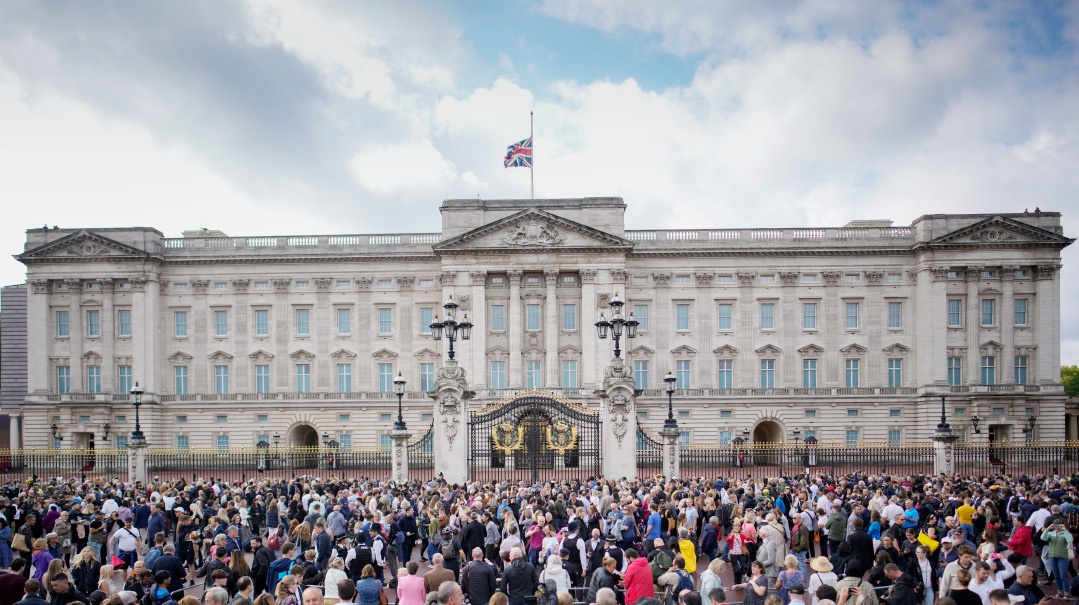
The unprecedented scenes her death has spawned prove as much. Seasoned broadcasters broke down in tears on air. Mounds of flowers filled the areas outside royal residences. In a liberal meritocracy in 2022, throngs paid their last respects to a 96-year-old woman who lived a life of inherited privilege, but through impeccable execution of her duties, was the lynchpin of the United Kingdom.
Ex-PM Boris Johnson, not a man easily moved, revealed that the BBC asked him a few months ago to speak about the queen in the past tense (presumably in preparation for her passing), but he became choked with emotion, and was unable to finish.
“She was universally admired and respected, and utterly selfless,” comments Rabbi Dov Oppenheimer, a longtime communal activist who met the queen when she visited Gateshead during the Millennium celebrations. “She gave of herself to her country, repeating over and over that her life was dedicated to service and serving her people.”
For British Jews, who say a tefillah in shul for the royal family every Shabbos morning after leining, the queen has represented a true malchus shel chesed, and the affection for her is real.
David Hirsh, chief executive of the London Centre for the Study of Contemporary Antisemitism, has told of how his mother, who arrived as a refugee from Nazi Germany when she was eight, viewed the queen as embodying the nation that had opened its doors to her and allowed her to put down roots and build a family. “This is a common experience among immigrant communities in Britain. For many, Queen Elizabeth symbolizes the country where they found refuge, freedom, and the opportunity to make new and successful lives.”
This respect and affection also extended to heimish, more insular parts of the community. Rabbi Avrohom Pinter ztz’’l invited her on more than one occasion to Yesodei Hatorah School in Stamford Hill, and brought pupils to see the queen during her walkabouts, during which they presented her with flowers. One of the Satmar schools in Manchester sent her congratulations on the occasion of her Diamond Jubilee in 2012. In the exclusively chareidi kehillah of Gateshead, schools celebrated her Platinum Jubilee in June.
In an age of irreverence, when concepts like restraint and modesty are considered outdated, the queen’s conduct earned her the respect of the Jewish community, where these values are held dear.
“The fact that she has been a staunch loyal friend of her Jewish subjects and communities is something we are profoundly grateful for,” says Rabbi YY Rubinstein.
Rabbi Rubinstein felt the queen’s admiration for him when she once visited the Manchester community. At the time, Rabbi Rubinstein was a regular contributor to BBC radio programs on the topic of religion.
During her tour, the queen asked the president of the community, “Is Rabbi YY here?”
The surprised president responded, “No, he isn’t, ma’am.”
“Oh, what a pity,” said the queen, “we listen to him all the time on the radio, and we think he’s awfully good.”

END OF AN ERA The Queen’s final journey from her Balmoral, Scotland home
Yes, Your Honor
One person who frequented the queen’s events was Rabbi Lord Immanuel Jacobovits, chief rabbi of the UK. Together with his wife, Lady Amelie, they were clear favorites of the queen, who once invited them for an overnight stay at Windsor Castle.
On arrival, a butler took their cases to their rooms, and Lord and Lady Jacobovits were escorted to another part of the building. Later, when they were shown their quarters (two separate bedrooms with an adjoining bathroom), they found that the staff had unpacked all of their cases. Coins had been lined up on a shelf in the correct order, with the queen’s head facing upward, and there was even toothpaste sitting prepared on the toothbrush. Amusingly, Lord Jacobovits’s tallis had been placed on his wife’s bed.
“They thought it was a lady’s shawl,” says a family member with a chuckle. “The high regard shown by the Palace for their religious requirements highlights the queen’s respect for the Jewish faith.”
Lord Jacobovits had been concerned about kashrus during his stay at Windsor and before attending royal banquets at Buckingham Palace, he wanted to ensure that the food was on an acceptable standard — but without making too much of a fuss about it.
“When they got there, they were astounded to see that the Palace had bought all new keilim and dishes! And the Palace had imitated the general menu with identical kosher food. My parents were so touched by the tremendous respect shown by the queen.”
Lord Michael Levy, a longstanding Jewish parliamentarian, met the queen of a number of occasions, including at state banquets.
“Her depth of knowledge with everything going on was amazing,” says Lord Levy. “The fact that she ensured that kosher meals were provided for Lady Levy and myself shows the warm respect and esteem she had for the Jewish community.”
“She was very respectful of everybody and genuinely cared for people,” says Mrs. Via Salomon, who accompanied her late husband Ezriel (brother of Rav Mattisyahu) to receive an award from the queen in 2010 in Buckingham Palace.
Mr. Salomon had sent a respectful request ahead of the event that the queen refrain from the traditional handshake, and she acceded. She also allowed him to make the brachah made on seeing a reigning monarch.
During the Manchester stop on the queen’s 2002 Golden Jubilee tour of the UK, she specifically requested to be introduced to a Jewish scribe. Dr. Mechel Haffner, a dentist who dabbles in safrus, was assigned the job — and was allotted precisely four minutes for his presentation of various sifrei Torah, tefillin, and mezuzos.
To the dismay of her staff, the queen became absorbed in the presentation, spending over ten minutes listening with genuine interest about the klaf and the text, even asking about the tagin (small crowns) above some letters.
“It was a profound experience and great honor, during which she showed her genuine respect for the Jewish religion,” says Dr. Haffner. “There was nothing superficial about it. She brought with her a tremendous presence and grace.”
Rebbetzin Ehrentreu, wife of Dayan Chanoch Ehrentreu (head of the London Beis Din), remembers when they were invited to a dinner and overnight stay in honor of the queen’s 60th birthday.
“In advance of the visit they told us exactly how to behave,” she remembers. “We had to address her as ‘ma’am,’ not ‘Your Majesty,’ and we were instructed to curtsy when seeing her.”
After she sat next to the queen for dinner, they chatted, and with the wedding of her own daughter approaching, the Rebbetzin decided to gift the queen with a silver chuppah, under which stood a miniature chassan and kallah.
“I remember, as we were leaving the Palace,” she concludes, “my husband quoted the Gemara that seeing the trappings of earthly monarchy gives us an inkling of Hashem’s true glory and kingship. We saw the ultimate in royalty, ceremony, and kavod. Just imagine what it’ll be like when Hashem’s full glory is revealed.”

The then-Prince of Wales with Stamford Hill community leader Rabbi Avraham Pinter z”l
Dedicated to Service
The queen’s coronation in Westminster Abbey in 1952 was the first service to be televised, and 32 million people in the UK (out of the 36 million population) viewed it, with 11 million tuning in on the radio. She became queen of not only the United Kingdom, but of 14 other nations and also Head of the Commonwealth, a group of former British colonies. Her face also featured on every bank note, coin and postage stamp.
She had only been married a few years and Prince Charles was but a toddler, but that point irrevocably transformed her life. As head of state, she was at the center of political life, but remained above party politics, a tightrope she walked impeccably for seven decades as she signed off laws, opened parliamentary sessions, and appointed prime ministers.
Her impartiality earned her the respect of politicians of all persuasions. In a special session of Parliament on Friday, tributes came from all corners of the House of Commons, from Prime Minister Liz Truss to former opposition Leader and socialist crank Jeremy Corbyn, from ardent Irish Unionist Jeffrey Donaldson to voluble Scottish Nationalist Ian Blackford.
The queen was well-versed in all aspects of current government policy as well as in the politics of Westminster. It was the job of a senior whip to update her in writing on all government matters, including political gossip, which she very much enjoyed, and she was always “formidably briefed,” former deputy prime minister David Lidington told Times Radio.
One of her duties was a weekly audience with the prime minister. These hardened politicians drew on her wisdom and impartiality, and, in her later years, her vast reservoir of experience. Tony Blair said that there wasn’t a single PM who wouldn’t come out of that audience feeling two inches taller. Prime ministers recalled that she would listen with keen attention and her perceptive questions would often help them straighten out matters in their own mind.
To the public, she was a constant who was there whenever duty demanded it. At national celebrations, she made the country feel proud, and at national tragedies, she provided comfort and solace. She opened the 2012 Olympics, visited the survivors of the 2017 Grenfell Tower fire that killed 72, and addressed the nation in April 2020 at the height of the Covid pandemic.
Despite her prominence, the queen never once gave an interview, and the royal family were fiercely protective of their privacy. The Telegraph’s Camilla Tominey, who covered royal affairs before moving to politics, told the Spectator she was incredulous at the contrast between politicians who continually fed stories to the media and the royal family, who rarely deigned to drop a few crumbs of information to a hungry press.
Her life was marred by difficulty, too. The year 1992, which she called an “annus horribilis,” saw the collapse of three of her children’s marriages, as well as a fire at Windsor Castle that caused extensive damage. In 1997, the death of Princess Diana in a Paris road tunnel shook the royal family and the country. She would also live through the deaths of her younger sister Margaret and her mother (the Queen Mother) in 2002. But in that same year, she celebrated her Golden Jubilee, marking 50 years on the throne.
With the famous British “stiff upper lip,” she invariably wore a face on which emotion — or her opinion on matters — was difficult to discern, with the media and public always struggling to detect the slightest hint of what the famously neutral queen might have been thinking at any given time or event.

Brand Britain
The queen was a representative of Britain and boosted its global brand. Her down-to-earth demeanor and duty-bound restraint were symbols of ”Britishness.” Buckingham Palace and Changing of the Guards attracted millions of tourists, who found the traditions quaint and the splendor impressive. She charmed diplomats and dictators alike, and the tributes that have poured in from around the world since her death are testament to the respect she commanded among global leaders, from Vladimir Putin to Joe Biden.
She became the only woman to ever drive the king of Saudi Arabia when he visited her Scottish vacation estate at Balmoral, a fact the queen delighted in.
Having overseen the demise of the Empire, she invested huge personal capital into establishing the Commonwealth and maintaining its relevance as a source of soft power, and the bloc owes its existence today to her.
In 2015, aged 89, she became the longest-reigning monarch, surpassing the reign of her great-great-grandmother Queen Victoria — and showing no signs of slowing down. The first hints of any difficulty came last October, when, in a rare move, the 95-year-old workaholic monarch canceled her appearance at a UN climate conference.
It represented a turning point after seven decades of relentless service, but clearly the queen needed to rest. As one royal watcher said, “Clearly at 95, there are limits.”
The countrywide Platinum Jubilee celebrations this summer saw a frail but smiling queen appear on the famous Buckingham Palace balcony enjoying the cheers of the adoring crowds and iconic Red Arrows fly past. Apart from that, she avoided public work, delegating to her children and grandchildren.
For King and Country
News of the queen’s death on Thursday sparked a rare change in nusach hatefillah in British shuls, whose gabbaim scrambled to ensure that the prayer for the monarchy recited every Shabbos morning would be correctly updated to reflect the new reality.
Semantics aside, the United Kingdom has undoubtedly served as a malchus shel chesed for Jews throughout the queen’s reign. Religious freedoms have been protected and Jews have found success, integrated, and prospered. Has the queen’s influence played a significant role in ensuring that continuity?
“Absolutely,” says Rabbi YY Rubinstein. “I feel that it’s because of the affection she’s shown to the Jewish community that Jews have felt safe here. All it needs is a tiny hint of something negative towards Yidden for animosity to grow and become very nasty. But for the entirety of her life, Her Majesty has shown only the warmest regard for the community.”
But it wasn’t always this way. A thousand years ago, King Edward I presided over the expulsion of the Jews from England, the culmination of over 200 years of increasing anti-Semitism that included the massacre of Jews in York Castle in 1190, among them some Baalei Tosafos.
During this period of transition, the well-established Jewish community will hope that the new king shows the same warmth that his mother did. In contrast to his mother’s calculated approach, the new king has a reputation for being his father’s son, more forthright and outspoken, his off-the-cuff remarks often raising eyebrows. But unlike his mother, he has come to Israel, to visit the gravesite of his grandmother Princess Alice of Battenberg, who was honored as a Righteous Gentile for hiding a Jewish family in her home in Athens during the Nazi occupation.
The visit by Charles’s son Prince William in 2018 to Israel overturned a de facto British policy that no state visit would be made until the resolution of the Israeli-Palestinian conflict. Although then-Prince Charles attended the funerals of Yitzchak Rabin in 1995 and Shimon Peres in 2016, no official visit had been made since the end of the British Mandate in 1948. In another departure from decades of tradition, Charles accepted the Israeli government’s invitation in 2019 to attend the 75th anniversary of the liberation of Auschwitz-Birkenau.
He is also patron of a number of Anglo-Jewish charities.
King Charles III was a great admirer of the late Lord Jonathan Sacks, and when the latter died in November 2020, he penned an uncharacteristically emotional tribute to him for Jewish News, highlighting the late chief rabbi’s intellect, character, and influence he had as a religious leader on the wider country.
Shimon Cohen, a PR professional who works closely with the government on issues, says the king has every admiration for the Jewish community. “On each and every occasion that I’ve met Charles, he’s warm and engaged, interested. In our new king, our community has a great friend.”
In a 2019 Chanukah reception for Jewish community leaders, Charles expressed his gratitude for the weekly prayer for the welfare of the queen and her family, saying he was deeply touched.
Dayan Ivan Binstock, rabbi of St. John’s Wood Synagogue in London, has hosted the new king numerous times in his shul for various memorial events and special occasions, and says, “Through his contacts with the Jewish community, Charles has deepened his appreciation for what we stand for.”
Earlier this year, the then-prince showed his affinity for Holocaust survivors, commissioning seven artists to paint portraits of seven survivors, in a tribute to their passing generation. He spent time with each one, hearing their experiences and stories, and the portraits are now part of a permanent exhibition at Buckingham Palace.
As the nation mourns, the new king is already out and about. On Saturday evening, his car stopped on its way to Buckingham Palace and he and Camilla, the queen consort, got out to greet some of the many well-wishers who lined the road down from Buckingham Palace. Amid shouts of “G-d Save the King,” he and his wife accepted bunches of flowers and handshakes.
With the enormous state funeral to be held next week, replete with the best in pomp that Britain can offer, and attended by presidents, prime ministers, and heads of state from around the globe, the royal family will look to their mother for an example of unwavering devotion to public service.
(Originally featured in Mishpacha, Issue 928)
Oops! We could not locate your form.
RELATED CONTENT


Without stricter oversight, America could begin to look as unrecognizable as Europe


With year one of his second term under his belt, Trump faces daunting challenges in 2026

The prime minister is being selective with his words and careful in choosing his battles

The multifront struggle between the conservative right-wing coalition and the liberal camp
