Family Story: Peeling the Layers
| April 2, 2014I run to my car, speed through the streets. And I bargain for my child’s life. Please. Please. Please, Hashem, not my child
It’s just a regular Monday morning: the usual flurry of lunch bags and kisses and lost shoes. With my gleaming, space-age, newly Pesachdig kitchen winking in the background, I’m particularly eager to get the kids off to school. Finally, finally, the schlepping, shopping, scrubbing, and kashering is done. As soon as the kids are off and the baby settled, I can start on the task I love most: cooking.
I get the kids out the door and take a moment for a cup of coffee while I consider what dishes to begin with. I revel in this — the creativity, the ability to nourish, to surprise my guests and delight my family with every bite. And family is a prominent theme this Yom Tov — my mother is arriving tonight on a flight from Eretz Yisrael, and my brother and his family are coming all the way from New Mexico — it’s been years since we were together, and the excitement tingles.
I tuck in the baby for her nap, roll up my sleeves, and the phone rings. It’s my five-year-old Yerachmiel’s school on the line. As I say hello, I hope that my little one hasn’t been sent to the office (who knew that Pre-K could be so tough?!).
Yerachmiel’s teacher tells me that he’s not himself, he threw up, and can I come and get him? No problem. “Plans change,” I tell my baby as I lift her up from her nap and strap her into the car seat. At school, I bend down to my little man and kiss his forehead. It’s cool. That’s a good sign, I tell myself. Still, he’s so tired that the teacher has to carry him out to the car for me.
He climbs into his seat. “My head hurts,” he says. I take another look. He really does look nauseous — why did I send pizza for a snack? — and he rubs his head. “It hurts,” he says. Mother’s instinct makes me grab a bag and push it in front of his face. He is promptly sick again.
Back home, Yerachmiel tells me that he just wants to rest. Good plan, I say, and I place him not in his own bed — the upper bunk — but in his brother’s bed where I can reach him in case he needs help. Yerachmiel is annoyed at the change, but the baby is cranky and I throw him a few soothing words before going out to deal with her. When I’m done, I check up on Yerachmiel again.
Ugh. He was sick again, and he was so tired that he must have fallen right back asleep. If I think of all the Pesach cooking I was going to get done today, I’ll only get frustrated, so I firmly shelve my plans. I wake my little boy and clean him up, trying to keep calm although he’s crying and the baby’s screaming. I shower him down and put on some warm pajamas. As I put my arms around him, he crumples into them. I lay him down on the bathroom floor and he closes his eyes. When I move him, he moans that he just wants to sleep.
This isn’t right. I lay him down in bed and reach for the phone to call the doctor. He talks about fluids and keeping him hydrated — I’m a mother, I know this stuff, but something still nags at me. I throw the dirty linens into the machine and call my husband.
Talking to him, I realize how illogical I sound. “I want you to take Yerachmiel to the ER.”
I wonder at myself. My husband started this job only a few months ago. Not the kind of time frame in which he wants to drop everything and run home because his wife is panicking.
“Flu is flu,” he protests. “Just let him sleep it off.”
“I need you to take him now,” I say.
My husband arrives home and scoops up the limp little figure from his bed. I trail after him, tucking in a blanket around him and helping my husband strap him into the car seat.
“Take him to the Children’s Hospital,” I say. They’re the best. Why do I want the best pediatric hospital in the area for a child with stomach flu?
I don’t know. But watching him drive away and tending to the baby and welcoming the rest of the clan home from school (what in the world do I serve for supper?), means that I don’t have time to think about it. I also wonder how I’ll get hold of my mother when she lands in a few hours’ time.
The ringing phone cuts through my thoughts. I check the caller ID. It’s my husband. I pick up, fast. “Hi.” He says. There’s something tight in his voice. “The doctors think you should come,” he says. He’s trying very hard to keep his words clear and steady and calm.
But in the microseconds it takes me to absorb his words, I feel the layers of my life peeling away and away and away. I sprint across the street and pound on my neighbor’s door, asking her to take care of my kids — and to pray. Plans, lists, menus… all forgotten. The layers keep peeling away.
I run to my car, speed through the streets. And I bargain for my child’s life. Please. Please. Please, Hashem, not my child. Don’t take my child away from me. I’m not that strong.
Besides, Hashem, I say as I drive down the highway, I’ve been through some stuff. I’m a BT, remember? You can’t take my son away from me.
Even as I say the words, I realize how flawed they are. Yerachmiel isn’t mine. He’s a gift. There: another layer gone.
I arrive at the hospital and run into the ER. I’m breathless, but even as I pant out my name, the nurse takes me by the arm and pulls me, runs with me down the hallway. “Where’s my baby?” I say, but I realize that the noise that comes out of my mouth is not a question but a wail.
And now I see my son on a gurney, my husband, doctors. He needs surgery right away, they tell me. Where? What?
On his brain.
He is so tiny, so fragile; I kiss his skin and burn the memory of him into my mind. I shake, sob, and I hear my husband ask the doctor: “What are the chances of a full recovery?”
He’s worried about brain damage.
The doctor just looks at us.
And then it hits me. We’re not talking here of brain damage. We’re talking survival.
The doctor has no idea if my little boy will ever make it out of the surgical suite.
We are shepherded to the waiting area. In the waiting area, I pray. I pray and beg and pace. And I wonder, how was it that this morning I woke up and did not daven and beg? How was it that I noticed small annoyances and became flustered by everyday frustrations? The me who woke up this morning seems far away from the person I am now: I am raw, open-wide.
I text my friends, tell them to daven, to pass around the message. I speak to my mother in the airport, tell her to make her own way to our home, to take care of the children for me — and to pray. Time stretches before me in horror and my hands twist and pull.
And then, the doctors appear. The surgery is over. We will be taken to the intensive care unit, we will wait there.
But he is with us. He is still with us. Thank You, Hashem. Thank You.
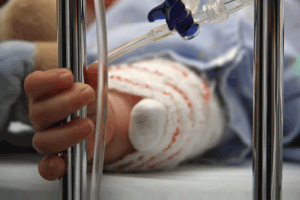
I have no idea what to expect as I walk into intensive care. A huge bed sits in the center of the room surrounded by numerous machines. Yerachmiel’s tiny body is dwarfed by the apparatus that pulls at him from every limb. I watch the rise and fall of his chest, and although I know that the breathing is thanks to the respirator, the movement is still a comfort. Tubes snake out of him: one drains liquid from his brain, another breathes for him, into his arm drip fluid, sedatives, antibiotics, anticonvulsants, morphine. All of this in a wisp of a boy.
The next 24–72 hours are critical, the doctors tell us. There is a chance of a second, more dangerous bleed. So foreign just a few minutes before, the room quickly becomes my world. Time is not measured by hours or minutes, but by shift changes, by vitals being checked, by two-hourly examinations, where Yerachmiel is prodded and poked and his bag is leveled to 15 degrees from the tragus.
We whisper to him, stroke his hands and face. I feel him fight against the drugs. I talk to him and he opens his eyes. The doctor increases the sedative.
In between watching him and talking to doctors, we daven. The tears burn and flow and burn. There’s no hiding from ourselves, from our little boy, from G-d. Tatte in Heaven, have mercy on us, please.
The doctor from ER comes up to see us. He has tears in his eyes when he looks at Yerachmiel and tells us that most kids like this don’t even make it to the hospital. Just hearing those words makes me want to shout dayeinu: Though pain and grief tumble over each other, so does an overwhelming feeling of gratitude that we have made it thus far.
We wade through tests: MRIs, angiograms, trying to detect and measure the damage, trying to discern why it happened, and how treatment should proceed. The next 48 hours are a blur of medical teams, all with titles, names, specialties.
I watch Yerachmiel all the time: Every few hours, as the sedative starts to wear away, he can harm himself, yank at the tubes. I am entirely present each moment — this very second is my mission and the reason I am here. I watch, guard, and pray, and then I move on to the next moment, and the next. And all the time, I feel Hashem with us. As well, I feel the community’s prayers and love accompanying us. A new sense of connectedness fills me and I understand something I should have always known: Yerachmiel is the child of us all.
For the first time in my life I feel connected to sefer Tehillim. My tongue has long felt thick and clumsy with the unfamiliar words and the difficult syntax; I have long felt unfeminine in my lack of kinship to Tehillim. And just like that, it all changes. The words dig deep into my heart, lifting my very being upward toward Hashem.
Miraculously, the test results all come back better than we had dared hope. The doctors have theories, explanations, but no real understanding. So, they focus on pushing forward his recovery. By Wednesday, they decide to allow the sedation to wear off and remove Yerachmiel’s breathing tube. This is a huge step, and the entire team must be present, “Just in case… ”
Although the procedure is scheduled for noon, other emergencies delay the moment I wait and pray for. At last, the team gathers around the bed. The sedative is removed and I am asked to rouse him. I lean over his unconscious body, stroke his cheek. “Yerachmiel,” I whisper, wondering that the noise of my beating heart isn’t enough to wake him. Under my palm, I feel something quickening. Is he returning to consciousness? He struggles to open his eyes; his eyelids flutter and flicker.
Fast, so fast, the doctors lean over him and I step back. They pull out the breathing tube, the whole endlessly long length of it, and suction repeatedly to prevent pneumonia. Yerachmiel’s arms and hands are tied down for his safety, but he arches his back and swings his head forward. The bag! The bag draining fluid from his head must be kept at 15 degrees! The fluid turns brighter and brighter pink and we quickly level it. He is heavy from the sedative and he fights it. I try to soothe him, calm him with soft words. He moves his lips. What’s he trying to say? A hoarse, faint whisper. Say it again, Yerachmiel!
“Get off of me!”
I laugh out loud. Such sweet, blessed words! My very own ornery little man. I shed hot tears of joy and thank Hashem for our miracle, revealed and open before our eyes.
Soon enough, euphoria mingles with dismay at his discomfort. He is hot. He is cold. He is itchy, itchy, itchy. He pulls at the head tube — no! He pulls at the IV. He is thirsty. He is hungry. We give him a tiny sip of apple juice and he throws up. The neuro doctor comes around. “What’s your name?” he asks Yerachmiel.
“Mickey Mouse,” comes the reply in his sharp, high-pitched voice.
Dayeinu, I sing inside. Our child has come back from the dead with his sense of humor intact. Every piece of him is a miracle and a blessing and more than we ever dared hoped for — dayeinu. And yet, every movement is excruciating and takes superhuman strength. Every question drains him; every touch is a burn from which he recoils. Pain is everywhere and everything.
I want to take his pain and make it my own, to see his hunched shoulders relax. I feel more drained than I have since the beginning of the ordeal, and I can’t help but cry. The nurses tell me to go home for an hour or two, see my other children, my baby. They need me, too, the nurses tell me.
But this tiny room has become my whole world and the outside is frightening, strange. My husband urges me and, with him at Yerachmiel’s side, I return home. The short visit is a rush of sweetness. My baby’s innocent, oblivious joy and love are a balm, giving me the strength to return to the hospital.
Slowly, we see Yerachmiel’s functions return. It’s time to move him from intensive care to the regular children’s ward. I say goodbye to the nurses, embracing them. I’ve known them only a few days but they journeyed with me to the netherworld and I am so grateful for their dedication and care.
After the quiet and focus of ICU, the children’s ward is overwhelming. It’s cramped, noisy; there’s no team surveying every breath, every vital sign. But I tell myself we can manage, that as long as I am present to care for Yerachmiel and watch him, he’ll be okay.
The difficulty, though, is compounded by Yerachmiel’s emotional state. He is forlorn, he is in pain, and he refuses to acknowledge most of the nurses and doctors. When they ask him a question, he simply waves his hand and says, “Blah, blah blah.” I apologize, but he is not an easy patient. He can’t be tempted out of bed: not by the activity room, the clowns, the magic show, not for any of the incentives we offer him. He lies there. “My legs are killing me,” is all that he’ll say.
Seeing him so debilitated, I wonder at the degree of pain he is in. His pain threshold has always been high — when he got five stitches over his eyebrow, he didn’t wince. He boasted that he loves shots. And yet, the physical therapists can’t get him to move. When I force him to take a few steps, he is livid. He blames me for his pain and I am left on a lonely island of miracles. I’m so helpless, so needed, so abused, so grateful, and so humbled all at the same time.
By the time the fourth physical therapist walks in, I am done for. “I need a break,” I tell her and apologize in advance: “He’s not an easy patient. I’m sorry.” I walk down the hallway, take a few breaths and, before I know it, I return. I cuddle him, reach for Curious George and start the book again.
Every aspect of life has become traumatic: eating, drinking, sleeping. Yerachmiel needs regular MRIs and I hold on to him even as he slides into the tube. I sing every lullaby I can remember in an effort to soothe him.
Despite the difficulty of the procedure, the results are good. The doctors are ready to clamp the tube that drains blood from his brain, although they continue to monitor how his brain and body will manage the pressure.
Erev Pesach. My husband takes over at the hospital while I run home to shower, see the family, the children, and my baby. In the kitchen, I’m overwhelmed by the vast quantities of food — while I have been ensconced in the hospital, the women of the community have been chopping and stirring and sautéing in their kitchens, and have sent us enough delicious food to feed a small army.
Still, I can’t help but put up a pot of chicken soup. There is something comforting about the menial tasks involved: peeling carrots, chopping onions, washing chicken, measuring salt. As well, I will be gone for Yom Tov and I want my family to have a piece of me with them.
But even as I savor my children’s hugs and smiles and endless questions, even as I throw Shabbos clothing and supplies into a large bag, my husband keeps me updated with Yerachmiel’s progress. They’ve dilated his eyes and woken him up to perform yet another MRI. He is kicking and screaming for his life.
The nurse has the chutzpah to tell our son and my husband that he is “not a nice boy.” I try not to let the report bother me, but it is hurtful to feel that I need to defend my child as he is struggling for his life.
That night, I sit beside him and conduct a Seder. We use the Haggadah that he made in school, which a wonderfully thoughtful morah dropped off at the hospital. Although the surroundings are sparse, although it is just the two of us, with no silver or crystal, no starched shirts or new clothing, the words leap and bound around me. In a wonderful instance of Hashgachah, we have a room to ourselves, so we sing Dayeinu at the top of our voices. For the first time, Yerachmiel looks happy. I march around the room with matzah on my back, telling him that we’re going out of Egypt, and though the sand and the heat and the desert are far, far away, the essence is true. We are, together, leaving Egypt. We finish the Seder in an ecstasy of joy and hope.
At midnight, though, the peace is broken. Another child is wheeled into our room and sleep then eludes us. As well, the scheduled MRI means that Yerachmiel has to fast and I can offer him no drink or treat to placate him. When they come for us in the morning, I have to slip in to Yerachmiel’s wheelchair and hold him on my lap to stop him from arching his back and trying to escape. When we arrive, they are forced to sedate him to perform the test.
Arriving back in our hospital room, we find our roommate eating McDonald’s. “It stinks,” Yerachmiel complains.
“Let’s go for a walk,” I suggest.
But although the doctors have told us that we must walk at least four or five times a day, it is a struggle to get Yerachmiel up and out of the bed even twice. I massage Yerachmiel’s legs over and over, and he relaxes. I relax too — at last I am doing something right. Aren’t we mothers meant to intuitively understand our children’s needs? But so often they elude us and we don’t know what to do or how to do it. I am left feeling helpless and incompetent.
My husband walks over to the hospital; I eat some cold salmon and try to remind myself that it’s Yom Tov. I’m so glad of his support, because the nurses come inside to check him and Yerachmiel is surly and uncooperative. Nothing they can say or do will calm him. Every time anyone touches him, he kicks and cries. He believes that the whole world has turned against him — he thinks they are all trying to hurt him, and no longer trusts anyone. It is crushing to see my own child lose confidence in the world, and I know it will be my job to restore it.
A few days later, Yerachmiel’s condition has improved enough for him to come home. I am dizzy with excitement and trepidation at the thought of leaving, of returning to our family. As I pack up the endless paraphernalia that has accumulated during our stay, and listen again and again to the doctors’ and nurses’ instructions, I wonder at it all, at the miracle of my son.
Ten days ago his eyes and body were nonresponsive to light and pain. Ten days ago the pressure in his brain almost killed him. Ten days ago our lives changed forever and I am still figuring out how. Today my beautiful boy is smiling and he is as sharp as he ever was. Today he is alive and laughing and growing. Today my family is whole and yet changed and will never be the same.
In an instant, the pieces of my life were scattered, thrown up into the sky. They have descended and started to settle, locking into place. But the picture is different from that which I remember. Or maybe this picture — with its porcelain fragility — was always the picture. Maybe what I saw until now was a mere illusion, put there to distract me from the essence and truth, so that I could wake up and think that any Monday morning could be normal.
(Originally featured in Family First, Issue 386)
Oops! We could not locate your form.
