In Search of the Perfect Esrog
| September 11, 2013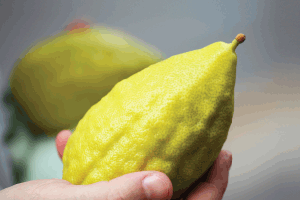 One day in the summer of 1935 the Chazon Ish went for a walk in the orchards of Tzfas. He had decided to summer in the cooler northern climes of Eretz Yisrael for health reasons but his active mind and wide pursuit of interests allowed not even a minute of idle time. He therefore set out to solve a centuries-old halachic problem.
By the time he arrived in Eretz Yisrael two years earlier in 1933 at the age of 57 nearly every halachic authority considered the esrogim grown there suspect. In the years prior to World War II many major growers openly admitted to grafting their esrogim to create a more attractive fruit. That practice made them pasul. The idea that Jews in Eretz Yisrael and elsewhere were using nonkosher esrogim appalled the Chazon Ish so he undertook to rediscover the strain of kosher esrogim that had grown in the area since the time of the kabbalists of Tzfas.
It was believed that the Beis Yosef and the Arizal had planted esrog trees in the fields around Tzfas for personal use. After the passing of these two Torah giants the Ottoman sultan had appropriated that same land and designated it as a royal arboretum. For several centuries this area was off-limits to everyone. Eventually the sultan relinquished the land and the Yidden resumed taking esrogim from the area. Over the years the rabbanim most notably the 19th century chief rabbi of Jerusalem Rav Shmuel Salant sent emissaries to ascertain that the trees located there were indeed pure esrogim with no possibility of harkavah or grafting.
The Chazon Ish studied the local trees and met with local agricultural experts. Initially he believed it was possible to discern if they had been grafted. But according to a letter (printed in Pe’er Hador Vol. II page 132) he wrote a year later he realized there were forms of grafting that he had been unaware of the previous summer and he believed that his findings were no longer valid and so contrary to legend he didn’t popularize these Tzfas esrogim.
Eventually the Chazon Ish turned to rediscovering the esrog already authenticated by Reb Zorach Braverman. Reb Zorach had with the support of Reb Yehoshua Leib Diskin (who moved to Eretz Yisrael in 1878) been selecting esrogim from the area of Shechem. After Reb Zorach’s death in 1938 only limited attempts were made to promote his findings. Reb Yitzchok Kivelevitz had planted a few trees of this strain in his yard in Petach Tikvah but when Reb Yitzchok passed away and the house was sold the trees were forgotten and neglected.
The Chazon Ish returned to Shechem in an attempt to track down the trees that had been authenticated by Rabbi Braverman. The Chazon Ish studied the area and after careful research was thoroughly convinced that he had found those trees. He selected some esrogim from there and for several years sent one of several bochurim to pick an esrog from those trees and bring it to him in Bnei Brak. One of those bochurim was Moshe Deutsch and the other was Michel Yehudah Lefkowitz who would later become the rosh yeshivah of the yeshivah ketanah of Ponovezh.
To read the rest of this story please buy this issue of Mishpacha or sign up for a weekly subscription.
Oops! We could not locate your form.
