Best Seat in the House
| September 2, 2013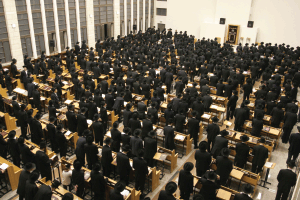 You sort through the pile of directories looking for the one containing your listing. You set aside volume after volume until you find the one you want. Flipping through the pages running your finger down the column of names you finally arrive at yours. You show it to a distinguished-looking man behind the table; he examines the page aims a scanner that flashes a blinding red light across your entry and seconds later there appears a ledger showing all your pertinent details from the previous year.
Is this the Sefer HaZichronos the Book of Remembrances that will be read aloud on Rosh HaShanah in which Hashem has recorded all your deeds? Is that your signature on the account?
Well not exactly. But if you want a seat for Rosh HaShanah davening you might want to get to know that man behind the table.
Shuls yeshivos and batei medrash are employing increasingly sophisticated means of matching mispallelim with seats. It’s a case of technology rising to meet the challenges presented by age-old dilemmas. Some challenges however are ageless and require generous doses of human ingenuity patience and bitachon.
Rabbi Uri Stern the international liaison for Yeshivas Mir in Yerushalayim sets the scene two to three weeks before Rosh HaShanah. In one of the large rooms at the yeshivah tables are lined up in rows and distributed across them are multiple copies of bound directories containing the names of everyone needing a seat for the Yamim Noraim. At four separate designated hours people descend on these books searching for their names. Upon finding his name a student will point it out to a man sitting behind one of these tables who wields a scanner. Flashing the scanner over the bar code adjacent to the name activates a printer which produces a report detailing the bochur’s seating preferences in previous years.
If he’s a new bochur then obviously this information needs to be collected for the first time. So the bochur is subjected to what Rabbi Stern calls the “airline questions.”
“They ask him his name his parents’ names his spouse’s name if he’s married and if he has any friends coming with him ” Reb Uri says. “Then they’ll ask him which beis medrash he wants to daven in [the Mir has three] whether he wants a middle seat or an aisle seat if he wants near the air conditioner or not.… When I was new here and they finished asking me all these questions I said to them ‘And I’d like a kosher meal.’ ”
Gauging the individual’s preferences is of course only half the equation. The other half involves creating the actual place for the person to sit.
To read the rest of this story please buy this issue of Mishpacha or sign up for a weekly subscription.
Oops! We could not locate your form.
