Hagaddah of Survival
| March 13, 2013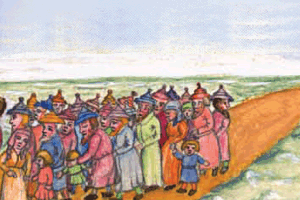 Budapest 1946
The war has ended. The Kahan-Frankl family a prominent family of Budapest Jewry before the war returns to their home — a large building that takes up the better part of a city block and houses a huge library a shul and many sifrei Torah. It is a home that has hosted Europe’s most distinguished rabbis (Rav Akiva Sofer Rav Yosef Tzvi Dushinsky Rav Mordechai Leib Winkler) as well as revered chassidic rebbes such as the Vizhnitzer Rebbe the Belzer Rebbe the Munkaczer Rebbe and the Bobover Rebbe.
The war has left many people without homes or family and the Kahan-Frankl home again becomes the address for people seeking help as well as the epicenter from which community institutions can attempt to revive. There are agunos seeking resolution people looking for lost family members everyone needing to put their lives back together.
Occasionally the family members manage to steal a few minutes of free time. On one occasion Mrs. Fradel Kahan-Frankl and her son Moshe Tzvi decide to seek some distraction by visiting a local museum to see the famous Kaufmann Haggadah an illuminated Haggadah dating from 14th-century Spain. (The misleading name “Kaufmann” refers to David Kaufmann owner of a collection that included the Haggadah.) They are refused permission to view it with a happy consequence: they resolve to recreate their own version of an illuminated Haggadah. Fradel is an accomplished artist who had trained professionally; Moshe Tzvi no small artistic talent himself is also a master scribe.
The two of them undertake to write the Haggadah with Moshe Tzvi as the scribe and his mother as the executor of all the ornamentation from the intricate borders to Biblical miniatures. They work on 12-inch by 24-inch panels creating a thing of color and beauty after so many dark and ugly years of war.
It takes them over a year to complete the project working a little bit each day. Fradel will later remember this as one of the happiest times of her life being able to spend many long peaceful hours together with her son sharing a mutually cherished pursuit. After a war they weren’t sure they’d survive a war during which they’d hidden in bunkers and gone hungry for the crime of being Jews the project of working on a deeply Jewish work of art — not simply Jewish but themed around deliverance from crushing oppression — is particularly meaningful and deeply satisfying.
To read the rest of this story please buy this issue of Mishpacha. To sign up for a weekly subscription click here.
Oops! We could not locate your form.
