Cooked To Order
| June 20, 2012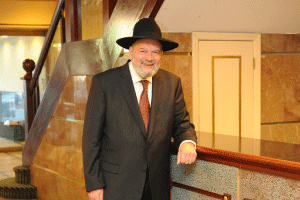 There is an episode on one of the vintage Marvelous Middos Machine albums in which the protagonist is trapped in a time machine and lands at a late 1960s Brooklyn chasunah. In that fictional account vintage 1968 music plays in the background — “Romemu Hashem Romemu” and new hit “Shmelke’s Niggun.” Of course we don’t learn who catered the wedding but if I had to guess … I would choose the Pruzansky Brothers. It just makes sense.
If you only see caterers on the job you imagine them as rushed even frantic. Yet meeting Reb Yosef Pruzansky the veteran owner of Pruzansky Brothers catering I wonder if he’s even capable of stress. He welcomes me with an unhurried air in suspenders and shirtsleeves his demeanor and accent vintage Brooklyn.
“I hope you didn’t come here for nothing” he offers smiling “and that you find this stuff interesting. Listen we’re caterers not writers.”
Like the man himself his story is solidly rooted. It starts with the commitment to authentic Yiddishkeit so rare in the early 1900s. It’s a tale — like so many others — that begins with a father who wouldn’t bow down.
If there was an epicenter of Lithuanian Jewry it was Vilna; it was from there that Reb Binyomin Pruzanky came to the United States a strange country where everyone it seemed worked on Shabbos — the only way to survive. He settled on the Lower East Side and along with a friend Reb Nissen Pilchik refused to accept that sad reality and each week they would lose their jobs. But they had another minhag as well. After being dismissed the two men would drink a l’chayim together rejoicing in their good fortune at being able to give up so much in honor of Shabbos.
“In the Pilchik family” says Reb Yosef “they would refer to my father as a misnaged with a chassidishe neshamah.”
Reb Binyomin was determined to raise ehrliche children despite the surrounding culture and when he met his future wife Miriam Kviat he knew he had found a suitable partner. The problem she confided to him was that she’d once had a medical procedure and she was worried that she couldn’t bear children. Reb Binyomin was unimpressed. “Kinder kumen fuhn di Ribono shel Olam ” he maintained — and he would be proven right seven times.
The Pruzanskys got married in late 1930s at a time when the news from their respective hometowns — Vilna and Slonim — was bleak. “At my parents’ wedding” says Reb Yosef “they sang the niggun of ‘Utzu eitzah v’sufar’ [a niggun of hope and fearlessness in the face of enemy onslaught] for hours on end. It was like a theme song.”
To read the rest of this story please buy this issue of Mishpacha or sign up for a weekly subscription.
Oops! We could not locate your form.
