Role Reversal
| March 7, 2012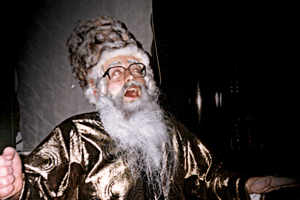 Jewish communities have a time-honored custom to designate a “Purim Rav ” but although most people consider this just a part of the general merrymaking and levity of Purim mystical tradition attaches an elevated significance to the institution. In the eyes of tzaddikim throughout the generations a Purim Rav has the opportunity to perform great wonders from behind his mask.
It is known that the Shpoler Zeideh used to appoint not only a rav but a king a judge sextons and community leaders on Purim and use them all to implement judgments and rescind decrees that would benefit other Jews who were in distress.
The custom is not mentioned in the writings of the Rishonim or the Acharonim and some argue that it has no basis at all. Still many communities won’t forgo the minhag to this day even though surprisingly the source is little understood. People assume a Purim Rav is part of the general merrymaking spirit of “v’nahafoch hu” — a humorous maneuver to take the place of the rabbi. Actually the custom originated for a very practical reason: since it is forbidden to issue a halachic ruling while one is intoxicated the rav of a community would not be able to fulfill the mitzvah of becoming drunk on Purim as long as he retained the responsibility of answering the community’s halachic queries. As a result a minhag developed for the rav to select another talmid chacham to be available to answer questions in his stead. This talmid chacham would refrain from becoming inebriated on Purim or would at least make sure he was sober in time to be available to answer questions. It was only in later years that the institution of Purim Rav lent itself to frivolity — but a Purim Rav is not necessarily a Purim shpiel.
The Imrei Chaim of Vizhnitz related “In Ropshitz Sanz and Dzhikov there was a practice of appointing a Purim Rav but they were prominent individuals and not merely actors.”
Rav Yosef Chaim Sonnenfeld the rav of Yerushalayim used to jokingly call himself a “Purim Rav” throughout the year. When asked what he meant he would respond “You know that there is a custom to appoint a Purim Rav on Purim. Every Jewish minhag has a source in halachah. I feel that the reason for this is that the rav is obligated to become drunk and reach the state of ad d’lo yada. What happens if a question pertaining to kashrus arises at that time and the question is relevant to the Purim feast? Because of this it became customary for another rav to be available to answer sh’eilos when the rav is drunk. In that sense I am a ‘Purim Rav.’ ”
To read the rest of this story please buy this issue of Mishpacha or sign up for a weekly subscription.
Oops! We could not locate your form.
