Snatching History
| February 15, 2012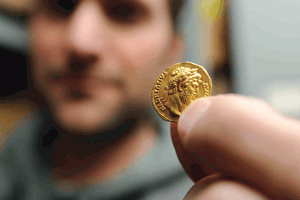 Holding an ancient solid gold coin worth a quarter-million dollars in my hand is a heady feeling — so heady I can almost begin to understand what leads people to steal these things.
I’m standing in a cramped crowded storeroom stuffed with huge cartons. In each of them are priceless antiquities — flint arrowheads bronze daggers mosaics clay jars vases oil lamps and a very very big safe that is full of all kinds of ancient coins. The storeroom belongs to the Israel Antiquities Authority’s Theft Prevention Unit and the antiquities temporarily stored there until their court cases are decided are plunder that the unit’s team has rescued from the hands of looters.
Formed in 1986 following a wave of antiquities looting that triggered calls for government intervention from academics the Theft Prevention Unit has a dual mission: prevent the theft of antiquities from archaeological sites and stop their illegal sale and smuggling.
That beautiful gold coin that I was privileged to hold is a perfect example of what the Theft Prevention Unit is up against. Shai Bar Tura a former New Yorker who is today the deputy director of the Theft Prevention Unit and our host during our visit to the unit’s headquarters — housed in a magnificent building belonging to the Rockefeller Archaeological Museum in East Jerusalem — tells the story.
“In 2007 workers from the Ramleh sewage company were digging a pipeline when they accidentally uncovered a hoard of ancient gold coins — 153 in total. The word spread fast around the nearby village and everyone dived in taking for himself. A middleman in Hevron also heard the news and came down to the village. He offered to pay $2000 for each coin and pretty soon he had 83 coins. He then informed a dealer in Beverly Hills that he had the coins. The dealer was interested in two coins both pure gold and dating from the rule of the Roman emperor Hadrian [76-138 CE] the emperor who fought Bar Kochba. The dealer flew to Israel traveled to Hevron and bought the two coins for $60 000 — which is nothing. One similar coin had recently sold in auction in Europe for $175 000. We got him in Jerusalem. Thanks to intelligence we had been following him from the moment he entered the country. And here are the coins!”
To read the rest of this story please buy this issue of Mishpacha or sign up for a weekly subscription.
Oops! We could not locate your form.
