Are You from Mars?
| January 25, 2012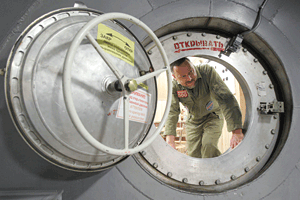 Two months after Chinese astronaut trainer Wang Yue and his five associates emerged from a 520-day lockup to simulate a flight to Mars and back he’s broken the silence of that self-imposed captivity with the release of the book Mars 500:Back from the Field — which his countrymen have grabbed off the shelves in the past week. It took a while for Yue his country’s newest hero to get back to himself after not seeing daylight for a year and a half eating spaceship rations and losing 20 pounds and much of his hair but Yue’s mother has been nursing him back to health with sesame milk and walnut powder.
Yue a 27-year-old graduate of China’s Astronaut Training Center was one of six men who defeated 6000 rivals from 42 countries with the honor of being confined to a capsule the size of a bus for a year and a half. The multinational crew emerged from Moscow’s Mars-500 isolation module blinking and a little shaky on November 4. Mars-500 is one of several experiments being staged around the world in preparation for a trip to Mars that Russia hopes to try in about 25 years.
What could possibly have caused six ordinary healthy sane human beings to voluntarily confine themselves to a series of interconnected metal tubes set up in the parking lot behind a Moscow research facility? What convinced the members of this group to spend 16 consecutive months together without visits from family members without a daily outdoor stroll without a weekend off without even a reduction of their “sentence” for good behavior? As the bleary-eyed crew emerged from their lockup the $15 million Mars-500 project was about to answer one of the big unknowns of deep-space travel: can people stay healthy and sane during a flight to Mars?
What can explain their readiness to survive for 520 consecutive days on a monotonous diet of granola bars canned preserves and recycled water? Throughout this time they breathed recycled air slept on thin foam mattresses washed themselves once a week in a makeshift shower and maintained a daily schedule that consisted of a series of rigorous exhausting physical exercises and an endless list of tasks with no apparent meaning or purpose. Why?
The Russians as it turns out are very curious to know what would happen to a group of cosmonauts during a two-year voyage to the planet Mars and back. Would they lose their sanity from boredom? Would violent altercations erupt over crucial questions such as what time the lights are turned out and whose turn it is to wash the dishes? It will take a projected 250 days to fly to Mars 30 days to investigate the planet and 240 days to return to Earth. Would astronauts be able to survive it?
It isn’t that anyone is actually planning to visit Mars anytime soon. But in Moscow the government prefers to be prepared for any eventuality even those in the realm of science fiction. In order to determine the answers the Russian Federal Space Agency decided to conduct a series of experiments in which human beings would be subjected to conditions that would simulate as much as possible an extended spaceflight.
If the Russians thought it would be a challenge to find human guinea pigs who would agree to sacrifice two years of their lives on a “flight” going nowhere they needn’t have worried. The offices of the space agency were inundated with calls from thousands of potential volunteers from all over the globe. From Brazil from China from Hungary and from Canada numerous competitors vied for the coveted slots. There was no shortage of people who would gladly jump at an opportunity for fame even if it meant that they would have to play the role of imaginary cosmonauts on a mock “spaceship.”
Is there anything that people would not do for a modicum of prestige — or a hundred thousand dollars?
To read the rest of this story please buy this issue of Mishpacha. To sign up for a weekly subscription click here.
Oops! We could not locate your form.
