Awake and Praise!
| January 18, 2012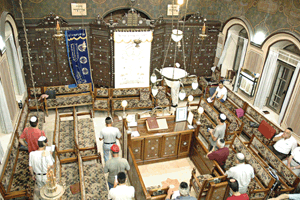
T
he light spills out from the large windows not only illuminating but also inviting. Just ahead of me walks a father with two young children who are gripping his hands. They turn into the courtyard at the corner of Beersheva and Shilo Streets toward the Ades Shul or as the letters across the facade announce “The Great Synagogue Ades of the Glorious Aleppo Community Est. 1901.”
Here 1901 is alive and well even though the people are very 2012.
Each Friday night from Shabbos Bereishis until Shabbos HaGadol a small crowd gathers at three o’clock in the morning — mainly Halabim (Syrians) but also assorted Persians Tunisians and Moroccans — for the weekly minhag of Shirat HaBakashot singing supplications until dawn. They sing according to the custom out of a special book comprised of the liturgy and poetry of the great paytanim including the Ibn Ezra Rav Shlomo Ibn Gabirol Rav Elazar Ezkari Rav Yehuda HaLevi Rav Yisrael Najara and others.
When I was first told of the minhag I imagined it was kept like so many other customs out of respect for the past a sense of obligation. But upon entering the warm room I step back and wipe the last traces of sleep from my eyes: the place is bursting with energy and life.
Brilliant chandeliers and lamps cast a warm glow from the high ceiling; rather than seats there are benches that are covered with colorful fabrics. The spectacular aron kodesh stretching across the entire front wall was brought I learn by donkey from its original home in Aleppo.
And the people …
Along the front wall sit the older men singing word for word without looking into the books before them. There are plenty of young people too well-coiffed and immaculately dressed reading through fashionable eyeglasses their song throaty and full as that of their grandfathers. There are children scattered around the periphery some sleeping endearingly across their father's laps others bright-eyed and awake heads tilted back as they strain to keep pace.
Each piyut is started by someone else; even the children get the honor. After a sweet boy hits a high note his father proudly accepts handshakes and back-slaps from his neighbors.
The faces …
There is the serious intense lines and focused gaze of the Torah scholar; the jocular unpretentiousness of the barber and falafel store proprietor; and the sharp-eyed darting glance of the street vendor. Whatever they do on the other six days of the week on the seventh they all meet here.
Near the door stands a gray-haired man with a youthful air about him beaming at me as if it’s high noon. He is Shmuel Abdan the shamash himself son of a legendary shamash Eliyahu Abdan. He leads me to a seat on one of the couch-benches and asks me with the easy familiarity of a regular host if I take sugar. That’s it. Not if I want a drink or if I prefer coffee or tea. Just if I take sugar.
He returns to his corner where a massive urn gleams decides (correctly) that I’m a tea drinker and brings me a steaming paper cup. Then he moves on to serve his next customer.
All around me are swirls of song the eternal ode of the Jewish soul singing to its Creator.
I will praise You, God of all souls
And I will thank You with great fear and awe
As I stand in Your congregation,
Stronghold to be praised
To You I will bend the knee and bow head and body
The high heavens —
Has He not stretched them forth with His speech?
And He founded the earth upon nothingness
Can a man investigate the secret of his Creator,
And who He is, with great fear and awe?
He is praised with every mouth and tongue
He who did wonders and did everything wisely
He will be made great with a holy, high people
May His great name be sanctified in His world.
A HOME IN JERUSALEM
The custom goes back hundreds of years, first established by the great men of Spain at about the time Jews were being expelled from that country. Later, in the 16th century, the Arizal and his group in Tzfas would gather before dawn, ushering in each new day with poetry and song, expressing the yearning of their flaming souls. From there the minhag continued to spread.
By the 1800s, books were printed preserving the special liturgy of each community, whether Syria, Morocco, Tunisia, or Amsterdam, each pizmon with its makamim. (The makamim, or melodic modes, are a complex and intricate system of scales and tones, with kabbalistic significance attached to the nuances of each note. The melodies used in any given makam aim to express the appropriate emotional message of the liturgy, and they are often connected with the theme of the weekly parshah. For further treatment of the makam system, see Barbara Bensoussan’s excellent article on Chazzan Yehezkel Zion in Issue 372).
In Aleppo, the rabbanim saw an opportunity: It was a place where each and every Jew, wealthy or impoverished, erudite or ignorant, could connect and come together as one. They encouraged their people to use the long winter Friday nights to go to sleep early, and to sing these bakashot before sunrise.
They discovered the capacity of this fusion of holy word with holy tune to lift the people up, to allow them to taste sublime spiritual joy. The rabbanim also taught that these Jews were providing their Maker with a profound joy through singing His praises on His special day.
At the turn of the 20th century, many of Syria’s Jews emigrated to Yerushalayim. In 1901, two wealthy cousins with connections in the Ottoman administration, Ovadiah Yoshia and Yosef Yitzchak Ades, constructed what was considered one of the most beautiful synagogues in the city. With the establishment of the Ades Shul, the minhag of Shirat HaBakashot had a home in the Holy City.
One hundred and ten years later, it’s still going strong.
PATH TO TESHUVAH
The book most people are using this Leil Shabbos is Shir Ushvacha, a one-volume compendium that includes many of the earlier books of bakashot.
There are other printed books of bakashot on the tables and I scan them: I recognize several piyutim from our own Shabbos zmiros, such as Kah Ribbon Olam, Ki Eshmera Shabbos, Yom Zeh l’Yisrael, and others. In a paperback booklet, in the section for Bakashot L’Motzaei Shabbat, there is a Hebrew piyut based on Rav Levi Yitzchak of Berditchev’s “Gott Fuhn Avrohom.” It says, “Meturgam M’Yiddish – translated from Yiddish.” So there! I think. “We also had paytanim!”
Taking a break, I step into the adjoining courtyard, where old-timers fill me in on some history. One man, Moshe, recalls walking each Friday night from the Moshava HaGermanit (the German Colony) to the Ades shul. “It was a long walk, at times very cold, but as soon as we heard the sounds, even before we saw the shul, we felt a new surge of energy. Sitting near my father in the warm beit haknesset, surrounded by pure Jewish emotion and sipping hot drinks, are among my fondest memories.”
Hot drinks, he confides, is an innovation. For a period of about ten years, during the 1930s and 40s, the people were drinking arak and cognac to keep warm, causing frivolity. So the rabbanim canceled the whole thing. After the War of Independence, they reinstituted Bakashot, but the beverage list included only tea and coffee.
Another new friend, Ariel, grew up in Katamon, and he remembers singing Bakashot at the Beer Yerushalayim beit haknesset. “It was bidieved held after the seudah on Friday night, a mere monument to the real minhag. Many of the local chassidim of the Erloi Rebbe would join us,” he relates. “One of them ‘claimed’ the piyut Shabbat Menuchah as his own, in the nusach of the Kurds, and perfected it. You would think he’d been fed makamim with his mother’s milk!”
Zion reminisces about the hardened Jews that would come, cigarettes snuffed out just outside the shul and kippot donned as they entered. “They would sit, heads bowed, sometimes humming along. It didn’t happen in one Shabbat or two, but most of them eventually did complete teshuvah.”
They confirm something I’d heard: Chacham Ovadiah Yosef was a regular at Bakashot during his younger years, sitting as a common man and singing along, a Jew among Jews. Even today, when Chacham Ovadiah needs to relax from the pressures of communal leadership, his family and close talmidim sing the familiar Bakashot with him. In the melodies and words, he finds the peace usually denied to him.
TAPPING ON SHUTTERS
There are five weeks that draw overflow crowds: The first week, Shabbos Bereishis, and then Shabbos Chanukah, Shabbos Shira, Shabbos Zachor, and the finale, Shabbos HaGadol.
“Then, if you want to get inside, you need to come early.”
The men tell me of two figures that were the early driving forces behind making the Bakashot happen week after week: Shlomo Salim Breska and Eliyahu Levi.
During the six days of the week, Salim’s powerful voice was heard from behind his stall at the Machaneh Yehudah shuk. Eliyahu sold Egged bus tickets from his small house near the old central bus station, humming as he carried out his business.
On Shabbos, the men recall, it wasn’t just these two men’s clothing that was different: Their eyes were bright and their faces radiant. “Unlike the chazzanim of today, who come in after the people are there, Salim and Eliyahu would walk to the beit haknesset tapping on the shutters they passed, waking us up to come join them. They would start the Bakashot themselves, quietly, their voices growing stronger as more people joined. They were charged with honoring different members of the tzibbur to lead, and they instinctively knew who’d had a difficult week and who ‘needed’ a beautiful piyut to energize him and transform his Shabbat to a happy one.”
Another recollection: “They always had time to teach the piyutim to children who wanted to learn, and there were even special piyutim that were always given to the children. We waited for our turn impatiently.”
Outside, there are so many pleasant memories. Inside:
Im ninalu, im ninalu …
Even if the gates of the nobles are closed, the gates of heaven will never be barred.
I am pulled back inside by chains of song.
Lecha odeh, b'odi chai...
To You I give praise while I still live, among my comrades and my brothers too
The first rays of inky blue are painting the alleys of Jerusalem with the colors of a new morning. Some of the men will head to the Kosel for vasikin, others will walk back to distant neighborhoods, revitalized after three hours of passionate, prayerful song.
I take one last look, take in one last memory: The gentle hiss of the samovar, the greetings of friends, the stacks of books, and, above all, the sounds of unabashed love:
I stood up to praise the honored Name of G-d
Who fashioned all and rested on the seventh day
And I sang to Him while His flame was yet in Me,
a song of praise for the day … the Shabbos day.
The praise of a People grateful for that gift itself: the gift of praise.
(Originally featured in Mishpacha issue 393)
Oops! We could not locate your form.
