Fake Views for the Jews from the Writers You (Shouldn’t) Trust
Challenge
Can Mishpacha’s op-ed writers pick up the pen as someone else… without AI?
Starring
JAKE TURX as YONOSON ROSENBLUM GEDALIA GUTTENTAG as YISROEL BESSER YITZCHOK LANDA as JAKE TURX SHMUEL BOTNICK as GEDALIA GUTTENTAG
P
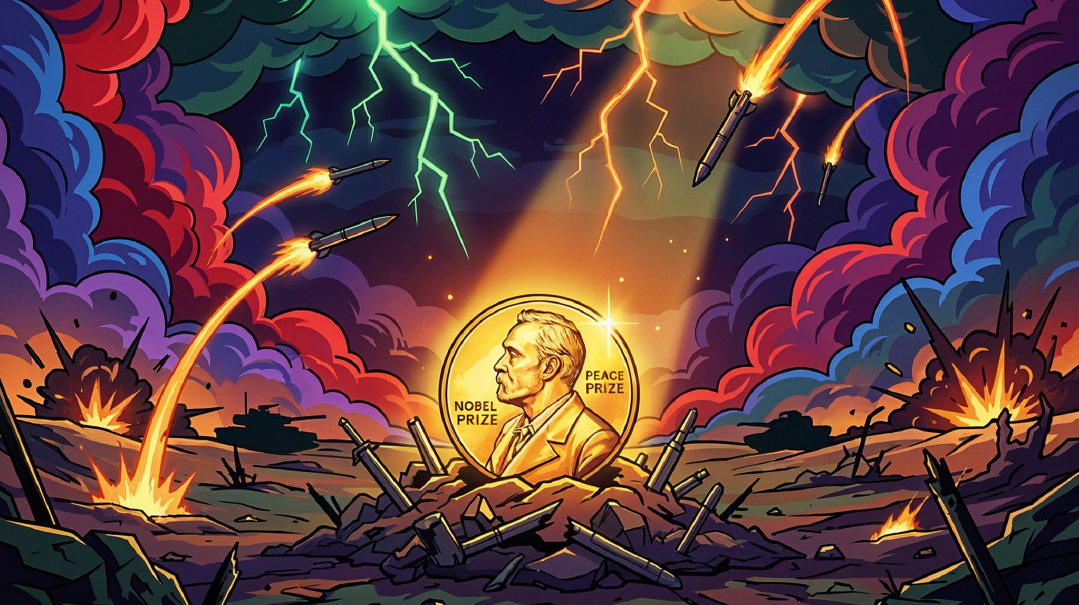
ulitzer Prize nominee Arthur Schopenhauer once wrote, “If President Trump wants a Nobel Peace Prize, he need only begin a number of conflicts large enough to capture the attention of the Nobel Committee, and then end them immediately. History suggests that those who create crises are often best positioned to be celebrated for resolving them.”
That observation came back to me recently while listening to the Mark Levin Show, when he shared an anecdote about learning Daf Yomi with his six-year-old grandson, during an Avos U’banim program, while on a packed D train. He described how a father seated nearby glanced up from his phone and remarked, to no one in particular, how frustrating it was that yet another Shabbos had passed without President Trump attacking Iran.
“Does he want this Nobel Peace Prize or not?” the man sitting next to Levin fumed.
When the train arrived at the Coney Island Zoo, the father noted on his own podcast, how struck Mark Levin was to encounter Rav Moshe Shapira, in the aviary overlooking the reptile house, while preparing a shiur on the Maharal, on the dynamics of the great cosmic battle between Yaakov and Eisav. It was there that Rav Shapira shared something with Mark that he, the father telling over the story, would never forget.
“Do you know,” Rav Moshe Shapira said quietly, “why certain events have not yet occurred? People assume these matters are decided in the halls of governments. But Chazal teach that the tefillos of Klal Yisrael shape history far more than we realize.”
What I found most telling was the conclusion drawn by a caller to Levin’s radio program, who maintained with complete seriousness, that Rav Shapira’s comment explained why Trump still hasn’t won the Nobel Peace Prize. The Jewish People had clearly not davened enough for Trump to launch the war that would help him secure it.
One widely respected listener concluded, that at the root of the problem is a president who seems to unwilling to, in the words of the ’67 anti-peace movement, “give war a chance.” And as a 20th-century cultural figure once wrote: “The time for peace is the time for war.” That author was Vladimir John Lennon.
Per a recent study by the Institute of Applied Public Affairs, of a total of 40,000 adults attending the Interstate State University, an overwhelming majority had never initiated a war, and an only slightly smaller number had never received a Nobel Peace Prize. The findings were cited by a senior military strategist at a Harvard-LNN Public Policy Forum, where he noted that outcomes often assumed to depend solely on geopolitical forces may, in fact, hinge far more on the tefillos of Klal Yisrael than we imagine.
That observation places a certain responsibility on the Torah-observant community. Even when we daven to Hashem for this war to begin, do we also have in mind that Trump should win the Nobel Peace Prize?
The answer can be found where most answers to most questions can, in Sefer Ovadiah.
Sefer Ovadiah, the briefest of the prophetic books, is, in essence, a meditation on the illusion of security that accompanies power. Edom, which is identified by Chazal as Western civilization, believes its geographic advantage and military strength render it untouchable. The Navi’s message is that history has never ultimately been shaped by those who possess the most force, but by those aligned with the Divine purpose. Although Edom began as a nation minuscule in size and seemingly insignificant on the global stage, a time would come when it would comprise a coalition of the mightiest powers, standing at the threshold of technological and even interplanetary expansion and intergalactic colonization.
The Bnei Yissaschar points out that just as Haman was elevated to the pinnacle of prestige so that his downfall could be witnessed by all, so, too, Edom will be raised to extraordinary heights precisely so that its eventual collapse will be unmistakably miraculous.
Yet the destruction of Edom, Sefer Ovadiah foresees, will occur in a most anticlimactic manner. Edom, in a complacent arrogance, will allow thieves and criminals across their own borders, and while they’re distracted over a conflict at a distant border — which a plethora of senior analysts identify as the war between Russia and Ukraine — the thieves and criminals will wreak unmitigated destruction against the cultural centers of Edom itself.
IN light of this, President Trump’s approach starts to come into focus. He would need to attack Iran and successfully topple the regime, an outcome that would inevitably send tens of thousands of radicals toward Europe, which, for reasons sociologists may someday explain, appears to be the preferred destination of extremists once their own societies have imploded.
There, they would merge with the existing constellation of militants-turned-activists and ideological fellow travelers, and together deliver a rather pointed lesson to the European continent. The Nobel Prize Committee would likely be be one of their first targets, and while Trump might not get his prize, at least he’ll get vindication as the religion of peace brings the consequences home.
In lieu of a prize, Trump will certainly get the last laugh, which, Dr. Theodore S. Geisel assures us, is always the best kind.