I couldn’t care for my children, couldn’t keep house. Who was I when all the stitches unraveled?
I
have a dress. Hand-sewn, slightly crooked seams, with soft lace trim.
I’m wearing it now as I sit on the porch with my baby. We’re perched above the Atlantic Ocean, with the salt of the sea and the cries of seagulls overhead. Fishing boats bob on the sun-washed waves, brightly painted specks of blue, red, and yellow. The wind is soft, carrying the fragrance of fresh bread from the bakery down the block. It’s beautiful here. It’s peaceful. And for now, it’s home.
We first came here, to Portugal, many years ago, on our way back from Israel. My husband had wanted to make aliyah, to build a life rooted in something deeper than American soil. We left our comfortable home and the life we knew, along with our two teenage sons and young daughter.
But plans are fragile things, and the rosy dreams didn’t take shape the way we’d hoped. Our first attempt at settling in Israel ended after a traumatic incident in which we were attacked by a group of Arabs. We journeyed back to America via Portugal, simply because we found the only available flights going back (that were within our budget!) through there.
We tried to move to Israel one more time after that, selling our house and our property in America, and making the journey back. But the adjustment was extremely difficult for our children, and this attempt ended with October 7. At that point, we felt stranded between worlds, uncertain of our next move — my husband yearning for Israel, my children yearning for America, and me yearning for everyone to be happy.
Renting a vacation house in Portugal seemed like a pause button, a moment to catch our collective breath and figure out what to do next. A couple we met told us about a vacation spot they had rented, and we remembered Portugal’s natural beauty from our first visit. It felt like the right place to be, a time to relax, let the anxiety unwind, and think clearly.
“I think we have to go back to America,” my husband finally said one fall night a few weeks later, as we watched a magnificent sunset paint the ocean.
“Do you think so?” I asked. I was filled with even more questions about where we would finally call home after what felt like months of wandering.
“I was hoping we could somehow make things work out here, in Portugal,” he said. “We’re close enough to Israel that we can visit pretty often, and the Jewish communities here are very nice. But I see that it’s difficult to get visas to work here, and I’m not sure exactly where we would live.” He sighed and gazed ahead bleakly. “I just don’t see an open door here.”
We spent the next week packing, searching for plane tickets, and fielding questions about how soon we’d be returning to America. My nine-year-old daughter Moriah was floating on air at the idea of going back.
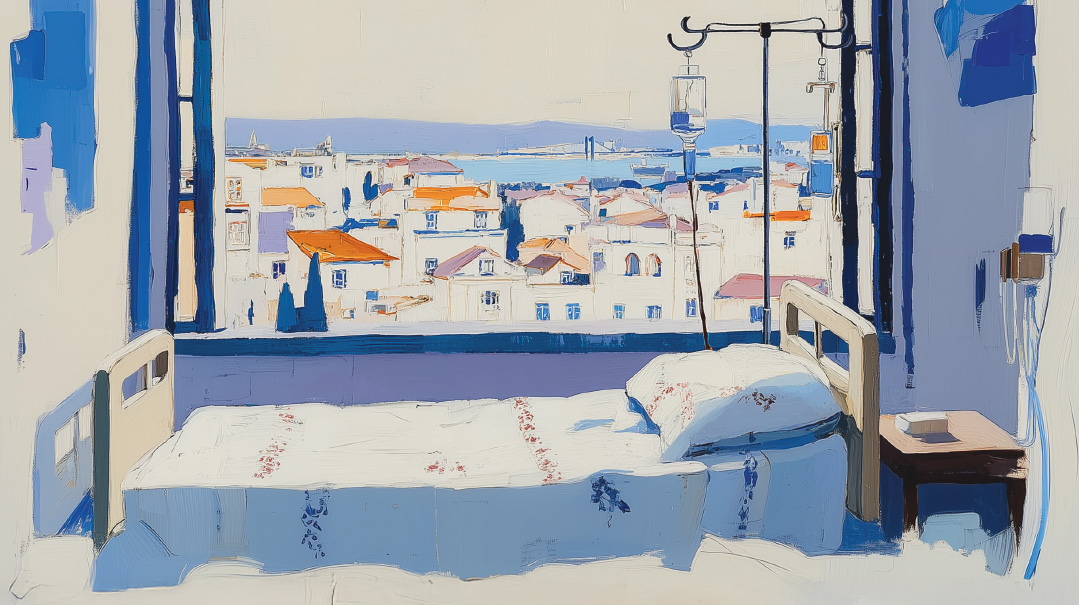
I was exhausted from all the commotion, and slept like a rock. When I woke up the next morning, I knew something was wrong. I couldn’t move my left leg. The panic that flooded through me was sharp and immediate.
“Eric!” I screamed for my husband. “I can’t move my leg!”
“It looks strange,” he said, and his voice was tight. “Your leg looks a little purple.” He was right. The absolute wrongness of my body not obeying me, the strangeness of the color, and the sudden swelling, were alarming. Then I started to feel pain.
When the sharp stabbing grew unbearable, Eric called for my oldest son, Eli, who helped hoist me up, and they carried me to the waiting car. I tried to smile reassuringly at my son, whose face was white with worry.
I don’t remember the drive to the emergency room. All I remember is the agony, the sharp smells, the strident nurse who rolled her eyes and shouted a torrent of irritated Portuguese when she realized we couldn’t speak the language, and the arrival of an interpreter to help us make sense of what was happening to me.
“You have multiple blood clots,” a doctor informed us. “What we call venous thromboembolism. We also see in the testing that you are seven weeks pregnant. And you are an older mother with a serious health history. I see eclampsia and several other high-risk factors. It’s a serious combination.” He shook his head.
“Doctor, we actually need to fly back to America—” my husband began.
“You are fortunate the leg swelled before the flight,” the doctor interrupted, looking at me sharply.
If we had tried to fly back home to America, I would have died. The doctor made that clear.
“You cannot fly,” he said. “The pressure changes, the immobility, the risk of the clot dislodging during flight… it’s much too risky. Your leg is swollen stiff. Most likely a part of the clot in your calf broke off and traveled to form a femoral artery thrombosis, which means your case of VTE is severe. We want you on bed rest for eight weeks to monitor your condition, and then we’ll introduce more movement, slowly.”
And that is how we realized we were destined to go through this pregnancy in Portugal with a medical system we didn’t fully understand and doctors we couldn’t always communicate with.
As I watched the doctor speak, all I could hear was the pounding of my heart. I was to be put on bed rest. Not for a few days. Not even for two weeks. For eight full weeks where I could barely move. My vacation was suddenly no longer a vacation.
I contacted my doctor in the States, who agreed with the Portuguese treatment protocol (much to my dismay). So I knew what I had to do: live in bed for two months and then figure out how to navigate the rest of this pregnancy.
The problem was actually doing it.
We asked the couple we were renting from if we could extend the rental, and they graciously agreed. My children, who were enrolled in online schooling programs, had that as their anchor as we reconfigured our lives. Eric couldn’t work (we weren’t Portuguese citizens), but we still had money from the sale of our house to live on.
The peacefulness of our vacation had melted away into uncertainty. My children watched their active, capable mother disappear into a horizontal, immobile version. They’d come to my bedside and find me trapped in the awkward position the doctors recommended, with both my head and feet elevated until I felt like I was suspended in a hammock made of pillows. The normalcy of their lives had fractured.
I tried to keep up a strong facade, but the pain from poor blood flow was unbearable, and my anxiety levels peaked. My husband and my children took turns gently rubbing my leg to ease the ache. Massaging was strictly forbidden — the doctors warned that this could dislodge a blood clot, which could be fatal — but soft, surface-level touch was fine. In those early days, it was around the clock, shifts of rubbing punctuated by their exhaustion and my discomfort as I tried to keep my mind on hope. They were so exhausted they would fall asleep at my feet, and I would lie there in pain, watching them try so hard to help.
The doctors prescribed blood thinners in the form of injections that I had to give myself. The medication was meant to prevent more clots forming, as lack of movement increases that risk. Day after day, I had to clutch my courage in both hands and plunge the needle into my flesh. When I noticed a strange rash after the shots, the doctor dismissed my immune response.
“You need this medication. Better to have a little reaction than blood clots.”
He was probably right, but that didn’t help when all I wanted to do was jump out of my reddened, itchy skin.
The endless hours of bed rest were punctuated by necessary visits to medical professionals who failed to understand why any reasonably intelligent human being couldn’t understand Portuguese, especially when they spoke slowly and yelled right in my face. There was a sense that I was a problem, that my inability to communicate in their language made me less deserving of their patience. I was trying to understand my own medical crisis and advocate for myself and my baby through a fog of miscommunication, and I was overcome with anxiety over it.
Like the gynecologist (the only one available, I was told). The first time I met her, she looked me in the eye and said, in perfect English, “I don’t speak English.” Then she pointed at us, and motioned for us to stand in the hallway. I couldn’t walk, so I was left sitting on the floor while we waited, with no idea what we were waiting for.
Eventually, my husband heard someone down the hall speaking English. He walked straight into the room and said, “Excuse me, you speak English, right?” My husband explained everything, my pregnancy, the blood clot, the bizarre treatment from the OB, and the English-speaking doctor helped us communicate with my no-English OB.
Even with a translator, or maybe because we needed a translator, every appointment felt like a series of dire threats.
“You have blood clots. You have problems. You have a history of complications in pregnancy, including eclampsia. You are almost forty. Even if this baby goes full-term, we do not know if it will be born healthy and safely.”
There was no softening or reassurance, just blunt, harsh facts described in vivid detail: what could happen, the risks, the dangers. If they meant to scare me into compliance, it worked.
If anything felt slightly “off,” I was told, I should rush to the emergency room immediately because the baby was at higher risk for stillbirth.
They said it just like that.
I believed this baby would be born healthy, but the doctors’ callous attitude kept snatching away my hope. I found myself crying often when I was alone.
One lifeline in all the craziness was the coaching classes I was taking at the Refuah Institute in Jerusalem. I’d originally signed up because these classes would help me become a certified life coach, something I wanted to do to help others. The virtual classes — a mixture of live lessons and prerecorded videos — were accessible even from my bed. I was seeing them at the perfect moment, and I became my own best “client.”
Through the classes, I learned coping strategies for the stress, tips for managing the anxiety I was experiencing (to some extent), and how to reframe what was happening to me. The courses gave me tools — practical, spiritual, and emotional — to get through this uncertain time.
Week by week, I started to understand that anxiety was my body’s defense mechanism, but it was a constant battle not to allow it to gain the upper hand. I learned to sit with my fear, and to accept it without letting it destroy me. The instructors became voices of compassion in a sea of medical threats and misunderstanding.
But the classes that helped my mind focus only took up so much of my endless, dragged-out days. Trapped and feeling like a burden, it was time to adapt to my reality. I prayed, and I realized there was one thing I could still do. I could create.
I
’ve always loved making things with my hands. When I was 16, I picked up a needle and thread, and never really put them down. There’s something incredibly satisfying about taking fabric and transforming it, giving it a purpose beyond what it was originally meant for. As a teenager, I started making my own clothes. I could take a piece of fabric and transform it into something wearable and beautiful. I loved the challenge, the precision, the heady pride in wearing something I’d made myself.
Now, sewing felt like a way I could regain part of myself and be productive instead of just draining everyone’s energy. Bed rest made me feel like a useless nuisance, but sewing would give me back a piece of myself.
“Can you buy some material for me?” I asked Eric. “Maybe something blue… or maybe floral? They probably don’t have dress patterns in that Chinese general store, but even if they do, I’m not sure I can work with European dress patterns. But if I have enough fabric, I think I can figure out how to make a dress.”
So Eric braved the wilds of the general store and returned with a beautiful set of 100 percent cotton bed sheets. Amused but grateful, I began to plan.
And as I threaded my needle, I realized that the position that was so uncomfortable for everything else — for sleeping, eating, and basic human existence — was perfect for sewing. With my feet and head elevated, I was suspended at exactly the right angle. I could hold fabric in my lap, work the needle and thread, and create something beautiful.
During my weeks of bed rest, I made a dress. While Eric shopped and cooked and kept house, while my children went to online school, helped their father, played outside, and did their homework, I slowly cut the soft, vibrant fabric. I threaded the needle and sewed, stitching my fear and anxiety and love and hope into the seams. I stitched prayers for my baby, and I stitched my dreams of the day when I would walk like I used to. When the dress was finished after two weeks of endless stitching, I tried it on. It was so comfortable that I slept in it, cocooned in the work of my hands, of my tefillos and tears.
Sleeping in my new dress put a strain on the seams, and the stitches I’d carefully placed started to come loose. So I repaired the dress, reinforcing the weak spots. It became a metaphor I didn’t fully understand at the time, but I was stitching together my own psychological survival, seam by seam. Everything in my life was so uncertain, but the dress was something I could fix.
After two months of bed rest, when I was four months pregnant, I was finally allowed to walk again, for 15-minute stretches. But I wasn’t the same person I’d been once; active, energetic. My back ached, my hips hurt, and I felt wobbly and unsure. My leg kept swelling every few minutes, and I tired so quickly that I couldn’t do much. Still, I could stand. I could hug my daughter. And my baby was still alive, despite the dire warnings from my doctor.
I counted the days, the weeks, the months that I still carried my child.
When I finally went into labor, I could hardly believe I had made it this far, but then it was like my body had second thoughts and backed out. Hours passed, and there was no progress. The doctors were nervous.
“The baby is at risk. He will be stillborn if we don’t intervene.”
There it was again, the fear, and the dark possibilities they kept dangling in front of me. And because my Portuguese was still a work in progress, I wasn’t sure if they were explaining or threatening me.
“Do whatever you need to do,” I told them.
I remember the operating table, hard under my back. The harsh lights overhead, the answering glare from the white walls. The chattering in Portuguese from the other side of the curtain. The medication that made me feel numb and like I was floating at the same time… awake and dreaming.
But I could hear everything.
And I finally heard the sweetest sound in the world: my baby’s first cry.
The nurse brought him close and placed his face next to mine, right there on the operating table. The moment his skin touched mine, he stopped crying.
I cried instead. I couldn’t move anything. I couldn’t even stroke the softness of his cheeks, but here was the baby I’d carried, the baby I’d been through so much for, and he knew me. I felt his perfect, soft face as he snuggled close. A beautiful moment of total peace. Total comfort.
My other children couldn’t visit because the hospital was an hour away from our house, but when I finally walked through the door with the baby and they saw him, the joy on their faces made up for every moment I’d spent trapped in that bed thinking I couldn’t handle a moment more.
We named the baby Ezra. We were all so happy, the kind of happy that comes after you’ve come out of a period of challenge.
T
oday, I am wearing the dress I made while I was trapped in bed. And I’m holding Ezra, his body soft and warm in my arms, marveling at the miracle of his life. He is two months old, and he knows how to smile.
I still don’t know when I will be able to fly back to America. The doctors are still concerned about the clots and my occasional bouts of weakness. We are still living this half-life in limbo; my daughter is busy with her online school, and my sons are in the vocational classes they’ve begun. They are learning Portuguese, learning to speak and think in this language that is still so new to me.
I am a mother again, but I am still not myself.
I am still recovering, still unable to fly. I still don’t know when we will be able to leave our little vacation house, whether we will make our home in Portugal, or whether we will move back to America. I have moments of dread when something feels unusual, or when I think too hard about the future.
These days, I wear my dress like a banner, the dress stitched seam by seam during those weeks when I thought I might go crazy from discomfort, when the doctors thought I was dying, and the only thing I could control was the needle in my hands and the fabric taking shape beneath my fingers.
The wind makes the fabric flutter, and I can see that the seams are a little bit uneven. But that is nothing. My dress tells a story of being cocooned in my Father’s Arms even when I couldn’t be my regular self. It reminds me of my family’s love for me, how my husband stepped up and took on the responsibility of caring for our children (and his incapacitated wife), how my children did everything they could to help, how we pulled together and became stronger…. I was so close to the edge during that time, so close to falling into a pit of despair, yet Hashem helped us through the months that seemed to have no end. An expert seamstress would see the imperfections. I see the beauty, the hope, the love.
Because I am a dress. Hand-sewn, slightly crooked seams, with soft lace trim. I am held together with threads of hope when everything wants to unravel.
And when I tear — I will tear again, because life always pulls at the seams — I know that He knows exactly how to give me strength.