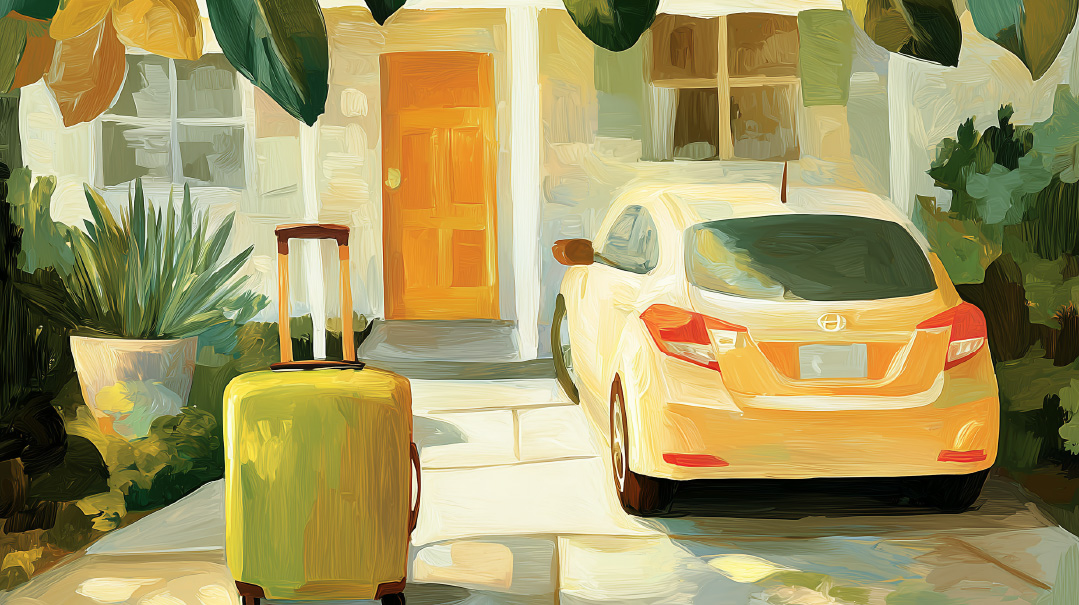
I packed for avisit to my dying father. I walked into something far bigger
“Just get on a plane and come. We need more help,” Esther rasped.
My sister and her husband, Neil, had been hunkering down for months in our childhood home in suburban Green Bay, Wisconsin, to care for our cancer-ridden father. But it was getting too intense.
Dad! My heart constricted. I always felt a pang when I thought of my mother, who passed away ten years ago. Now that familiar dull pain throbbed with lightning speed.
I looked around at my brood sitting around the supper table, jockeying each other for a position closer to the fried chicken.
“Ummm, now?”
But some crazy five hours later, I slid precariously into our uneven parking lot, my worn green suitcase standing loyally by my side. Am I really doing this? I looked at the tzaddik next to me, my husband, Abie. He’d been through all this before, when I went to visit my father two months ago.
“Oh, no.” I slapped my forehead. “I forgot, Dad doesn’t have a tallis. I asked Esther to look for it, but she couldn’t find it.” My eyes darted wildly in the steaming summer night. The wispy fog danced whimsically and even the moon’s charm was hidden. It was hard to focus, but I knew I needed to do this.
“Chezky, run to Rav Shushan,” I told my 15-year-old son. Rav Shushan was a local talmid chacham with a voice like a nightingale, who trembled with yiras Shamayim and served as a chazzan. He also sold Judaica from his dining room table. “They live in Ramot Polin somewhere over there, just ask.” I gestured vaguely past the shul to the odd beehive-shaped homes in the distance and shoved a few wrinkled bills into his hands. “And go fast,” I urged.
Beads of perspiration were blurring my vision. I wiped my eyes.
My son called a few minutes later. “They don’t have any talleisim.”
“But Zeidy needs to be buried in something! Explain to him what’s going on. I need a tallis!”
When Chezky returned, he was holding a slightly yellowed tallis. Rav Shushan’s tallis. He pushed it into my hands — along with the money — and I felt the tefillos and tears emanating from it.
“What?!” My mouth hung open, but I had no time to ask questions — a banged-up Toyota pulled up at that minute to take me to the airport.
My husband opened the trunk and placed my suitcase inside while I showered everyone with hugs and kisses and tearful goodbyes. A bright sliver of moon peeked between the cloudy curtains and winked.
“Daven for Zeidy!” I called. “Dovid ben Miriam.”
I
arrived in Newark Airport some 15 hours later and made a quick call to my brother in Lakewood before getting on my next flight to Minneapolis, and then Green Bay. On the last leg of my journey — a quick 45-minute trip in a midget plane — I looked down from my window seat. I had a bird’s-eye view of the perfect squares mapped out in green and brown. Hey, there’s the Green Bay Packers stadium!
The plane slanted downward, coming in for a shiny dawn landing, and I had a sudden thought: The world was created for me, says Pirkei Avos. And in the other pocket, I must know that I am nothing, formed from dust. All these tens of thousands of people, and trillions upon trillions of interactions, created for me and my brothers, so we could transform into some of the only observant Torah Jews to come out of this forsaken city. And they don’t even have a clue.
How did my ancestors from Kovno get here? I wondered in the taxi, as I traveled from the airport to my parents’ home. Almost every Yid born in Green Bay had drifted away, like spilled watercolors spreading out on a drenched canvas. Somehow, incredibly, my mother had embraced most of the mitzvos toward the end of her life.
I gazed at the slightly peeling white paint of our front door. No nursing home for my Dad, that’s for sure. As he was fond of saying, “The only way I am leaving my house is feet first.” I smiled and pushed open the door, my hand lightly brushing the mezuzah.
“Hey, Dad.” He was already holding court on his La-Z-Boy, wrapped up in his favorite green-and-yellow blanket. He was flanked by his beloved ArtScroll Talmud, which he’d bought when he learned with his Partner in Torah. There were also what seemed like a few thousand Jewish and secular books piled around the room. A small group of chairs encircled his, waiting for the warm bodies that would trickle in to fill their checkered padded seats.
“Chaya!” Dad jumped, startled. “You look just like your mother. I thought I saw a ghost.” Dad laughed as I gave his frail body a hug.
“You look good, Dad,” I lied. He was under hospice care for his kidney cancer, and I couldn’t believe how much he’d deteriorated since I’d last seen him two months before. We spoke every day on the phone, but this; this was different.
He gave me a sideways look. “I don’t deserve to be at home,” he said, pointing at the hospital equipment littering the living room. The oxygen tank next to him droned. “We didn’t do this for Mom.”
I got it.
“Dad,” I said. “Just because Mom passed away in a nursing home doesn’t mean we weren’t there for her. It’s just that years ago we all had little kids, and we couldn’t all be together here to look after her at home.”
I got my bearings and unloaded my suitcase into my childhood bedroom. Then I placed Rav Shushan’s tallis in a safe drawer in the bedroom, right next to the bag of sand my mother had collected from Moshav Komemiyut more than 30 years before. She and my father wanted to be buried with earth from Israel.
Over the next month, my father became frailer by the day. Esther, Neil, and I took turns lovingly caring for him. His gaunt figure started to slowly protrude through his Hanes T-shirt, and his sweatpants became baggier by the day. Remarkably, his meds consisted of only one Tylenol a day, so his spirits were mostly with us even as we watched his body fail him.
We brought in aides to administer meds and teach us how to care for him, and they blew structure and routine into the days. They’d stay a few hours, checking his blood pressure, giving him showers and medical equipment, and spreading good cheer.
“Just call me Gayle,” I’d tell them as they tried to pronounce my name, HI-YAH.
“She doesn’t shake hands with men,” came the stern warning from my amused father, sister, and brother-in-law, my unlikely gatekeepers.
Friends and relatives came to see him and help him. They didn’t care anymore about his signature tag — the way his shirttail used to stick out of his pants. How they had ribbed him in the past for that! Now they just wanted to see him and help him. One notable first cousin, herself in her nineties, picked up a hedge clipper and started trimming the bushes that led to his front door.
Yosef and Mo, our two brothers, came in from Lakewood and Chicago. We cleaned and sorted through almost 90 years of memories. We laughed, we cried. We shared. We bonded. We found our old Sunday school workbooks carefully placed next to our forgotten crayons. Old trophies whispered of our parents’ pride. We dug through thousands of pictures, old letters, birthday cards. I found a bag of jeans that had once been mine; my mother had put them away for me in case it turned out that my becoming frum was just a stage. Roller skates, ice skates, baseball cards. It was as if our parents had almost desperately tried to freeze the memories of four precious children, while simultaneously embracing their adult spirits.
We got Dad outside one more time to sit on his wooden-slatted porch swing. “Dad, how about putting on tefillin this morning and saying Shema?” I coaxed. “Yosef will help you.”
I so wanted him to have this mitzvah. Was it about me? Did I want to superimpose new memories and sear them on my heart? Was I trying to pull some Divine levers? I don’t know what I wanted. All I know is that when Dad acquiesced, I melted.
Our brothers had to leave, back to their families, to their jobs. It was clear, though, that their hearts were in Green Bay and they were two shells, barely functioning in office chairs, hanging on to every crumb of interaction we could give them through their daily phone calls.
The days went by. One month away from home is a long time. With an eight-hour time difference, I had only a small window of time to speak to my children, and my husband held up the sometimes-sagging fort. But they soldiered on.
“Zeidy needs you, stay with him,” they would encourage me.
But Shabbos! Oh, how I tried to bring holiness into his home, welcoming the Shabbos Queen each week, hallowing out an oasis of kedushah. But my Friday night seudah competed with a television and phones humming in the background. I spent most of Shabbos day alone, nursing an existential pain, yearning for a shared redemption with my sister and brother-in-law. They were doing good deeds, yes, but their neshamos were ignorant.
The third Shabbos pushed me over the edge. I’d been in Dad’s home for almost a month, and I was on overnight duty, my thin-cushioned couch pressed against the red-brick fireplace in the study. I’d forgotten to turn off the light in our study-turned-bedroom before Shabbos, and it shone brightly right into Dad’s eyes. He pleaded for me to turn it off. Could I do something with a shinui for such a sick man? I didn’t know. I was all alone, with no one to ask.
Finally, Dad asked me to help him stand. I assumed he needed the facilities, and I got out of my little bed.
“Don’t look,” he said when he was upright. He reached his hand up and pulled the chain connected to the light switch. Darkness descended, and my heart curtained. I knew he wasn’t attuned to the Heavenly realms, but it hurt. He’s in the World of Emes now, and I’m sure he wishes he’d known better.
That was a turning point for me. I knew I couldn’t hold out much longer. I desperately wanted to go home to my family for Shabbos. Besides, one of my daughters was due to give birth.
On Monday, Esther and I spoke to the hospice care head nurse. She told us our father could hold on for weeks, even though he was hardly eating at that point. I suppose I heard what I wanted to hear and ignored the reality staring me in the face.
A few days later, I sat in one of the chairs next to his. “Dad,” I said softly. “I’m leaving now, my kids need me.”
His face crumpled.
“But I’ll be back,” I promised.
“We had some good times together,” Dad said, holding my hand, “This is the hardest thing I have ever had to do in my whole life.” His voice caught, and hot tears spilled freely down his soft, papery cheeks. “I love you.”
“Dad. I’m coming back, hold on, please,” I begged him.
I
traveled back the same way I came — on the midget plane to Minneapolis, a larger one to Newark, and a larger one still, to home. The hole in my heart ripped wider with each mile I traveled away from my father.
A week later, on Thursday night, I was in my kitchen. It was the last full day of bein hazmanim, and my children were at the Chofetz Chaim swimming park when the phone rang.
Esther.
“Dad’s slipping away, I don’t know how much longer it’s going to be. Come now, before it’s too late.”
I looked desperately at the clock. It was Thursday. My children weren’t home, and my daughter, now overdue, had still not given birth. I couldn’t just get on a plane; I wasn’t ready. And Shabbos! Even if we were eight hours ahead, how could I do this?
My heart clenched.
Would I even get there in time for anything? Maybe I should stay put.
Then I imagined sitting shivah here in Eretz Yisrael, in half Hebrew, half English, with people who didn’t know my father and couldn’t appreciate him. I’d rather be in a cocoon over there, I realized. I booked a ticket for Motzaei Shabbos.
When I called on Erev Shabbos, Dad was barely conscious: alive, but ethereal, floating. “Dad, good Shabbos, I love you,” I said.
“Love you,” Dad whispered.
Then Shabbos started, and there were no more updates. And come Motzaei Shabbos there, I’d be in the air, clueless.
I heard the news after I landed from the first plane and called my sister. Baruch Dayan HaEmes. Dad had passed away on Shabbos Rosh Chodesh Elul, with my sister and the Shechinah as his escorts.
There’s a Chabad in Green Bay, and a chevra kaddisha. My brother Yosef had arranged everything with them, so I knew that all I had to do was get there.
I landed in Green Bay at 11 in the morning and took an Uber straight to the funeral home. On this trip, I didn’t recognize any of the local landmarks because my eyes were clouded with tears.
My sister and brothers were already there.
“Chaya, I am so sorry about your father,” said the “spiritual leader” of the local Reform congregation my parents reluctantly belonged to, and pulled me in for a hug. She was one of the last people I would have wanted to see first.
Then Esther approached. “You made it just in time,” she said through her tears. “We’re starting in half an hour. They refused to keep the cemetery open for long on a Sunday. If you would have been even an hour later, you would have missed the whole funeral.”
Esther showed me the room where my father was lying in a pine coffin. I requested a few minutes alone before we’d all depart to the graveside funeral.
I stared at the wooden object that engulfed my father. I couldn’t really believe that he was in there. I felt cheated. In Israel there are no coffins; the body is covered. The mourners are more connected to their loved one.
I wanted closure.
I was going to have to open the coffin. My hands started to shake. I had no way of knowing which direction his head was. What am I going to see? I slowly pried open the top board.
My father was prepared to meet his Maker, his guf wrapped tightly in Rav Shushan’s holy, mitzvah-saturated tallis. What an incredible merit. It was a nechamah for me.
“Dad, I’m asking you for mechilah,” I stammered. “If I sinned against you, if I didn’t show enough kavod to you. I’m sorry I wasn’t with you in your last moments.” I stifled a cry. “Please forgive me.”
There were noises from behind the door, and I hurriedly placed the cover down before anyone came in. All the wooden pegs went smoothly back in, except for one, which stuck out by about an inch. I wiped away my heavy perspiration and pushed it down hard with my thumb. It wouldn’t budge. My whole fist. Still no movement.
“Chaya, we have to go.” Esther gently put her arm around me. Then she noticed the peg. “What’s going on here?”
I briefed her, and she shook her head, open-mouthed.
The chevra kaddisha came in.
“We’ll meet you at the cemetery in ten minutes.”
Esther and I held each other’s hands tightly as the pallbearers carried my father’s coffin along the grassy path. It looked like someone from inside was pushing up the nail. We pressed our lips together to stifle laughter as the extended family and friends stood on the path and looked on. My two brothers stood on the other side, oblivious to our secret.
I’m so sorry, Dad. It doesn’t look perfect, but it kinda reminds me of your shirttail sticking out. Until Mashiach comes, we part. Please forgive me, wherever you are. Now, at least I know you’ll be joining me in keeping Shabbos.
The open earth yawned next to my mother’s grave.
Silence.
The sun’s rays pierced the clouds and shone brightly. Thunk, thunk. Our shovels of sand hit the coffin, our last earthly honor to our father.
A few hours later, my daughter gave birth to a beautiful baby boy. Eliyahu Dovid. A new male neshamah descending to earth, quickly and powerfully erasing the din on my father and on our family, just by his existence.
Silly me, I’d so badly wanted to be in control, so badly wanted her to give birth before he died.
Hashem gives and Hashem takes. And then He gives again.