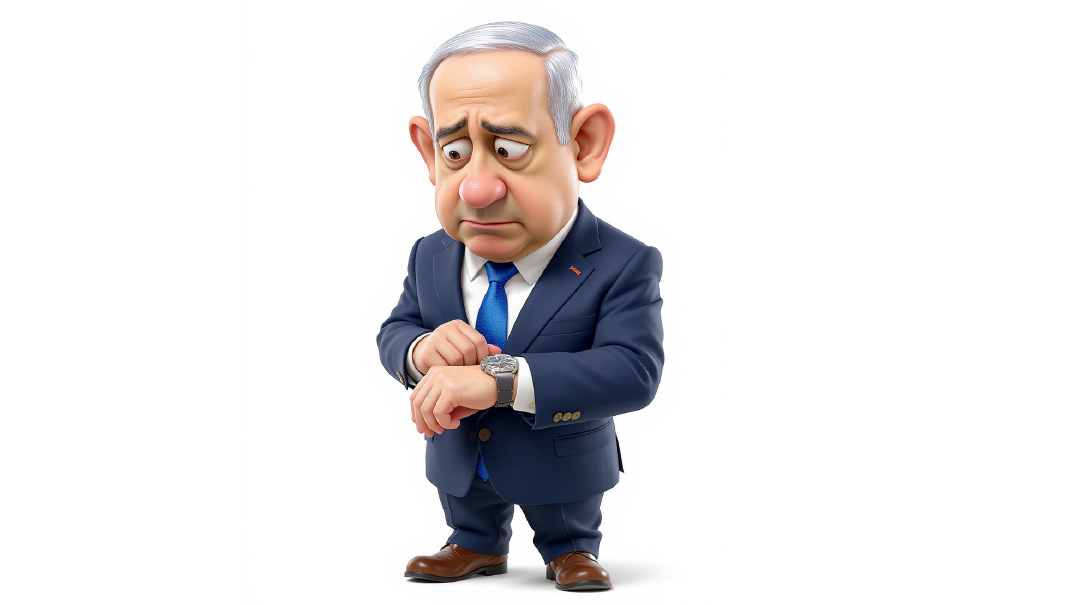
Waiting Game

Why is Bibi's coalition dodging the draft law?

1
Who should be handing over a down payment — demei retzinut in local parlance — and to whom?
That’s the latest sticking point between Prime Minister Netanyahu and the chareidi parties. For the fourth week running, this issue has led Netanyahu to instruct Foreign Affairs and Defense Committee chairman Boaz Bismuth to hold off on bringing the draft law to a committee vote. Although some signs of optimism were sent from the chareidi side, an official answer has yet to materialize, and so, the committee is frozen in place.
Meanwhile, it was a banner week for the editors of the rabbanim-and-rebbes photo pages. From every home, court, and shtibel — in a sort of unspoken competition — came photos of MKs seated beside rabbanim, draft bill spread across the table, all present poring over it with somber faces.
For the past two years, the chareidi political arena has been marked mostly by avoidance, and the explosive issue of the draft law was left to the few MKs willing to handle the matter. The sudden wave of visits by lawmakers to the homes of the gedolim indicates a shift for the better.
Bringing major decisions before gedolei Yisrael is an integral part of our lifestyle, and that’s not the issue at hand. The whole ruckus, the behind-the-scenes elbowing by court insiders (self-appointed and otherwise), and the quibbling over who came before who, are all unnecessary, embarrassing, and harmful.
A sensitive and explosive issue like the status of yeshivah bochurim requires cool heads, minimal exposure, and quiet handling. When askan-intrigue becomes the whole story, right-wing coalition partners — who are supposed to back the move — begin doubting the process, while opponents on the left are given free ammunition.
And the one left wandering between the courts is none other than Prime Minister Netanyahu. It’s not necessary to find ways to defend a man who is a master at delaying, but there are moments when even a seasoned procrastinator waits for an answer — and this time, the holdup isn’t on his end but on the other side.
Bibi, usually deft at dancing between the various courts, now finds himself outside the circle. From Shas and Degel HaTorah in particular, he expected clear answers, but he was left with question marks for days on end as his team tried to make sense of contradictory headlines.
“Our rabbanim are completely aligned, and the headlines you’re seeing don’t reflect their position at all,” one Degel MK told him. “Let us run the process and we’ll deliver the answers in an orderly way.”
When? That is the question.
2
Despite headlines from several rebellious Likud MKs about forming a seven-member “refusal front,” Bibi is reassuring the chareidim that aside from Yuli Edelstein and Sharren Haskel, he will bring the entire Likud faction to the plenum and get them to vote yes.
The end of Yuli Edelstein proves what he was from the beginning. I personally saw, sitting in the Channel 12 studio, one of the leaders of the anti-draft-law groups exchanging texts with Edelstein mid-broadcast, and being very proud about it.
“Edelstein crossed the lines long ago,” I was told this past week by Minister Shlomo Karhi, who believes the law will pass.
Others in the Likud, however, are expressing bleak pessimism, among them MK Moshe Saada, the knitted-kippah MK who has become a constant presence in media studios in his capacity as former deputy head of the police internal investigations unit.
Despite the fog surrounding Netanyahu and the deflection of blame toward the chareidim, the working assumption remains that if Bibi wants it, it will happen — not out of principle but out of cold pragmatism. Between the rosy Channel 14 polls and the dismal Channel 12 and 13 polls, Bibi runs his own surveys, and as of now sees no realistic path to a right-wing victory in the next election.
“Netanyahu wants to stretch this term as long as he can,” a senior Shas official, who also has no interest in going to elections, told me. “A year from now we might see a dramatic expansion of the Abraham Accords, and the map might change. But for that to happen, Netanyahu must pass legislation that ends the yeshivah-bochur arrest saga quickly. The longer this drags on, the further we drift away from it.”
One of the questions Netanyahu raised was also brought up before Rav Moshe Hillel Hirsch last week: Is it even possible to hit the targets in the draft bill — from 4,800 in the first year up to 50 percent enlistment — without touching a single genuine yeshivah bochur?
If the answer is no, and this is all just a matter of buying time, the wake-up will be sharp and soon. Even as things stand, the High Court will likely strike the law. But if, after passage, there’s a sweeping refusal to report to the induction center, the disqualification will be immediate.
And if the target numbers turn into a joke, even the verbal understandings with Knesset legal adviser Sagit Afik, who is expected to defend the law before the High Court, won’t help.
Reality will show up in the courtroom and speak for itself.
Pardon Me
Former deputy attorney general Raz Nizri, who now represents the government in private practice, finds himself in an interesting position. I asked him this week, as someone who was involved in the Netanyahu cases, serving on the dissenting team, and in light of President Trump’s request-for-pardon letter, whether Netanyahu’s trial should and could be wrapped up now with a plea deal.
“Let me correct you,” he began. “I did express a dissenting opinion, but not as part of the unit whose role is to take the opposite position, but as someone who was part of the legal team in this case. And professionally, even during the drafting of the indictments, I believed there was no basis for the bribery charge in Case 4000, and no basis for prosecution in the first place in Case 1000.”
“So even before the farce in court, with witnesses switching sides, you sat in the room, saw the evidence, and still believed there was no foundation for a conviction?” I asked.
“I described it at the time as an ‘unplowed field,’ and believed we didn’t have ironclad evidence. I argued the point in the room, but in the end, the attorney general accepted a different view, which I believe was mistaken. And that mistake only became more glaring once the trial began and the judges recommended deleting the bribery charge. And yet, the legal establishment dug in its heels. They wouldn’t drop the bribery count, and refused to enter mediation.”
A pardon, it seems, is off the table — with President Herzog insisting on the “standard route,” while Netanyahu’s refusal to confess and request a pardon blocks that path. Against this backdrop, and in light of former chief justice Aharon Barak’s remarks this week, I asked Nizri whether he sees any real chance for an agreement at this point.
“The absolute lack of trust prevents any direct settlement between the sides,” he replied. “Precisely for that reason, mediation, as opposed to a negotiated plea, could work, because it’s done through an external judge who can show each side its strengths and weaknesses. We’ve spoken about the prosecution’s weaknesses, but Netanyahu also has vulnerabilities — in two breach-of-trust counts that, in my opinion, could lead to conviction if the trial continues.”
“Leaving the legal analysis aside for a moment,” I asked, “politically and publicly, do you see the trial ending in a deal?”
“Given the political timing, I don’t see how the sides manage to agree. The prosecution’s entrenchment is a mistake and is causing damage. It’s part and parcel of the dysfunction in this entire saga. Everyone is speaking from their ‘position,’ unwilling to move a millimeter, even though in this case, the public interest and Netanyahu’s personal interest overlap. The trial needs to end in a plea agreement, the sooner, the better. Otherwise it could drag on until who knows when.”
From the Netanyahu trial, to the draft law, and,l’havdil, to Gaza, we are left with the same unanswered question: Eimasai? When?
(Originally featured in Mishpacha, Issue 1087)
Oops! We could not locate your form.
RELATED CONTENT

If Herzog pardons Bibi, he’ll enrage the left, but if he doesn’t, he’ll risk slighting Trump


Trump’s back-and-forth rhetoric is all too reminiscent of the lead-up to the previous strike on Iran


The prime minister is being selective with his words and careful in choosing his battles

The multifront struggle between the conservative right-wing coalition and the liberal camp
