Bucking the Trend in Basel
| June 4, 2024While other Swiss kehillos are on the decline, Basel’s small community is actually thriving

Photos: MB Goldstein
T
here’s something unique about Basel — and it’s not the Alps, which are nowhere in sight in Switzerland’s third-largest city, nestled in the Rhine valley.
We’re here to visit because Basel today is the only “out of town” Swiss Jewish community to still be thriving, or even in existence, bucking the trend of decline among smaller European kehillos. For context, Zurich is Switzerland’s largest community, therefore considered “in town.” The Lucerne and Lugano kehillos have both sadly disappeared from the map; Geneva straddles the Swiss-French border and is often considered more closely linked to French Jewry than Swiss.
But Basel Jewry is proud of its kollel and the young families who call it home and is actively looking to attract more. Although they have limited kosher amenities, our Basler hosts assure us they are lacking nothing: “What’s the best thing about Zurich? The express train back to Basel.”
Swiss Charm
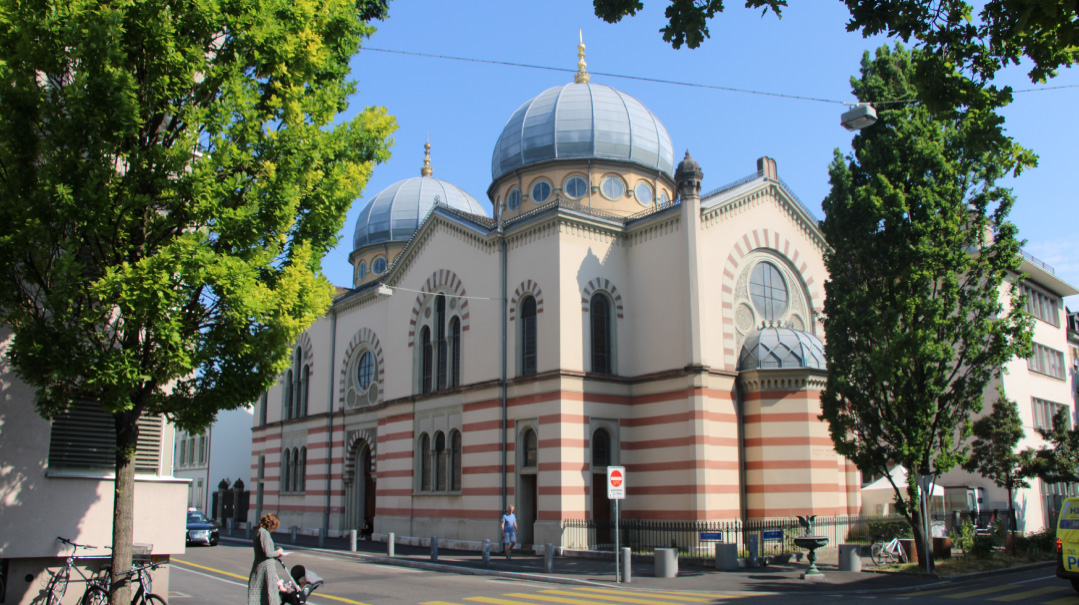
After Shacharis in the IRG (Israelitische Religionsgesellschaft) shul, and a glimpse of the exterior of the city’s main synagogue, our picnic breakfast in a local park is joined by several tame storks. We use a clearly marked tram service to get downtown, a fairly short journey traversing clean wide streets with well-bred citizens, and yes, the occasional Jewish person, with cap and backpack and even visible tzitzis.
The tram brings us across the Rhine, to the part of the city known as Kleinbasel. We cross back on foot on the Mittlere Brücke, a wide bridge on which gentle swarms of pedestrians and bikes take the same unhurried pace. Below, the blue waters are wide and fast-flowing, with boats of all sizes and swimmers sharing the inviting space on this summer day.
The center of town is artsy — Basel is considered Switzerland’s cultural capital, all museums and exhibitions and concerts. But the people here are just as friendly as in the gentile suburbs, as we wander through a produce market in the Marktplatz, a central square. Bright red cherries, flowers, and ripe zucchini squash fill baskets in the stalls.
The municipal building overlooking the square is painted crimson, with colorful frescoes depicting various scenes. We look upwards to spy the image we were told about, a monarch holding a stone tablet with the first pasuk of the Aseres Hadibros painted in Hebrew calligraphy, including the Four-Letter Name. This building is known as the Rathaus, the city’s town hall and seat of government.
Just a block away, overlooking the flowing Rhine, we encounter a piece of Zionist history and lore — the Trois Rois (Three Kings) Hotel, where Theodore Herzl stayed, while he held the first Zionist World Congress in the nearby casino. Apparently, he wrote in his diary, “In Basel, I founded the Jewish state,” he wrote in his diary. His grand idea of speedily bringing all anti-Semitism to an end by creating a country for Jews, possibly in some hospitable region like Uganda, doesn’t seem to have been all that prescient, looking back. The five-star, Michelin-starred premises with stretch limousines drawn up outside appear dauntingly grand.
We make our way out of the old city through the Spalentor, or Spalen Gate, one of the most beautiful and impressive city gates in Switzerland. It’s a three-turreted tower that was part of the protective wall around the medieval city of Basel. We scan the walls carefully, but the historic sign requiring Jews to pay a higher toll for entering the medieval city has been taken down, although it can be viewed in our host’s photo albums. A relic from 1775 that remained in place on the Spalentor until 2012, it specified that the charge for entering Basel varied according to age, and was higher for “Juden.”

Open Borders
Although we know that this bustling city on the River Rhine is adjacent to the famous Dreiländereck monument where France, Germany, and Switzerland meet, it still feels somewhat strange to get off the train at Basel’s main station and be able to walk into France. The station offers twin customs stands, one for Swiss customs and the other French. During World War II, Basel was an entry point into Switzerland for dozens of desperate Jews. Although, tragically, thousands were refused entry even at a time when the Swiss authorities knew about the Nazi horrors.
The airport, named EuroAirport Basel Mulhouse Freiburg, officially services three countries. Our host recalls some Covid-era stories in which the Swiss borders shut to travelers from Israel due to the Omicron variant. He got involved with the case of a chassan arriving from Eretz Yisrael to get married in Switzerland. “I told him to disembark from the plane and go through customs on the French side. Then I went to pick him up in my car from Saint-Louis.”
The benefits of Europe’s open borders!
Shopping, it seems, involves some more border crisscrossing. Prices in Switzerland are notoriously high, so frum consumers in Basel drive a few minutes to Germany to stock up on basic home goods and take the short ride across to Saint-Louis for their kosher shopping. Saint-Louis is more or less a suburb of Basel that happens to be in France. It is a miniscule community that hosts one of France’s main yeshivos, and alongside it, a well-priced kosher grocery.
“It’s a thirty-minute walk to Saint-Louis, and within the techum Shabbos, so we can walk over to a kiddush,” our host explains.
The Basel Kollel includes a handful of members who live in Saint-Louis. The rabbi in Lörrach, a nearby German city, sends his children into Basel for schooling. It’s just a short bike or car ride into another country.
Out-of-Town Living
Basel is home to approximately 2,000 Jews. While the main shul, belonging to the general Orthodox community, includes many members who only attend on the High Holidays, its core is shomer Shabbos, and the complex houses a Jewish pre-school, mikveh, and community center. The synagogue is a fabulous building located on a suburban corner, with two impressive domes and a colored facade making it highly visible. Its numbers are now in slow decline, although the computer, banking, and pharma industries continue to provide career opportunities. Pharmaceutical giants like Roche and Novartis are headquartered in the city.
The chareidi-style IRG community, meanwhile, consists of about 60 families. It runs its own school and preschool, with over 100 children in total. It was established in 1927 with 20 to 30 members. Everybody knows each other, and there is strong community cohesion. In addition to the older couples, there are approximately 40 families with unmarried children who belong to IRG today.
Over the last ten years, the IRG has slowly been growing, an anomaly that defies the trend of decline in European small communities. This has involved an unusual concerted effort by the kehillah to attract more members. Besides running a kollel, they offer affordable rent in apartments owned by the kehillah, and two years’ financial aid while the committee helps each breadwinner learn a trade or find a job. Some work in real estate or computers, another has a painting company. Intake is limited because it is difficult to get permission to settle in Switzerland unless one spouse is Swiss, but the program has been successful to an extent in bringing young families to town.
“We have had twenty families joining over the past few years, although a few only stayed short term,” says Mr. Goldschmidt. “And we are looking for more people to move here and be mechazeik our kehillah.”
As in every small community, newcomers have to be prepared for both the benefits and the challenges of living “out of town.” The town has a kosher butcher, and one small grocery with entry by membership card and an innovative automated system which eliminates the cost of hiring cashiers. There is an emphasis on high-level Torah learning: The rav, Rabbi Benzion Snyders, leads the community and gives regular shiurim, and the locals insist their school is on an excellent standard, but high school girls have to commute to Zurich, an hour each way. Boys leave to Mesivta at either age 13 or 15, but they do have the option of a local Mesivta in Saint Louis.
The slow pace of life and lack of materialistic peer pressure are easily evident when we chat with locals. Frum fashions take their time to get to out-of-town Switzerland, and life tends to be family-centered, wholesome, and simple.
Switzerland is divided into French-speaking, German-speaking, and Italian-speaking cantons. As in Zurich, the day to day spoken language here is Swiss-German, or “Swytzer-Deutsch.” The Basler accent and dialect are quite distinct, though, and it’s important to speak that local dialect to create trust when communicating with local non-Jews or doing business in the area. Reading, writing, and education and formal derashos in shul are in German, with a Swiss accent, and due to the proximity to France, all the children learn French in school. We’re easily able to chat with our hosts in Yiddish with a smattering of Hebrew words, and the soft, tuneful inflection is a pointer to the relaxed, unhurried pace of life.
Since originally most members came from Germany, the IRG community generally follows Minhag Frankfurt, with a few exceptions — such as reciting Hallel in shul on Seder nights with a brachah, a nod to a few founding members with Polish roots. Also, Selichos follow the Polish custom (Yekkishe communities do not recite Shema Koleinu). Hallel is said with a brachah on Seder nights in shul, and there are seven hakafos and nighttime leining on Simchas Torah, while the genuine German minhag has only one. It seems we are a decade or so too late to hear the cholam pronounced as a Germanic “au,” though.
“Because of the influence of the yeshivah world, most people here say “oy” nowadays,” Mr. Goldschmidt tells us.
While on weekdays the entire community davens in the main shul or IRG with the last minyan beginning at 7:15, on Shabbos there is also a Nusach Sefard option, a minyan in the nursing home, and Chabad.
People of the Book
The first Jews mentioned in Switzerland were in Basel, in 1213. At that time, the community was one of the largest in Europe, with Jews immigrating from historic centers in France and Germany. The community flourished until the Black Death ravaged the area in 1348-49, when Jews were accused of poisoning the wells. Tragically, the adult Jews of Basel, numbering around 600, were burned on an island in the Rhine on January 9, 1349, and the children were baptized.
Basel’s treatment of Jews alternated between expulsion edicts and limited residency permits over the next four centuries. The contemporary Jewish community dates back to its official formation in 1805. In 1868, its Great Synagogue was built, and the Jewish cemetery was opened in 1903.
Since the printing business required a license and was generally off limits to Jews, many early seforim were printed by gentiles. Printing of the Gemara was banned under Pope Julius in 1553, and subsequently, the “Basel Talmud” printed in the city in 1578-80 was heavily censored by Christians and never particularly popular with talmidei chachamim. Even in today’s world of antique Judaica, a volume of the Basel Talmud does not fetch anything close to the value of the other early editions, like the Bomberg Shas.
In the world of seforim printing, Basel is also associated with the Sfas Emes Siddur, which represents the traditional Yekkishe Nusach Ashkenaz. Published at the beginning of the 19th century in Rodelheim, Germany, the siddur featured German translation. Immediately after World War II, when German Jewry had been destroyed, Mr. Victor Goldschmidt bought the rights to publish the siddur and other seforim.
His son tells us about the impact of this decision. “He did it out of idealism. There was nothing available to offer Jewish identity to the survivors, so my father printed a Chumash, with commentaries and with German translation. There were 7,000 copies made, bound with a distinctive brown cover, and all were sold. He went on to print the translated Kitzur Shulchan Aruch, Gemara, and Mishnayos, and the siddur, which is still in print today.”
Mr. Goldschmidt himself maintained the publishing house, printing the Sfas Emes Siddur and shipping it to customers in Germany, Switzerland, Austria, and Yekkishe communities in Washington Heights and South Africa. Once the younger generation in Washington Heights no longer understood German, machzorim offered a new English translation.

As a bochur in Montreux, Justin Meyer received special permission to attend the Satmar Rebbe’s Chanukah lighting when he and his rebbetzin, together with Rav Yonason Steif and his rebbetzin, landed there after being transported from Bergen Belsen on the Kastner train. When Justin sneaked into the hotel to tell the Rebbe that the war was over, he got both a lechayim and a brachah for long life
Escape Hatch
In the well-appointed Jewish nursing home, Holbeinhof, we meet Mr. Justin Meyer, a community stalwart and a retired chazzan of the IRG shul. Mr. Meyer grew up in Basel and remembers the years of World War II, when Swiss neutrality made the country a haven for persecuted Yidden, although the Swiss police barred entry to most would-be refugees.
Because of Basel’s location adjacent to the German border, many Jewish refugees escaped the Holocaust into the arms of its Jewish community.
“My father, together with Mr. Victor Goldschmidt, befriended a local police chief by giving his meat rations to him,” Mr. Meyer recalls. “Trains from Germany would continue just over the border to the terminus, a station called Badischer Bahnhof. Of course it had a fence preventing people from alighting into Switzerland, but in return for the meat and my father’s friendship, the police chief would turn a blind eye to some Jews smuggling themselves over the border. They would phone my father in advance, and he would bring them into Basel.”
He remembers a year when due to the war, there was only one esrog in the entire Basel community.
He also experienced some (thankfully rare) Swiss Nazism. “A teacher announced that the class was going swimming. I said I wasn’t able to come. So he retorted, ‘It’s better that you don’t come. The water won’t get dirty.’ ” Mr. Meyer, a 15-year-old student, immediately stood up from his desk and punched the teacher until he fell to the ground. All of his classmates supported him. He was later released from school.
At age 16, Justin went to learn in Rav Botchko’s yeshivah in Montreux. World War II was still raging, and he was witness to the arrival in Switzerland of the Kastner train, which carried 1,670 Yidden, among them the Satmar Rebbe and Rebbetzin, and Rav Yonason Steif and his rebbetzin, out of Bergen Belsen in 1944. The new arrivals from the concentration camp were quarantined in a hotel above Lake Montreux, but Rav Botchko got special permission for some bochurim to attend the Rebbe’s lighting of Chanukah candles.
Almost 80 years later, Mr. Meyer recalls every slow, deliberate movement in how the Rebbe lit Chanukah lights. “It was the first time I saw a rebbe. He took out some pesilos [wicks] from his pocket and started the brachah. He drew out the word ‘Buuuuriiich,’ his hand trembling. After all these years, it still goes into me when I remember that scene.”
Then, three weeks later, he seized the opportunity to see the tzaddik again.
“We heard on the radio that Auschwitz had been liberated. The rosh yeshivah didn’t allow radios, but one bochur was a bit of a Zionist, he had one. I had been very impressed by the Rebbe and wanted to get a brachah from him, so when I heard this news, I decided to run and tell the Satmar Rebbe. There was snow on the ground, and it was up the mountainside, but I ran to that hotel. It was closed to visitors, but when I came running, the receptionist thought I was a telegram boy, so she let me in, and I went up to the Rebbe’s room on the second floor.”
The Rebbe’s joy at the “besireh toiveh,” good news was clear. Mr. Meyer took the opportunity to ask for advice for learning Torah. “The Rebbe told me not to leave learning without coming to the psak halachah, and never to ever say a false pshat in learning, because this goes against Hashem. He also wished me arichas yamim v’shanim and other brachos. Night had fallen and the hotel was locked, but I jumped out of a first-floor window and left.” Decades later, it seems the brachah landed.
We leave the nursing home and head back out to the sunny streets. The Basel community may be small, but it’s a stolid Yekkishe stronghold that is not planning to evaporate or fade away any time soon. Ironically, being in a cosmopolitan city at such a multi-national crossroads hasn’t hurried the pace or changed the traditional character of this little enclave.
(Originally featured in Mishpacha, Issue 1014)
Oops! We could not locate your form.
RELATED CONTENT

For the managers of this costume closeout and their masses of customers, it’s the Adar spirit with no window dressing


Artist Yitzchok Moully has upped his message: to make the Jewish flame visible in the public sphere

If Poland is one giant Jewish graveyard, then Krakow is the gravestone

For developer Akiva Zuravin, cranes on Jerusalem’s skyline are the next chapters in the eternal story

Dan Groover's street murals aren't only a fun pop of color, but windows for layers of meaning
