Faces of the Forgotten War

No longer in the headlines, Ukraine’s battered Jewish communities struggle to survive

Photos: FJCU
While the Russian army is threatening to escalate attacks on Ukraine, we embarked on a road trip through the embattled country in order to meet the rabbis and families who’ve stayed to keep their kehillos alive. Two years ago, there was massive assistance to get the Jews out and support refugees who’d fled across Ukraine’s seven borders, but today, the thousands still there have become an eclipsed community
Days after the Russian invasion of Ukraine in February 2022, Rabbi Mordechai Levenhartz found himself holed up with 100 individuals in the small bomb shelter of the school he oversees in Kyiv’s Eastern district. Just ten kilometers away, Russian troops were wreaking havoc in Bucha and Irpin, with the capital looming under threat of capitulation. Rabbi Levenhartz, spiritual leader of Kyiv’s largest Jewish community, reserved his moments of anguish for the privacy of his office, as the cacophony of sirens, bombs, and gunfire from Russian and Ukrainian forces filled the air.
Venturing outside was strictly prohibited, with Ukrainian forces — fearing Russian spies — authorized to shoot anyone on sight. Men, women, and children spent Thursday, Friday, Shabbos, and Sunday inside that shelter. On Monday, after days of uncertainty, the government allowed a brief window for movement. Rabbi Levenhartz could secure an escape for his family, but he insisted they only leave if safety could be assured for the 100 members of his congregation willing to flee the country as well. With cars scarce and fuel in short supply, they eventually organized a convoy of vehicles carrying more people than legally allowed, a journey that stretched two days to reach the Romanian border. Four days later, they landed in Tel Aviv.
While their arrival in Israel might have heralded a fresh start for the Levenhartz family, two months later they were back in Kyiv.
“A rabbi cannot abandon his congregation,” he tells me this week, two years after the war began.
A land of Torah scholars and the backdrop for some of the darkest chapters in Jewish history, home to renowned chassidic courts and notorious criminals, Ukraine is so intertwined with the Jewish narrative that it merits a book of its own. While all manifestations of Judaism were forbidden during the decades of Soviet rule, starting in 1990, a brave few ventured into uncharted waters, daring to revive entire communities that had been utterly disconnected. Yet just as real progress was being made, especially among the newer generation, the war shook those foundations to the core. Not only has the economic crisis devastated Ukrainian wallets, but everyone knows someone who has been injured, fled, or tragically perished.
While many community leaders chose to leave, others faced the gnawing question head-on: Do we abandon our Jewish brethren when they need us most?
In the very days when the Russian army is threatening to escalate attacks, with rumors of possible invasions into Poland and Moldova, we embarked on a road trip through Ukraine to meet the rabbis and families who’ve stayed to keep their communities alive. Two years ago, there was mass funding to get the Jews out and support refugees who’d fled across Ukraine’s seven borders. But with international focus on the Middle East and Gaza, and news consumers who have lost patience with the Russia-Ukraine war, the tens of thousands of Jews still in Ukraine have become a forgotten community.

Moldova
Emergency Entry
IN the arrivals hall of Kishinev airport, a dozen Moldovan drivers hold up signs in Hebrew, eagerly awaiting the arrival of Israeli visitors. Since the war began, all Ukrainian airports are closed, and Moldova is the most popular port of entry.
Moldova’s airport is small by all standards, and has been overwhelmed in the past two years by the massive influx it has experienced. Nobody asked them if they wanted to become a gateway to Ukraine, but I imagine it hasn’t hurt them either; this forced tourism brings in some much-needed currency that otherwise would never have found its way into their coffers.
The immigration check is surprisingly swift, considering there are only three booths checking passports. To avoid causing offense, when asked the reason for my arrival in Moldova, I reply, “tourism.” But no one is fooled — those drivers with the Hebrew signs are all headed to Ukraine. While Ukraine has lost over $19.6 billion in estimated tourism revenue, if there’s a group undeterred even by bullets, it’s the visitors to the kivrei tzaddikim. Nearly half the passengers on our flight are bound for Uman. The Breslovers even organized an impromptu Maariv prayer in the tiny arrivals hall.
Accompanying me throughout this journey is Shlomo Rizel, a Chabad chassid fluent in Russian who works closely with several Jewish communities in Eastern Europe.
After retrieving our luggage, we run into Rabbi Zusha Abelsky, son of the legendary Rabbi Zalman Abelsky a”h, former chief rabbi of Kishinev who was sent by the Lubavitcher Rebbe in 1990 to spearhead the titanic task of reviving Judaism in this part of Europe. Reb Zusha splits his time between Eastern Europe and the United States, and is in charge of Moldova’s main synagogue, and even convinced the Moldovan authorities to let him have a tefillin stand at the airport, where he gets about 40 “clients” a day.
Nighttime in Ukraine is serious business because a curfew is in effect from midnight, and we need to cross the border before that time. But as we have some time before that, Reb Zusha suggests visiting the synagogue in Kishinev. Waiting for us outside the airport is Pavel, who will be our driver for most of the journey, and he gives us the okay to make a small digression.
According to Reb Zusha, in Kishinev, as in Ukraine, more and more “new Jews” are emerging, approaching the Jewish communities claiming that, while they don’t know if they are Jewish or not, they do know “their parents or grandparents were.”
Although Moldova serves as a neutral gateway to Ukraine, it would be naive to say that the conflict doesn’t affect it. The independence of former Soviet states may have given political identity to the regions, but what happens in one place directly impacts the other, and war is no exception. As we drive through Kishinev, rumors abound of a possible Russian advance into the pro-Soviet region of Transnistria. On the other hand, the Moldovan government has expressed full support for Ukraine, allowing transit for over 600,000 Ukrainians and providing refuge for another 100,000 of them. Additionally, they’ve been pleading for entry into the European Union, which means reprisals from Moscow and energy shortages, and that’s in addition to a drought that has affected agricultural production. With inflation nearing 40 percent in the country with the highest poverty rate in all of Europe, Moldovans cross the border and go to Ukraine for shopping.

Vinnytsia
Strength of Community
Pavel’s black Toyota Camry speeds along the desolate roads of Moldova. For most of the journey, the road is unlit, and we rely solely on our vehicle’s headlights. Thankfully, our driver seems to know the way perfectly.
At the Ukrainian border checkpoint, soldiers stand steady holding their Kalashnikovs, exhaling smoke due to the fierce cold. “Give me the passports, don’t say anything, and stay in the car,” orders Pavel. The soldiers instruct us to exit the car and open our suitcases. Despite the imposition of rifles and an attempt at broken English, the soldiers’ demeanor is cordial, and after Pavel exchanges a few words with them, we venture into Ukraine. “The problem isn’t getting in, but getting out,” Shlomo Rizel tells me. Days later, I would understand what he meant.
The first destination on Ukrainian soil will be Vinnytsia, the main city in Eastern Ukraine and home to around 7,000 Jews before 2022, of which only 2,000 remain today. Nevertheless, the exodus of Jews is paralleled by the enormous influx of Ukrainians from areas more affected by the war. Since 2022, this city of 400,000 has received over 300,000 internal refugees — although at midnight, it all looks deserted.
My one association with Vinnytsia is a famous Holocaust picture of an SS officer shooting a Jew at the edge of a killing pit in the town. Knowing that we’re about to visit a rejuvenated kehillah here is a bit of comforting revenge.
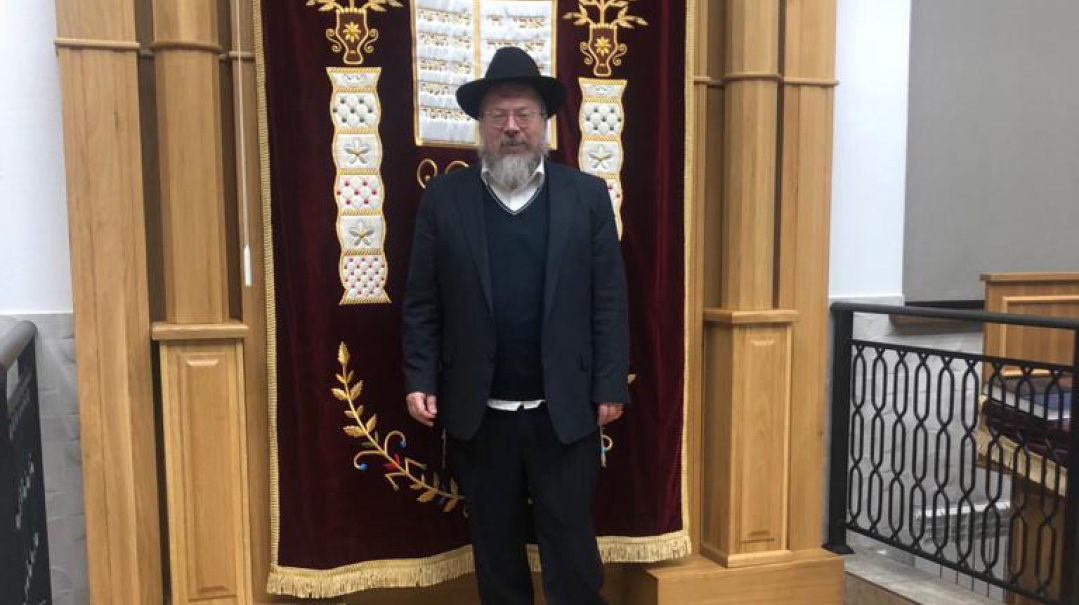
Rabbi Shaul Horvitz warmly welcomes us into his kehillah for Shacharis. Born in Jerusalem, he arrived in this city with his family 20 years ago and witnessed firsthand the slow but steady growth of a community that, upon his arrival, had many synagogues but little religious activity.
This first visit to a modern Ukrainian synagogue is typical for the others we will soon see: davening led by the rabbi (most others aren’t totally familiar with the structure), an attendant marking on a giant whiteboard and announcing the page in the siddur we’re on, but most of all, the genuine feeling of what a true kehillah is. The synagogue isn’t just a place to pray or study — it’s the heart of Jewish life.
As opposed to other Ukrainian congregations, this kehillah has a more “beginner” feel, which begs a question many are asking: “Why should we send money to support them? Why don’t they leave Ukraine and go somewhere else?” But seeing this community in real time, the answer becomes evident: The majority of those present during this morning prayer, if not sustained by such a community in which they can feel comfortable and grow at their own pace, would abandon their Jewish tradition.
“We strongly encourage the idea of aliyah whenever possible,” Rabbi Horvitz says, “but it’s important to understand that if they don’t have a structure in Israel, they can fall between the cracks there as well. There was a young man here who was very firm in his Jewish growth, and despite his family’s warnings of danger, he decided to start wearing a kippah and tzitizis outside because he wanted to dress like a proud Jew. Shortly after the war began, he went to Israel before the borders closed, fell into a bad crowd, and left all the Torah he’d begun to learn behind. And today, even if we’d want to help people emigrate, leaving is prohibited for every male aged 18 to 60. So we certainly can’t abandon them.”
The plea for help from the Ukrainian Jewish community has become more acute in recent months since the outbreak of the war in Gaza, as many foreign donors have begun redirecting their aid to Israel instead. (A member of the Jewish federation (FJCU) told me that nowadays it’s more likely for a Jew to die of hunger in Ukraine than to die from a Russian attack.)
The kehillah here is a colorful mix. Gregor tells me that when he was a child, his family made aliyah and lived in Haifa before returning to Ukraine, and although he’d like to go back, with what he would get for his apartment in Vinnytsia he couldn’t by a shack in Israel. Aharon says that he lived in Kharkov, an area devastated by the Russians, and found refuge in Vinnytsia. Andrei says he’s looking for a shidduch and prefers not to think about the possibility of leaving Ukraine, “because, anyway, even if I wanted to, I couldn’t.” Leiv, on the other hand, assures me he has no intention of leaving the city. “My father is buried here, I have my family, and,” he says, embracing Rabbi Horvitz, “I have my rabbi!”
Rabbi Horvitz takes us to visit the Ohr Avner school, part of the educational network funded by billionaire diamond entrepreneur Lev Leviev, who’s personal fortune is over $1 billion. The building is enormous and located in an area that was once the poorest in the city but has since become the desired residential area for the wealthy. Before the war, over 200 children came to study at Ohr Avner. Today there are only 42.
“When the war started, we made the building available to the thousands of refugees arriving from different parts of the country,” Rabbi Horvitz recounts. They ended up hosting more than 2,000 refugees until it was decided to resume the school year. Shlomo Rizel distributes chocolates among the students while Rebbetzin Horvitz, who teaches in the institution, tells us that the daily routine includes prayers for the well-being of Ukrainian soldiers as well as for those kidnapped in Gaza. She explains that the educational focus during the war has been “obviously wishing the government success but making it clear to the children that among Jews, we are brothers and that there’s no need to be angry with Jews from Russia.”

Kyiv’s
Political Perspectives
The rural villages of Ukraine evoke tales of Machanayim books, with their rustic, solid houses, vast plots of land, cows grazing, dirt roads, and weathered faces of the people. One can envision the “kafri” chopping trees, the Jewish innkeeper pleading with the poritz to extend the payment deadline, the great tzaddikim being moser nefesh for the Jewish people. Yet as we approach the capital, the landscape changes, becoming more urbanized (but still retaining a somewhat chaotic order).
In Kyiv, there seems to be an architectural struggle between structures seeking to erase the Soviet past and those resisting such rapid change. On many corners, it feels like the arrival of the West is vying for space with Soviet culture and not always winning. Neon signs are directly embedded onto the facade of buildings, while apartment blocks stand just meters away from skyscrapers. An urban planner might be horrified by the mix, but I, for one, find it not only interesting but also very powerful, a metaphor for the political situation of a country striving to align with the West yet unable to let go of its communist roots.
A few days before we arrived, the Russian army conquered the city of Avdiivka after the newly appointed commander in chief of the Ukrainian army, Oleksandr Syrskyi, ordered the withdrawal of troops “to avoid encirclement and preserve the lives and health of service personnel.” The retreat of soldiers from that enclave marked the hardest military defeat in several months of combat, as it was a city that had been reclaimed by Kyiv-led forces in 2017 after a pro-Russian uprising.
Ten days earlier, Russian President Vladimir Putin had given an interview to right-wing media personality Tucker Carlson, where he hinted at the possibility of further advancing into Ukrainian territory and threatened Zelensky’s government with accusations of having “Nazi positions,” justifying the invasion as a “de-Nazification campaign” of Ukraine. While I can attest that throughout my stay in Ukraine, I wore a yarmulke and never had the slightest inconvenience, it’s true that this country has internal issues to resolve regarding some national heroes and their brutal collaboration with the Nazis during World War II.
We’ve been hearing a lot about “low morale” among Ukrainians, and some informal conversations confirmed a reality of disillusionment, disappointment, and pessimism, along with some uncertainty after the departure of former military chief Valerii Zaluzhnyi, considered a national hero and the only politician with a better public image than President Zelensky. What does the Ukrainian government have to say about the national mood?
We spoke with Dr. Rostyslav Karandieiev, the former advisor to President Zelensky’s chief of staff, who is now acting minister of culture and information. Behind the grandiose title, he is mainly responsible for “informational sovereignty” in the country, which is the polite way of saying what is communicated and what is not.
The Ministry of Culture is nestled in an elegant area of the capital, in a neighborhood where the patrician families have taken root. We’re a few steps away from the famed Kyiv Opera House, one of the city’s university campuses, and several cathedrals whose unmistakably Russian style makes mentally detaching Kyiv from Moscow nearly impossible. As we ascend the stairs and navigate through security (once again, passports are demanded), I can’t help but wonder why the entirety of the political administration is nestled in the western part of the capital. The somewhat Parisian tint of the Ministry’s building seems to proclaim a desire to align more closely with Europe than the constructions of the Ukrainian East would suggest.
A secretary ushers us in to a meeting room, where a display case filled with historical memorabilia makes its best effort to demonstrate that Ukraine as a nation existed long before its declaration of independence in 1991. Dr. Karandieiev enters a few seconds after we do. Unlike President Zelensky, who always appears in either combat attire or a green sweatshirt, Dr. Karandieiev is clad in a pristine gray suit, with elegant spectacles and a modern haircut.
T
here are topics that, for various reasons, the Ukrainian government prefers not to discuss. One of them, for example, has to do with numbers — it’s very difficult to find official figures for the dead or wounded. Only when, a few days before, Putin spoke of “hundreds of thousands dead,” did President Zelensky clarify that “only” about 31,000 had died, marking the first official figure in two years of conflict. The reason, it is whispered, is to “not further dampen morale,” but the minister insisted that everything related to rumors of “low morale” is part of a “disinformation” campaign orchestrated by the Kremlin. But the truth is that the figures being thrown around resemble a game of ping-pong. President Zelensky went as far as claiming they had annihilated 180,000 Russian soldiers, a statement promptly denied by Moscow, though it’s worth noting there are no official figures forthcoming from Russia either. Beyond the exchange of ballistic fire, the war between these two nations has devolved into a festival of fake news.
“What Russia is trying to do is misinform the population, and it does so in any way possible,” Minister Karandieiev told Mishpacha. “There is a Russian narrative that is repeated over and over, claiming that Ukrainian society has low morale or that people don’t want to join the army. These are Russia’s strategies to make inhabitants of Western countries believe that Ukraine is failing, and to pressure their governments not to support us. Fortunately, it is not working, and support levels are very high,” he assured.
Yet, that wasn’t exactly the impression I gleaned on the streets. Walking through Kyiv, I asked someone how it could be that there were groups of young men wandering about, and not in the army. “They bought their freedom,” I was told. There are plenty of Ukrainians who, given the chance, would avoid joining the ranks — not out of a lack of love for their country, but because the odds of returning home in one piece are not so high.
When asked about a large part of the population in countries like the United States and some European countries demanding more clarity regarding the need to financially support Ukraine, the minister seized the opportunity to justify economic aid.
“Ukraine is now the bastion defending democracy and Western values. If we cannot stop the Russian advance, they will continue moving through Europe,” he declared. “These are not conjectures — Putin himself has said it. They have territorial ambitions on the continent. Economically speaking, the issue is simple: It’s cheaper for the West, for the United States, for NATO, to support Ukraine in this war and finance defense against Russia, because if Ukraine cannot withstand Russian troops, the outcome will be much more costly for the West.”
While Dr. Karandieiev may have a valid point in the long run, what the Ukrainian government seems to ignore is that Western nations are facing their own immediate internal challenges, contending with issues of poverty, unemployment, and immigration. It’s exceedingly difficult, for example, to convince a taxpayer in Texas, who watches tens of thousands of illegal immigrants cross through his backyard, to allocate funds for a potential conflict with Russia when there are insufficient resources to secure the border with Mexico.
The minister, who repeatedly emphasized that this is not “a war” but rather defined it as “The Big Invasion,” responded harshly to Putin’s accusations that Ukraine is a “Nazi state.” “This narrative about needing to ‘de-Nazify Ukraine’ began in 2013, before the first territorial conflict in 2014. Evidently, they were already planning the future invasion back then and wanted to create internal confrontations in our country. This discourse is not only a lie but also the modus operandi of all dictators, as they always seek to justify reasons for invading other nations. The ‘de-Nazification’ narrative serves only to justify to Russian society why their country is invading ours.”
The minister preferred not to comment about national heroes with a Nazi past, and the reason was pretty clear. Minister Karandieiev himself confirmed that “the absolute priority right now for Ukraine is to gain entry into the European Union, and it will do everything in its power to meet the requirements.”
We asked the minister about the tense relationship Israel has had with Ukraine since the start of the conflict, as Ukraine still harbors a bitter taste over the lack of immediate support they expected from Israel, which has had to do its own finagling as Putin’s Russia had been Israel’s ally for two decades.
With the political finesse necessary to avoid criticism of the Netanyahu government, Dr. Karandieiev stated that, “Russia has shown which side it’s on in Israel’s war, and it’s not with the Israeli people,” while affirming that “a relationship with Israel would be very important and desired by Ukraine.”
But such political maneuvering is not commonplace in this arena: Ukrainian Ambassador to Israel, Yevgen Korniychuk, deemed Netanyahu’s purported “neutrality” a “clear pro-Russian stance.” Perhaps aware of bilateral negotiations, a week after our interview, the Israeli government committed to providing an anti-missile system as part of a military aid package to Kyiv.

Kyiv’s Human Face
The best way to get to know a city is simply by walking through it. A nighttime stroll was an opportunity to contemplate the legendary Maidan Square, with its imposing monument to Independence, commemorating the liberation from the Soviet Union in 1991. In the very place where a victory column stands today, there used to be a monument to Vladimir Lenin — making one ponder how some conflicts never seem to resolve. Years later, in 2014, this very place became the epicenter of the massive protests that toppled the pro-Russian government of President Viktor Yanukovych, who is now in exile in Russia. The square’s quarries are filled with small Ukrainian flags, along with some photos or messages. They represent the tens of thousands of dead since the conflict began and, with all due respect to official numbers, would seem to be more than 31,000.
The next morning, we left the elegant downtown area to head to the eastern part of the city. As we moved away from the bustling streets, Soviet architecture began to regain ground over modernism. In the middle of the street stands a soldier holding a black and red flag and singing the Ukrainian anthem at the top of his lungs. “It’s to boost societal morale,” says Pavel.
Eastern Kyiv bears an unmistakably communist imprint, yet the inroads of capitalism have facilitated an improvement in the quality of life for many. As Pavel speeds ahead, out the window I glimpse a brand-new Porsche followed immediately by an aging Lada (which I somehow find more enchanting).
We daven Shacharis in the shul of Rabbi Mordechai Levenhartz, the rav of the largest community in Kyiv.
Rabbi Levenhartz arrived with his family in 1998, almost by chance. “The position had been offered to my brother-in-law, but he preferred to let it pass, so my wife said, ‘Maybe we go?’ If it hadn’t been for her, I would never have thought of coming here,” he says — even though his own parents are Ukrainian. “Precisely because of that, I wasn’t pulled back here,” he admits. “I grew up hearing about the persecutions, the difficulties, the hatred against Jews, how my grandfather was imprisoned in a Ukrainian jail for living as a Jew.”
The building that contains the shul also houses part of the educational institutions under the rabbi’s orbit, along with a space dedicated to countless charitable initiatives. But the first feeling standing at the entrance of this large complex is actually one of sadness: It’s not a good sign that in such a large building there is so much silence. Among all the educational branches (a cheder, a girls’ school, and a mixed Jewish school), there used to be over 500 students. Today, if lucky, they reach 90.
“The vast majority of religious families went to Israel or other European countries,” explains Rabbi Levenhartz, who left with a communal convoy at the start of the war but returned two months later. “For 30 years, we invested our lives into this community, and then suddenly, when something uncomfortable happens, we leave? How would the members of our own community see us? Besides, shluchim don’t leave.”
Despite the obvious difficulties of the war, Rabbi Levenhartz acknowledges that the situation allowed him to see another side of the local community. “Little by little, we ‘found’ other Jews. Even though Wikipedia and other sources say that there are about 70,000 Jews in all of Ukraine, we estimate that the number is much higher. We believe it’s closer to 400,000. Kyiv alone has 50,000.
“What happens in the countries that were part of the Soviet Union doesn’t happen anywhere else in the world,” he continues. “In other communities, even if Jews are distant, they know about bris milah, that mezuzos are placed on doors of homes. Here, putting up a mezuzah was a death sentence. Until 1990, every form of religious practice was outlawed under penalty of prison or even death. To give you an idea, we perform 50 brissim on adults for every bris on a newborn.”
After touring the educational institutions (all equipped with an enormous bomb shelter fitted with classrooms and even cribs for the little ones, where they can spend hours each day) and the only mikveh in all of Eastern Kyiv, we had a special meeting: A Jewish soldier was waiting to tell us about his experiences on the front lines.

P
ablo Chazan, a calm man with a constant smile, is a lieutenant colonel in the Ukrainian army. He is not allowed to tell us where he is fighting or how many people he commands, but he hints that they are many. He has been a reservist for over 20 years and participated in the confrontations against Russian troops in 2013 that ended with the annexation of Crimea and that is considered the beginning of the present conflict. Like the minister, Officer Chazan refuses to call this a “war” but rather calls it “The Big Invasion” and corrects me every time I use the “wrong” term.
“Everyone expected Russia to conquer Kyiv in three days, except us,” says Chazan. “We were prepared for an invasion, but what we didn’t expect was that the Russian attack would be so massive.”
When asked about the impact of changing the military chief, Lieutenant Colonel Chazan responds like any good soldier. “Oleksandr Syrskyi is our commander in chief now, he is the President’s chosen one, and that’s all that matters.”
What is it like to be Jewish in the army? “It’s always very good to be Jewish!” says Officer Chazan, laughing, “I don’t wear a kippah all the time, only when I pray or go to the synagogue, but all my comrades know I’m Jewish. We were on the front lines during Chanukah, and my friends made me a menorah out of machine gun bullets.” He recalls another occasion when, after an operation, he was very hungry at the base, and the well-meaning but clueless sergeant approached him and said, “I know you’re Jewish and don’t eat pork, so even though everyone else is going to eat pork, I asked them to specially prepare a chicken dish for you.
“In the army, it’s good to always have always something to read, and I constantly carry a book of Tehillim with me,” he says. “Rabbi Shmuel Kaminetsky, chief rabbi of Dnipro and Ukraine’s chief Torah authority, recommended that, so since the start of the war, I’ve carried it with me everywhere.”
Officer Chazan, who has fought in bloody confrontations in Kharkiv, Zaporizhzhia, and Mariupol, was recently discharged from the hospital, where he was sent to “recover.” “The pressure, lack of sleep, and tense situations are very draining, so I spent some time in the hospital to recover and return.” He says he not only “saw miracles,” but that, “the simple fact that I am still alive is a miracle,” while affirming that, “I speak to G-d all the time because that’s what gives me strength to continue.”
He wasn’t the only soldier we met. Later, in Dnipro, we met with Asher Yosef Cherkassky and his son David, father and son soldiers who had their moment of fame when photos of them in uniform with yarmulkes and tefillin went viral. Both were on leave from the ranks but seemed happy to return to fight the good fight for their country.
C
ontinuing our journey through Kyiv, we’re joined by Yakiv (Yaakov Pinchas) Sinyakov, chaplain of the Federation of Jewish Communities of Ukraine. Reb Yakiv is a dynamic figure who has taken it upon himself to bring everything Jewish-related to the soldiers on the front lines. As part of the Jewish Federation, he delivers everything from matzos to siddurim, in addition to explaining the values and customs that Jewish soldiers must uphold.
We’re about to head off toward Bucha and Irpin, two towns that were massacred by the Russians at the beginning of the conflict. Yet just as I was beginning to believe that conflicts are between “good” and “bad,” we make a stop in a huge square. “Babi Yar,” says Sinyakov.
During World War II, Ukraine was the site of one of the worst mass massacres of Jews in all of Europe. On September 26, 1941, with the advance of Russian troops, the Nazis ordered all Jews in Kyiv to report to a point in the city. Those who did not comply would be executed. In the announcement, the Nazis ordered the Jews to bring their documents and valuables with them, leading everyone to believe they would be transported elsewhere. Deceived, they were taken to the ravine of Babi Yar and executed en masse — 33,771 Jews murdered in this place where today stands a stainless-steel monument resembling shot tree trunks. In the background, choral music serves to give it a more tragic frame, though reality itself is tragic enough.
Before traveling to Ukraine, I grew tired of hearing the refrain that, “Ukrainians deserved it for the atrocities committed in the past.” What responsibility do children bear for the crimes of their parents? How much “deserving” is enough? From Ukraine, I came away with many answers, but these questions remained unanswered.
In the outskirts of Kyiv, with quite some regularity, I see many huge iron “Xs.” “They’re to stop tanks,” says Rizel. Since I started paying attention, I notice them alongside the roads throughout Ukraine. It’s one way of safeguarding against a possible (expected?) Russian attack.
A few meters from the entrance to Bucha, a quiet neighborhood in the suburbs of Kyiv, there’s a kind of monument erected with remnants of cars from the massacre. They’re destroyed, dynamited, with bullet holes everywhere. I recently visited Kibbutz Nir Oz, where Hamas terrorists massacred and burned civilians, and I can’t help but make the comparison. In this town, between February 24 and March 1, 2022, Russian troops killed 458 civilians and prisoners of war. There are still destroyed buildings, and several homes have the marks of being shot at. But life goes on, and for a moment, it seems somewhat cruel. But I remember that a few minutes ago, we were at Babi Yar. The best payback is to move forward.
Before leaving Kyiv, we have to make a stop that will stay with me for many days.
The Mykhailivska Square, in the old part of Kyiv, was an important square in the capital of Ukraine, but nothing compared to May 21, 2022, when President Volodymyr Zelensky decided to turn it into the exhibition center for Russian military equipment captured by Ukrainian troops. It had been only three months since the start of the war, and morale was high: Against all odds, Ukrainian soldiers had stood up to the mighty Russian army and even tasted victories.
Fast forward two years from that fateful February 24, and the square seems to narrate a different tale. It’s snowing in Kyiv, but that doesn’t stop several young men from approaching the tanks on display. Some kick them. Others spit on them. One of the young men who just filmed himself with his cellphone hitting one of the units starts shouting something in Ukrainian. Yakiv Sinyakov tells me that the young man is exclaiming, “May they all rot!” He sees us talking and approaches our group. They speak something in Ukrainian and hug. The young man wipes away his tears and leaves. “It’s all very difficult,” says Yaakov Pinchas. We continue walking because there’s still much to cover, much to understand, and many questions to answer.
In Kyiv, we were able to clarify political positions and the reality of the nerve center of Ukraine, but there are still doubts about how Jewish communities can move forward, especially in the face of the enormous lack of economic support they have experienced since the beginning of the war in Gaza. What do the leaders of the Jewish community think? Is it true that there are complaints against the Netanyahu government for not being more active in its assistance to Ukrainian Jews? I can’t find those answers here because, in fact, the center of Jewish life is not in the capital but further into the heartland of this complicated country.

Passing Through
Berditchev
The city of Berdychiv (Berditchev) is just a shadow of a past that, it seems, will not return. Two hundred years ago, 75 percent of its inhabitants were Jewish, the town was a center of chassidus, and Yiddish was practically the official language. Today, this city of around 75,000 residents, having sustained damage during the Russian invasion in 2022, is home to only 300 Jews. Still, while Jewish life here is but a shadow of its former self, the city’s tourism relies almost entirely on Jewish travelers.
The tzaddik Rav Levi Yitzchak Derbaremdiker ztz”l, known as the Kedushas Levi or the Holy Berditchever, is recognized by every inhabitant of Berditchev, Jewish or not. Before 2022, around 100,000 people per year visited this enclave that was home to one of the giants of the chassidic world. Yet according to Hershel Kislok, the rosh hakahal of Berditchev, since the beginning of the war, only about 5,000 tourists visit the city each year.
Mr. Kislok leads us through the town, which feels like we’re walking through an open-air museum of Judaism. Our first stop is the Great Synagogue of Berdychiv, currently undergoing renovation. It will boast space for hundreds of worshippers, with a mikveh under construction, while maintaining its facade reminiscent of the golden age of Jewish life here. Although, based on the size of the actual local community, it seems that the entire project serves solely as a response to tourist demand, nonetheless, years after both Nazism and Communism attempted to erase all traces of Judaism in the city, the Jewish spirit perseveres.
The cemetery where Rav Levi Yitzchak rests resembles an abandoned wasteland. Except for the ohel dedicated to the tzaddik, the graves are disorganized in an area without even a fence. The tombstones, with Hebrew letters, are weathered, some even broken. From the street, there is a bridge that allows direct access to the Kedushas Levi’s ohel, which is actually surprisingly small. We were the only ones there, a common occurrence in recent years but strange in the past when “there was always someone there saying Tehillim,” according to Hershel.

Dnipro
Unexpected Torah Center
The chill on the platform, the architecture of Kyiv’s central station, and the smell of burnt fuel transport us back in time to Communist Ukraine. And, to be frank, the train that will take us overnight to Dnipro (formerly Dnepropetrovsk) fits the picture. The carriage is extremely narrow, with barely enough space to carry the suitcases along the single aisle leading to the different compartments. “It feels like we’re in a submarine,” says Rizel.
At six-thirty in the morning, we arrive at Dnipro’s central station. The city is the fourth largest in the country (with about a million inhabitants), but it ranks first in terms of religious life. We immediately head to the Menorah Center, Europe’s largest community center. The entire edifice encompasses seven interconnected buildings, covering a total of 50,000 square meters housing offices, halls, a huge synagogue, a mikveh, hotels, restaurants, and shops.
Jewish life in Dnipro — the city where the Lubavitcher Rebbe grew up, and where his father, Rav Levi Yitzchak Schneerson, was the city’s rav — has no comparison to any other place in Ukraine. It’s estimated there are about 30,000 Jews here, and while in the rest of the country synagogues struggle to form a minyan, here there are three Shacharis minyanim every day.
In the second minyan, we find Rabbi Meir Stambler, president of the Jewish Federation of Ukraine and one of the country’s primary communal leaders. Despite holding a position that opens doors to any office (he has direct contact with President Volodymyr Zelensky), he’s an extremely pleasant and down-to-earth person, greeting everyone with a smile and seeming to know the life of each and every community member. While he orchestrated the departure of tens of thousands of Jews since the start of the war, he’s stayed in Ukraine the whole time.
Behind his constant smile, the truth is that livelihood of tens of thousands of Jews rests on Rabbi Stambler’s shoulders. The Jewish Federation of Ukraine not only unifies the more than 160 synagogues and community centers in the country but also provides all kinds of necessary help and support — budgets for food, medicine, clothing, even cleaning products. “Ukraine is not a country capable of providing basic needs to its inhabitants, so the Federation, at some point, takes on the responsibility of providing services to the Jews that in other countries are provided by the state,” he explains. “We used to rely on local donations for about 70 percent of our budget, but the economic situation has been very tough for our community. Also, we understand that many people from abroad are very concerned about the situation in Israel and want to help there. I think that’s wonderful, but the difference is that in Israel, the state covers basic needs, food, children’s education, medicines. Here the state has no resources, and even less in a war like the one we’re experiencing.”
A few meters from the Menorah Center, there’s a building under construction. “It’s part of a housing project by the local kehillah,” explains Rabbi Stambler. “The community is growing, so we need more rabbis and teachers. They’re building this subsidized housing building so that more rabbinic families, who can’t afford to buy private homes, can settle in Dnipro.” What about the war and the complications that would entail? “There were moments when we doubted whether to continue with the projects, but we understood that this is what Hashem wants, and we don’t have to make calculations.”
The empire managed by the Federation may seem imposing, but it took many years for this dream to materialize. Rabbi Stambler, originally from Crown Heights, arrived in Ukraine as a bochur in 1991, at a time when “there wasn’t even toilet paper.” Like a good shaliach, he got to work and became so connected to the place that he set out to continue there.
“The problem was that I had to find a shidduch, and not many people were willing to come to Ukraine in the early 90s.” His father suggested he meet a girl in Israel; the chemistry was good but… Ukraine was not an option. “At that time, after the Rebbe’s stroke, the Rebbe wasn’t speaking, but he answered questions with gestures. I felt I had to continue working here, but I couldn’t do it without the Rebbe’s approval. Through one of his secretaries, we sent three questions: if it was more convenient to wait to get married, if I should continue with the shidduch, and if it was okay to insist on staying in Dnipro. Soon after, I received the answer: I should continue with the shidduch, and it was okay to pigeonhole myself in Dnipro. I was thrilled, but the young woman who would become my wife cut me off: ‘The Rebbe answered you. He didn’t say anything to me.’ I was shattered, but I understood that I had to move forward. The Rebbe had told me that my task was necessary in Dnipro, so I left. And then my future father-in-law calls me and says, ‘The Rebbe said yes! The Rebbe said yes!’
“I’m not going to lie to you. The first few years were very difficult. With just a few dollars, I could rent the largest apartment in the city, but everything was very precarious — and there were no disposable diapers. That’s why I can assure you that the biggest secret to a rabbi’s success is the support and self-sacrifice of his wife.”

W
hen asked about the relationship between Ukraine and the Jewish community, Rabbi Stambler is firm in his position. “We are on Ukraine’s side. In fact, I don’t believe there are two sides. Here there’s an invasion, an attack on democracy, and the Jewish Federation will always be on Ukraine’s side.” At the beginning of the war, the community made all their installations available to help distribute food and medicine. “When the war began, many wondered if the Jews would leave or stand with our Ukrainian neighbors. Our attitude served to strengthen the bonds,” he says.
We visited the Jewish Medical Center, where community members have free medical coverage and where anyone, regardless of religion, can be serviced. We also visited the distribution center from where they send packages to all communities in need of various necessities (from food to matzah for Pesach), the Holocaust Museum (the largest in Eastern Europe), and the safrus center, where Torah scrolls recovered from communities around Eastern Europe are refurbished.
One of the great sources of pride for the Jewish community of Dnipro is the standard of education. “The Jews of Ukraine didn’t grow up connected to religion, so they dont understand the importance of giving their children a proper Jewish education. We understood that the only way we could convince them to send their children to our school was if the educational level was high. Today we’re within the top 100 schools out of 17,000 in the country,” says Chavi Engelsman, one of the school directors together with Rebbetzins Leah Althoiz and Chani Segal.
Joining our conversation with Dnipro’s education leaders is Elena Krasnova, the general director on behalf of the state. Elena, a single mother who lost her only son in the war, has received tremendous emotional support from the Jewish community.
Later in the day we meet with Rabbi Shmuel Kaminetsky, chief rabbi of Dnipro and the country’s highest rabbinical authority. Rabbi Kaminetsky (who called himself “the small one – the big one is in Philadelphia”) came to Dnipro — then Dnipropetrovsk — as a shaliach of the Lubavitcher Rebbe toward the end of communism. Besides being the final word on halachic matters for the community, Rabbi Kaminetsky is also responsible for the most respected kashrus seal in the country. He, too, hasn’t left the country since the start of the war.
Rabbi Kaminetsky lived through the gradual transition of a poor country to a more Western style, and yet, he considers the situation of the Ukrainian community today to be one of the most tragic in history. “Before the war, many communities could sustain themselves independently. Now there’s no economic activity, many have gone bankrupt, and most of the men are either in the army or wounded. Here, rabbis not only provide spiritual assistance but also distribute food and medicine, literally saving lives of other Jews.”
Our last stop in Dnipro was for me, the most powerful: the yeshivah, also under the leadership of Rabbi Kaminetsky. The building is on the outskirts of the city, in a semi-industrial area. Before the war, it housed about 80 bochurim, of whom today only 25 remain — all of them sons of shluchim. Many have left, but the rosh yeshivah, Rabbi Eliahu Heifer, believes that, slowly, many of they will return.
The maggid shiur, Rabbi Zelig Althoiz, tells me about the ordeal they experienced at the start of the war. “When the attacks began, we didn’t know what to do until we received the order to leave with the entire yeshivah,” he says. But many boys didn’t have passports, it was impossible to find transportation to reach the border, they moved from one town to another, managed to get a Jewish ambassador to help them with some legal procedures, and passed through Romania until they finally settled in Dusseldorf, Germany. They were there for several months until they understood it was time to return. For the Althoiz family, it wasn’t an easy decision, as they’d been offered positions in Germany.
“We thought about it a lot, but we understood that our shlichus was in Ukraine,” says Rebbetzin Leah Althoiz. “Our friends and family thought we were crazy.”
In Vinnytsia, I got a glimpse of a small, struggling kehillah; in Kyiv, I understood Zelensky’s government’s stance to request international economic support; in Dnipro, I delved into the real, lifesaving needs of the Jewish community of Ukraine. But I have one question left: The war continues, attacks are increasing, and the number of dead is rising… perhaps there’s no hope for a better future? It’s time to convince myself that “ein shum yiush.” We’re leaving for Uman.

Uman, Uman
Anyone who has studied Chumash with Rashi knows how a tzaddik can have a profound impact on a city. This unquestionably applies to the effect Rabbi Nachman of Breslov has on the city of Uman. Nothing illustrates this better than the fact that the signs of all the shops and even the streets surrounding the tzaddik’s ohel are entirely in Hebrew.
It’s 2:30 in the morning in Uman — where the signs on all the shops, and even the street signs, are in Hebrew — but the hotel concierge tells us we won’t have any trouble with the authorities due to the curfew. “The police here already know that Jews come to pray at the tomb at all hours,” he assures us.
The next morning, after Shacharis in the structure near Rebbe Nachman’s kever, I speak with Rabbi Peretz Krohn, the community leader who’s been overseeing everything that happens in Uman since 2012.
“A thousand people used to come here every day. Today, at most, only a hundred arrive,” he tells me. The impact of the war not only affected outside visitors, but also the lives of the 800 people who lived in the city year-round — more than three-quarters of them have left the country. Rabbi Krohn tells me about the difficulties he himself faced, especially last year when for 11 months they were forced to move the entire kehillah over the border to Bulgaria because there was no electricity. However, they have already returned, and like in the rest of the Ukrainian communities, they hope that things can gradually return to some level of normalcy.
We have to leave for Moldova with plenty of time to spare because, unlike our arrival, leaving Ukraine can be very complicated. We’re stuck in the car for hours. Besides passenger cars, there are countless trucks carrying goods that, due to martial law, can only be exported by land. But beyond that, what delays the crossing the most is the soldiers’ thorough investigation: They check the seats and trunks meticulously to ensure that no man is attempting to escape the country. Moments like these make you bless your tourist status: You come in, do your thing, and return home. How many of our brothers are in the ranks fighting a war they didn’t desire? How many families have been destroyed by political decisions that seem disconnected from daily reality?
After a group of soldiers checks our passports for the third time, they give us a green card that we must hand over before entering Moldova, indicating that we have permission to pass.
Visions of the last days swirl in my head, but one scene keeps repeating itself: In Uman, we visited a matzah factory, which at the time seemed pretty standard and no big deal — but then its significance hit me. In this land where Torah giants once lived, where the Jewish people suffered relentless attacks whether from pogroms, the Nazis, or the communists, what keeps the Jewish people moving forward? The answer was simple yet profound: At this time of year, we don’t have to ponder how to halt the war. Frankly, that’s a matter beyond us. We’re in Adar, and Jewish communities must start preparing for Pesach — that’s what Hashem expects of us. That’s what has kept us alive for so many centuries, and there’s no reason to think otherwise right now.
(Originally featured in Mishpacha, Issue 1002)
Oops! We could not locate your form.
RELATED CONTENT

Jewish Panama may be known for wealth, but its real treasure is a Torah revival

Rav Yitzchak Biton and his wife, Tamar, have become powerful symbols of faith for a nation under fire

A former financial wiz bridges the gap between virtual reality and eternal content

The Pnei Menachem's youngest child opens a rare window into his father’s mesirus nefesh for his chassidim — and for every Yid


