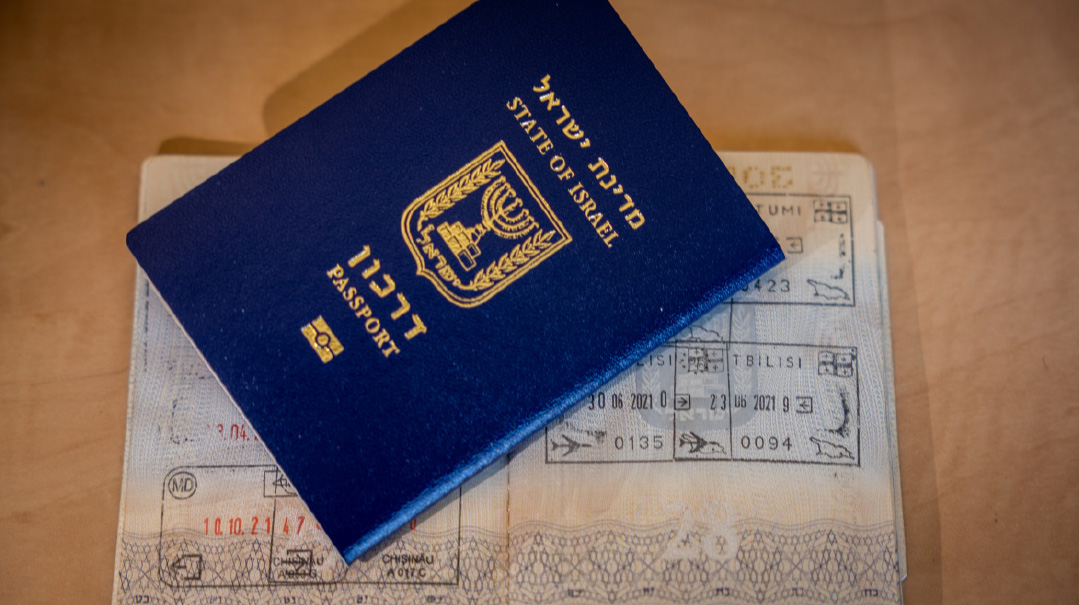
New Interior Minister Moshe Arbel on Israel’s Passport Chaos
Photo: Flash 90
He’s a chareidi who can speak the polished Hebrew favored by educated secular elites, and a shul rabbi with multiple law degrees. He criticizes the Israeli justice system — but not too harshly, as a product of Ono Academic College and Reichman University’s law program, taught by Aharon Barak, the father of the judicial revolution that put Israeli judges in charge of the government.
Please welcome Shas MK Moshe Arbel, the new minister of health and the interior. At 39, he’s one of the government’s younger ministers, and was only appointed to the two senior posts last month. Moshe Arbel is considered a rising star in Israeli politics and reminds many of the Aryeh Deri of the ’80s.
Arbel has accompanied Deri for years as the interior minister’s chief of staff, and was drafted to replace him in the cabinet when the High Court disqualified Deri from serving as a minister. Deri himself is still waiting for a legal arrangement that will enable his return to the government table.
But for now, Arbel is giving his job everything he’s got. He devoted the first two weeks of his term to tackling the Interior Ministry’s passport crisis, which made it harder for Israeli citizens to renew their passports than to get an American green card. The phenomenon came to a head when Russian hackers took over the government system for scheduling appointments, snapping up time slots wholesale and selling them on the dark web to the highest bidder.
We met Arbel this week during a surprise visit to Interior Ministry offices and hospitals. He’s keeping one ear attuned to Aryeh Deri, who’s still giving orders from afar to Shas MKs. But he’s giving all the rest of his attention to Interior Ministry staff, who have been forced to spend extended hours in the office to deal with a backlog of more than a million Israelis waiting for new passports. Unfortunately for the 30,000 kollel families who live in Israel without citizenship, the passport marathon has meant that all other normal Interior Ministry services have ceased totally for weeks.
Minister Arbel sat with Mishpacha to discuss this crisis, as well as how the judicial reform and the Knesset debate over the budget have impacted chareidim.
With your permission, let’s start with the story that’s been occupying you night and day. How did we reach a state of affairs where an Israeli citizen can’t get a passport?
You have to go back ten years to understand the magnitude of the crisis. About a decade ago, Israel began switching to biometric passports to prevent fraud. Naturally, the process of issuing a biometric passport takes more time, and this led to congestion. Add to this the Covid pandemic, which led many to delay renewing their passports because there were no flights… And on top of all that, Israel’s population growth is the fastest in the West.
Largely thanks to the chareidi community…
Thanks in part to the chareidi and Arab communities, but the average in the rest of the population is also higher than in the West, and of course we see this as a blessing.
But all these factors led to a massive traffic jam on the waiting list for passports. All kinds of solutions have been tried over the years. The previous government’s interior minister, Ayelet Shaked, came up with a temporary solution of issuing non-biometric passports good for two years, but now that those temporary passports have expired, it’s intensifying the congestion.
And then we have the unbelievable story of the Russian hackers who took over the appointment scheduling system of a country that calls itself the “start-up nation.”
That’s true. There were hackers, some of them Russian, who took over the scheduling system and sold appointments to the highest bidder. What led to this is a distortion in the law. The current law allows any new oleh to receive Israeli citizenship, even if he doesn’t reside in Israel. But many immigrants from the former Soviet Union have abused this. They arrive on a stopover in Israel, obtain a passport, and continue to their actual destination country. And for those taking advantage of this loophole, it’s worth it to purchase an appointment from the hackers, to save the costs of a few days’ stay in Israel. They land for a few hours, get the appointment they bought from the hackers, obtain a passport, and move on.
KNOCK-ON EFFECT A passport blitz for Israelis means no appointments for Americans visiting the country – and it’s no use queueing at the US embassy without documents
What you describe is hard to believe, not only with regard to the hackers taking over the government system, but in the very fact that you can obtain citizenship that easily, with no commitment.
And for that very reason, we’re advancing a bill that would bring back the requirement of a year’s residence in Israel as a condition for receiving a passport. As for the hackers, we’ve taken steps to deal with this technologically, but I’ll admit that for all our capabilities, we’ve been unable to eradicate this phenomenon.
And this is where we come to my initiative of opening the four largest offices of the Population and Immigration Authority (including another in Bnei Brak) to the public all day long. This has deprived appointments of economic value, because you can get service without one.
The pile-up at the Population Authority’s offices brought to mind the waiting lines outside bakeries on Motzaei Pesach.
In the first four days of the operation, we issued more than 50,000 passports across the country, which is a record number. I expect that by the end of the operation, we’ll have hit 250,000 passports.
There are some 30,000 yeshivah students from abroad in Israel (most of them Americans) who have to apply to the Interior Ministry for every little thing, and because all resources are being directed toward Israeli passports, they can’t get service. For example, if a child is born, they can’t get a passport to leave the country. How do you intend to deal with this? Because there’s a substantial number of foreign nationals, mostly Americans, who are directly impacted by this move.
We’re aware that the operation to solve the passport crisis is coming at a cost. But we want people to understand that it’s a temporary measure that will, in the long run, enable more efficient service in the visa department as well. Nevertheless, we’ve created a special e-mail address for humanitarian cases to which you can apply for help throughout the course of the passport operation. [Readers can contact Mishpacha for details.]
But at the end of the day, you have to admit that this operation is coming at others’ expense. You don’t have sufficient manpower to deal both with passports for Israeli citizens and with tourist visas or integrating new olim.
We’re trying to minimize the damage, but I’m aware of the temporary difficulties, and my policy on this is simply that the many take precedence over the few. Over 1.2 million Israeli citizens are in line for passports, so that’s the priority.
You went for a creative solution, but if that’s the number, you won’t be able to get more than a million passports in a few weeks. This traffic jam will never end…
A shortfall of over 1.2 million passports is indeed a large number, and you’re right that even if we do reduce it — and with G-d’s help, we’ll reduce it dramatically — it still won’t solve the problem entirely. A long-term solution can be achieved through technological means. In Ireland, the UK, and other Western countries, people can get passports from the comfort of their homes through a computerized identification system. I held discussions about this with the government’s digital division.
My argument was that if it’s possible to transfer ownership of a car from home, it should be possible to obtain a passport in the same way. Even if a legislative amendment is required, I will make sure that it passes, and through the substantive dialogue that I am trying to maintain with the other side, I’ll make sure that even the opposition supports it.
We can’t leave this subject without mentioning the disgrace taking place at Israel’s ports of entry. It’s not a pleasant feeling as an Israeli citizen to go through and see the endless lines of tourists who just want to get their passports stamped and come in. What kind of welcome is that?
Your description is accurate. The issue has been on my agenda ever since I assumed the post. And I’m very familiar with the problem — after all, I was Deri’s chief of staff, and quality of service was his top priority. We do have a problem, and I won’t try to dodge responsibility for it.
But let me try to describe the situation for your readers: The Interior Ministry, which is responsible for border control, is struggling to recruit staff, because the salary — which is set by the Finance Ministry’s wages commissioner — is lower than the salary paid by the Airports Authority.
Wait a minute, I’m confused. These are two government bodies. Are you telling me that the government’s right hand is competing against its left hand for the same workers?
Exactly. And that’s exactly what’s so absurd about it. The moment we recruit new border control staff, they receive a better offer from the Airports Authority, which is also a government agency but isn’t subject to the limits set by the wages commissioner. And all this comes at the expense of tourism and everyone visiting the country. We’re talking with the Finance Ministry to help them understand the issue. There is stiff competition in the field of tourism, and to meet it, we have to provide better service.
And we also have a human obligation to fellow Jews and to everyone else who comes to visit our country. We all suffer when we have to wait in line at the airport on a trip abroad, and we shouldn’t do to others what we don’t enjoy ourselves. The welcome received by everyone arriving on a tourist visa is not good, and we’ll do everything possible to change that.
And now, as a minister, can you not only promise to try to change things but name a date when tourists will see a change for the better?
I can tell you this: It’s on my desk, it’s on my agenda. We need the finance minister for this, because of the wages aspect, and I can tell you that he’s on it — and I’ve brought the Tourism Ministry in as well. Everyone should understand that it’s in the national interest to provide efficient service to everyone who visits our country and to welcome them with respect.
Before the formation of this government, there was talk of amending the Law of Return, specifically the grandchild clause, to prevent non-Jews from making aliyah and receiving citizenship. Will the coalition move forward on this issue, or will every controversial move be put on hold, as the judicial reform was?
I’m no prophet, but I would walk on eggshells around the Law of Return in the current judicial situation. There may be room to reevaluate it in the future, but meanwhile, as long as laws passed before the Basic Laws are protected under the “preservation of laws” clause, reopening the Law of Return would be a judicial minefield.
There’s a list of rabbis abroad, mostly in the United States, who are recognized by the Interior Ministry for the purpose of confirming the Judaism of a candidate for aliyah or conversion. One noted rabbi from New York was on the list, Rav Berel Wein. But when he himself made aliyah, he was asked to provide proof of his own Judaism. So on the one hand, total non-Jews are allowed to come in, and at the same time obvious Jews are confronted with absurd demands…
The disadvantage of large bureaucracies is excess regulation. We try to reduce it as much as possible. At the same time, the regulations aren’t intended to discourage olim, chalilah, but rather to create efficient gate-keeping. The price we pay for this bureaucracy as a society is worth it in the long run, as granting full discretion to officials could lead to even greater distortions in granting citizenship to those not entitled to it.
As a chareidi, an Israeli, and a jurist, you see the tremendous polarization that the judicial reform has caused. Those watching from afar have the feeling that we’ve lost our way.
Polarization is a global phenomenon in our time. I’ve read a lot of studies that attribute this to the global transition to social media. It puts people in an echo chamber that reinforces their positions, filters out all alternative viewpoints, and leads to polarization. The fact that Israel isn’t the only country where this is happening isn’t a consolation, but it can give us some perspective and ideas about how to cope.
The current government hasn’t exactly helped solve this problem with the judicial reform, particularly with the way it’s handled it, to put it mildly.
First of all, about the reform: Israel needs legal reform in order to shore up public trust in our institutions, and for that, there needs to be change. Now I agree that this needs to be done with broad consensus, and the path to that runs through the talks at President Herzog’s residence.
Isn’t that defeatism, a way of raising your hands and admitting that you can’t take independent steps, even in a fully right-wing government?
On the contrary. My point is not only ethical, but practical, and I’ll explain how. In the previous government, Minister of Religious Services Matan Kahana advanced significant reforms in the area under his authority without broad consensus. The first thing this government did was roll back all his reforms.
And I tell my colleagues: We won’t be in power forever, and if we don’t want the same fate to befall our reforms, we have to advance them with as much agreement as possible. And so, beyond the need to heal the rift, arriving at agreements has a very high practical value as well.
Part of the difficulty in arriving at a compromise is the problematic composition of the government, in which the tone is set by the margins. Don’t you feel that you’re being dragged to the right?
Not at all. We’re standing by our positions. It’s true that the extreme flank of the coalition usually gets more media attention, but I think the public is tired of the polarizing discourse. They want service, they want to see that ministers are working for them. And if we focus on that, we’ll succeed.
Let’s move from a national issue to a sectoral one: The chareidim have become the face of the judicial reform and are bearing the brunt of the crisis. As usual, the media is fanning the flames, but at the same time there’s a sense that some chareidi MKs’ budget demands haven’t helped.
The Navi already wrote about “your brothers, who hate you and shun you,” and Chazal say that this refers to the age-old hatred for Torah learners, who have always been undervalued and reviled. But our job is to continue smiling, so that, as the Rambam said, people will say of us: “Look how beautiful are the ways of those who study the Torah.”
To me, this is a halachic imperative and a life mission. I think that if there’s any reason to enter public service, it’s to help people and sanctify Hashem’s name. After all, public service in modern Israel is neither rewarding nor enjoyable. Anyone who’s just in it for himself would do much better in the private sector. Our mission is to be mekadeish Sheim Shamayim and endear the Torah to the people. This is a sublime mission, and it’s doable, as well.
Nice words, but it seems that in this term, they aren’t backed up by action.
You bet they are, but here too, the media will focus on anything other than our successes in any area. And just to take my own area of responsibility as an example: the Health and Interior Ministries are both responsible for key government services, and these are areas where the coalition and opposition can agree on many joint initiatives. In a democracy, disagreements are a good thing, but in a period of polarization, it’s important to focus on areas of consensus. The health system serves Jews and Arabs, religious and secular, and they all stand shoulder to shoulder. The passport crisis also spans sectors.
In my view, it’s a kiddush Hashem that we, the chareidi community, as a minority, come from the perspective that seeks the good of everyone through cooperation. And even if there are disagreements, it’s good to rally around common goals. I see my colleagues in our various roles also doing a lot of good for the entire public.