
Remaining Embers

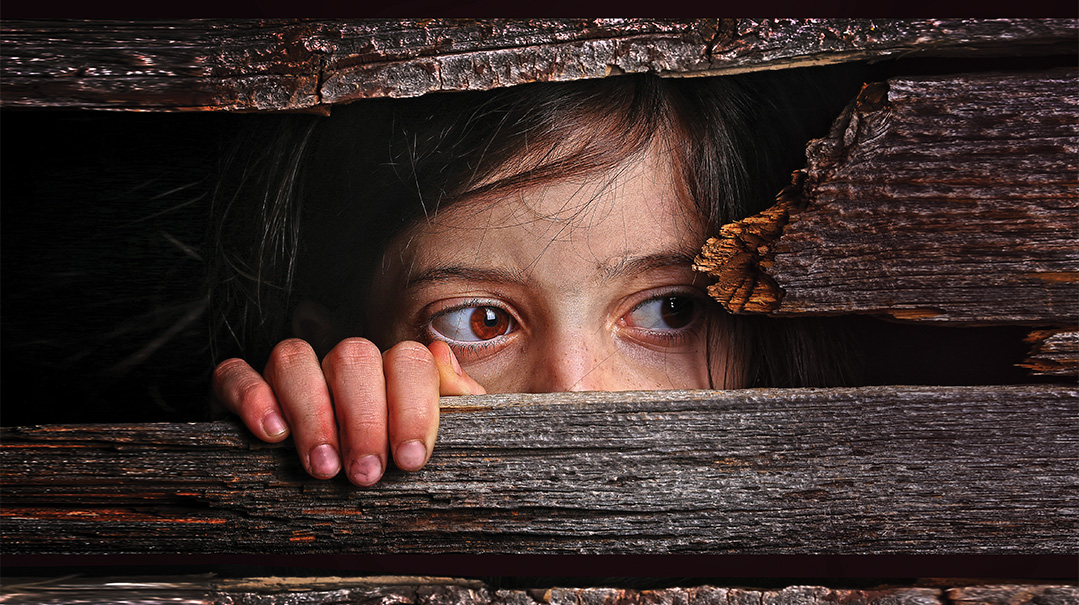
And then the Nazi demon arrived. Her family scattered; little Esia Friedman went into hiding. A story of faith amid the flames

As told to Tzivia Meth by Esia Friedman
Vilna, September 1943
“ ‘This is it,’ Mama said, ‘Now you must go. Hopefully yo′u will survive.’
“I was freezing — I had one little coat,” Esia Friedman recalled of that day.
“ ‘When I send you away, you must only speak Polish,’ Mama said, ‘because if you speak Russian or German, they’ll know you’re a Jew.’
“She dressed me in my dirty coat and said, ‘But you must remember — mein kind, zolst nit fargessen — don’t forget that you’re a Jew.’ ”
With those words, Esia’s mother sent her young daughter away from the ghetto — to danger and possible death, but also to the chance of survival.
Great Connections
Esia Friedman (née Baran) was born in Vilna in 1930. Her father Yitzchak was a wine distributer, and her mother Aidel was a homemaker. Esia lived in a small courtyard, surrounded by grandparents, aunts, uncles, cousins, and friends.
“We had a wonderful life, despite the antisemitism,” Esia recounted on a beautiful spring afternoon this past May, speaking at Shevach High School in Queens, New York. At 92, her undiminished sense of humor and youthful spunk, interwoven through her tragic story, captivated her teenage audience, many of whom were too young to remember their own Holocaust survivor great-grandparents.
Spiritually, it was paradise. “My street had ten synagogues,” Esia proudly recalled. Rav Yisrael Zev Gustman, renowned rav and dayan in Vilna, lived down the block. But it was Shabbos afternoons that were particularly memorable. After the seudah, her maternal grandfather, Rav Binyamin Dov Shoag (a noted talmid chacham who spoke 11 languages), would learn with Rav Chaim Ozer Grodzenski, Rav Gustman, and others in his home. Esia often came along and was thus afforded a close-up glimpse of the spiritual giants of her time.
“After the cholent, they’d all go to my grandfather’s house to study and argue. We kids used to sit on the floor, or sometimes on the red velvet couch in the living room, and listen to them,” Esia remembered. Her 16-year-old brother Zev (Velvel) was the only child who learned with the illustrious group, but she and the few other children “didn’t understand a word they said,” she admitted with a chuckle.
Esia’s idyllic childhood soon came to a crashing halt. In September 1939, Vilna, which was part of Poland between the wars, was taken over by the Soviets. Shortly thereafter, in October 1939, it was given back to Lithuania, which had always considered Vilna Lithuania’s capital and resented its time in Polish hands. Many high-ranking Poles in Vilna feared harsh treatment from the Lithuanian government and were desperate for cover.
Esia’s father, who had been appointed head of the military hospital in Vilna under the Soviets, became a noted address for help. One individual assisted by Esia’s father was Rav Yisroel Zev Gustman, who became Mr. Baran’s “medical assistant,” thereby avoiding working on Shabbos. Another man, Leon, had been a prominent official in the Polish police department. Leon knew the Lithuanians would soon be after him, so he begged the well-connected Yitzchak Baran for assistance.
Esia’s father quietly put a plaque with his own family’s name on Leon’s door, and the Lithuanians soon gave up the chase. Yitzchak Baran didn’t know it then, but this small act of kindness would yield high dividends only a few years later, when Leon and his wife would save Esia.
A Family Torn Apart
While Esia’s time during the early days of the war was smoothed by her father’s connections, her life soon took a shuddering turn for the worse in June 1941. The Germans were about to invade Lithuania — and Yitzchak Baran knew that his position would be of no help to his family under the Nazis. The only recourse was to flee eastward, into Russia.
“My papa came and said, ‘Aidel, take the children — we’re being evacuated,’ ” Esia recalled. He was driving a truck borrowed from the Russian military depot, ready to depart. But there was a hitch in the plan: He could only take his immediate relatives — there was no room for any of the extended family, who were all an integral part of the Barans’ life. Aidel refused to leave them. “If they can’t go, we all die together,” she declared.
Yitzchak went to return the truck to the Russians, but he never came back. The Russians refused to let him — a military employee — go home, and instead forced him to continue his service in Russia. His family was bereft and clueless about his fate. (Yitzchak was forced to serve in the Russian army for many years, even after World War II ended. Ultimately, after years of separation, he was reunited with his family in Meriden, Connecticut.)
Like his father, Esia’s older brother knew he’d be a prime target for the Nazis for two reasons: First, he was a talmid chacham, and second, he was active in the Beitar movement. Thus, 16-year-old Zev made himself disappear shortly after his father. When the Germans marched into Vilna on June 24th, 1941, Esia and Aidel were completely on their own.
It didn’t take long for the situation of Vilna’s Jews to deteriorate. “Within minutes, and I mean minutes, the Poles attacked us with a vengeance. They began to come into our houses and take whatever they wanted. We couldn’t go on the sidewalk…” Esia described. The Germans, for their part, began rounding up Jews — some to be murdered and some to be used as laborers.
Luckily, Esia and her mother were chosen to be part of the latter group. Every day, the Germans “threw us on a truck and took us to a place called Riese, where we were working on a farm,” Esia recalled. At night, they were told to return home by foot — but Aidel, wary of bloodthirsty Poles, decided to brave the forest with Esia instead. The ordeal was a terrifying one for the 11-year-old girl, but nothing would compare to what lay ahead.
Within weeks, by September 1941, the German annihilation scheme was in full swing. “Suddenly, they began to take away our young people, our religious people,” Esia recounted.
Aidel begged her daughter to escape. “She wanted me to go to those Polish people my papa had helped,” Esia remembered. “But I said, ‘No, I’m going with you!’ And she said, ‘Together we will die.’ And I said, ‘That’s okay.’ ”
“When you’re nine, ten, eleven,” she remarked of her decision at the time, “what do you know?”
All too soon, the Germans showed up in Esia’s courtyard. She watched them drag out her best friend Nechamaleh and an elderly couple from the next building.
The Germans were almost at their door. Esia’s Aunt Batya, Uncle Avrum, and their children were dragged to the trucks next. Chava, the baby, was crying, so “they put an end to that,” Esia recalled grimly. “Those were the wonderful Ukrainians, Poles, Germans, and Lithuanians.”
Again, Aidel begged her daughter to flee. They both knew where the trucks were headed: a beautiful wooded area outside Vilna called Ponary, which had been a popular holiday spot before the war. Now it was used as a mass killing site: Around 100,000 Jews would be murdered there by the end of World War II.
“No, I’m going with you,” Esia declared. She and her mother were shoved onto a waiting truck, fearing the worst. But they were spared — this roundup was not headed for the dreaded killing site, but instead, for the Vilna Ghetto.
Esia and Aidel had escaped immediate death, but Esia’s mother was not deceived about their eventual fate. She immediately set to work scouting out hiding places for her daughter: in the attic, behind the closet, under the bed — any place out of sight. “The first thing that came to her mind was that I had to survive. She’d already lost her husband, her son, everyone, and so her only desire was that I live,” Esia remembered.
While Esia crouched, utterly silent, in different hiding spots throughout the ghetto, Aidel was lucky enough to receive a work permit in the ghetto hospital. She brought Esia whatever scraps of food she could procure, refusing any for herself. And slowly, the ghetto inhabitants were disappearing. “First they took the old people, then the babies,” Esia described, crying for a moment at the horrible memory.
By September 1943, the final liquidation of the ghetto was imminent. Aidel knew this was her last chance to save her daughter. Trembling in the shadow of the ghetto wall, Aidel wrapped Esia lovingly in a threadbare coat, reminding her to speak only Polish, so as not to give herself away. Then she shoved her 13-year-old daughter through a hole in the ghetto wall and sent her to seek freedom.

Happier times, clockwise from top left: Esia’s maternal grandfather; Esia as a little girl before the war; Esia’s older brother, Zev/Velvel, before the war, and then after the war; Esia and Velvel with their father, Yitzchok; Esia’s house on Wilkomierska Street in Vilna; Rav Shoag
Always Hiding
“I set out on a journey, scared to death,” Esia recalled. Showing her terrified face to the world, though, was essentially a death sentence. So, following her mother’s advice, she skipped all the way to the apartment of Leon the police chief, pretending to be carefree, all the while engulfed in fear.
Luckily, her siyata d’Shmaya held. Esia soon reached a beautiful building that housed the nobility of Vilna — and no one was guarding the door! Esia didn’t waste time. She slipped into the building, found Leon’s apartment, and knocked on the door.
“What are you doing here?” Leon’s wife Anna asked.
“Mama said they’re going to kill me. Maybe you could take me in?” Esia entreated.
Anna grabbed her out of the hallway with a hurried “shhh” and went to consult with her husband. After conferring in whispers, the verdict was in: “We’ll hide you.”
There were no registered children in the Polish couple’s building, and they knew that having Esia pose as a gentile would be futile. So with ingenuity and daring, they crafted an array of hiding spots in and around their building: “They’d hide me in the garbage bin, they’d hide me under the bed, they’d hide me in the cellar…” Esia recounted.
But with all the pluck and fortitude of Leon and his wife, there were many close calls. One night, they awoke to hear loud banging on the door. Anna, thinking quickly, told the Germans through the door that she needed to put on her robe. She shoved Esia under her bed, and Esia, with rising dread, watched their boots storm through the apartment. Miraculously, they didn’t find her.
Anna and Leon realized they needed a better hiding place. They tried concealing Esia in an alcove behind the door — sprinkled with pepper to hide her scent — but it was too close for comfort. They decided, instead, to send her to a wooded area behind the apartment whenever they heard Germans in the vicinity.
Living in the woods, however, had its own set of dangers — Esia soon came down with an infection. “Red stripes were going through my arm,” Esia recollected, and Anna realized there was no choice but to take her to the doctor. She introduced Esia as “her niece from Warsaw,” hoping the ruse would work due to Esia’s fluent Polish and fair coloring. The doctor politely asked them to have a seat, then left the room. But Anna realized something was amiss. Grabbing Esia by the arm, they fled the room — and not a moment too soon, as the doctor had indeed gone to turn them in.
Death lurked in every corner — even when close relatives came to visit. After a series of knocks one day, Esia scrambled under the bed, only to realize that the visitors were her Uncle Ezriel and his wife Rebecca, sitting emaciated on the couch. “It was like Mashiach had come,” Esia recalled.
Uncle Ezriel announced that his best friend, a gentile, was arranging false papers for him and his wife. They only needed a place to hide until the papers were ready. Having no clue that he was about to save her life, Ezriel asked Esia to bring him a glass of water. She dutifully went to the kitchen, followed by Leon’s dog, when suddenly, the Germans stormed into the apartment. Ezriel’s “best friend” had betrayed him. The dog, sensing Esia’s predicament, hastily tugged her down the steps to the cellar. Her aunt and uncle were not as fortunate — they were dragged out of the apartment. Through the grimy basement windows, Esia watched them executed the following morning.
Unexpected guests usually portended peril, but one day, Esia found a visitor who heralded safety and hope. “On the couch sat a lady, without teeth, with broken hands, and she was so old-looking that I got scared — she looked just like a scarecrow,” Esia remembered. She had no idea who this old lady was.
“Esia, it’s your mama!” Anna told her. Since Aidel Baran had previously “looked like she was 16,” Esia was shocked by the revelation. Aidel described her horrific experiences and miraculous delivery from death.
Mrs. Baran had been taken to a labor camp outside Vilna to dig peat (Rav Gustman was there as well). For sport, the Nazi guards would tell the prisoners to run and then would engage in “target practice.” Under this horrific tension, Aidel remembered a nugget her Beitar-trained son had told her: If someone is shooting at you, run in a zigzag. She did so and was spared. Not content to let her go free, however, the Nazis knocked out her teeth and broke her hands.
But this was not the end of the nightmare. Soon afterward, the Germans placed Aidel and the remaining prisoners in a barn and set it aflame. On the brink of death, she was pulled back to life — she was right by the doors, and a Lithuanian manager, short on workers, grabbed her from the flames and put her to work. As soon as she got the chance, Aidel fled. She sought out Anna and Leon and remained with them, reunited with Esia, until the Russians liberated Vilna in July 1944.
A Rocky New Start
Even with the Germans gone, the Barans’ troubles were far from over. Venturing out of Leon’s apartment after the liberation, they found Vilna’s Poles just as murderous as they had been on the eve of the German invasion. Esia narrowly escaped being shot, and it was only due to Anna’s insistence that Esia was her “niece from Warsaw.”
And then there was the problem of housing. Braving their way through bombed-out streets, Aidel and Esia returned to their old apartment, only to find a Polish family living there — and threatening to murder them if they didn’t leave immediately. “So we slept in our yard,” Esia stated matter-of-factly.
But Aidel and Esia’s stint as wanderers was short. Aidel found an apartment vacated by Nazi sympathizers, and her new home soon became a hub for returning Jews looking for a warm meal and news of relatives. Determined to make sure that the rest of Esia’s childhood should be as normal as possible, Aidel set out to register her daughter in school.
Since there were no Jewish schools in Vilna (no Jewish children were left), Aidel set her sights on a local Polish school. This led to an awkward yet humorous misunderstanding. At the interview, the headmistress requested Esia’s name. In Europe, last names are given first; hence Aidel’s reply was, “Baran, Esia.” The headmistress thought she was a baroness! She was thrilled to receive such a distinguished applicant — until she requested Esia’s report card. Aidel then admitted the truth: “We’re Jews, we have nothing.”
The headmistress was not amused — and recommended that Aidel take her daughter to a Jewish school instead. But Aidel “wasn’t scared of anybody.” She looked the headmistress straight in the eye and demanded: “Where do you want me to take my daughter? To Ponary?” Esia was duly enrolled.
An even greater consolation was in store for Esia and her mother. One day, they were taking a walk on Wilkomierska Street (Groys Sznipiszik in Yiddish), where they had lived before the war, when Esia noticed a Russian officer standing in front of their old shul.
“What a nice-looking officer,” Esia commented to her mother. To 15-year-old Esia, the Russian soldiers were the heroes who had rescued them from the accursed Germans. But Aidel was wary of too-friendly officers: “Be quiet, Esia, or he’ll hear you,” Aidel hushed her daughter. Unexpectedly, the officer turned around. “Are you my sister Esie?” he asked.
It was her brother Zev, who had gone underground in the prelude to the Nazi’s invasion, and now resurfaced as a decorated officer in the Russian army.
Esia’s brother Zev was determined to escape the blood-soaked Vilna, but as a Soviet officer, leaving his post wasn’t easy. While waiting for an opportunity to escape, he put his time in Vilna to good use. Esia would make false papers for Jewish men in the Russian army, and Zev would lead transports spiriting them out of the country.
Together, Esia and Zev saved a Jewish child from spiritual perdition. One day, about a year after liberation, Esia was walking on her block and noticed a young girl with blonde braids on the other side of the street. Esia stared at her for a moment and then recognized her good friend Chayaleh (Szczeranski) from elementary school.
Esia hurried across the street and greeted her in Yiddish, thrilled that her old friend had survived. But Chayaleh, obviously frightened, responded that she didn’t understand Yiddish. Esia wasn’t so quick to let her go: “How did you know I was speaking Yiddish?” Chayaleh started crying, and the story soon came tumbling out.
Chayaleh’s nanny, a German Catholic, had baptized her young charge and sent her to a farm to work for a doctor’s family. Chayaleh was terrified to leave them now, afraid she would be burned at the stake like the famous ger tzedek, Avraham ben Avraham. But Esia wasn’t deterred: “I told her she has to come back to us.”
She finally managed to convince Chayaleh to return with her, particularly because Esia knew Chayaleh’s aunt had survived in Russia and was looking for her. But Chayaleh’s fears were not unfounded. Shortly after Chayaleh’s disappearance, her nanny showed up at the Barans’ door with two Polish men. They threatened to kill the family if Chayaleh was not returned.
Aidel refused, and Zev, hearing the commotion from the next room, decided to intervene. Wearing his Russian army jacket and holding a gun, “He came out and said that if they don’t leave, he will not only kill all of them but every relative that they have,” Esia recalled. They left and were never heard from again. Chayaleh was placed in the Jewish orphanage established by Rav Gustman and later reunited with her aunt.
The Barans eventually escaped from Vilna — helped by a Jewish NKVD officer, of all people. Esia acknowledged that he was eager to help because he was hoping to marry her. In the years in Europe after the war, Esia recalled, “I had all the proposals in the world.” But Esia didn’t let it go to her head; it was too sad: “Every young man who survived wanted to marry me, not because I was anything — after all, I was a kid — but because there were no Jewish girls…”
After detouring through a DP camp in Austria, Esia and her family eventually made their way to Meriden, Connecticut, where many of Aidel’s relatives had moved before the war. Edward Friedman, just out of the US army, saw Esia in shul not long after she arrived and decided, on the spot, she was for him. The courtship took a few years, since Esia didn’t speak a word of English. But when Esia discovered that Edward’s grandparents hailed from the same street as hers in Vilna, she felt it was clearly bashert.
As Esia concluded her speech, the teenage girls began to stir. It wasn’t just the tragic elements, or the nonstop Hashgachah pratis, but her special personality — weaving humor and tears through her narrative — that captivated her young audience. And she clearly loved interacting with them.
At one point, when recounting how the Nazis murdered Jewish babies, Esia broke down in tears. But when she looked out at the girls, she regained her composure, taking comfort in the contrast between her bleak memories and the hopeful future before her eyes: “When I see your faces, it does my heart good.”
The Giants in Her Life
The Barans’ relationship with gedolim went well beyond the beis medrash. Rav Chaim Ozer attended Esia’s brother Zev’s bar mitzvah, and Esia’s grandfather was Rav Gustman’s shadchan.
After she was already married with adult children, Esia traveled with her grown son Rabbi Cary Friedman (who was featured in Mishpacha in 2007 in “Wanted by the FBI”) to Eretz Yisrael and went to visit Rav Gustman.
Rav Gustman’s secretary refused to let Esia see him, however, as Rav Gustman was about to give a shiur. “I’m pushy,” Esia recounted. She insisted Rav Gustman would be happy to see her. When Rav Gustman came out with one of his students, Esia told him that she was Rabbi Shoag’s granddaughter. “He turned to his student,” Esia recalls, “and said, ‘That was the greatest scholar I ever knew, and he was my shadchan.’ ”
In gratitude for what Rav Shoag had done, Rav Gustman had told Esia right after the war, “Mein kind, when you get married, I will charge you nothing.” “He had a great sense of humor,” Esia remembers.
With thanks to Leah Forgosh, Chaya Mirsky, and Ahuva Jurkowitz for their help in organizing the recordings and pictures for this piece.
(Originally featured in Family First, Issue 802)
Oops! We could not locate your form.
RELATED CONTENT

What it’s like living with an invisible allergy no one believes exists

How to partner with your child’s school with clarity and calm


Once a hunted child, Rebbetzin Shulamis Wolpe became a builder of souls

Everyone has a shidduch story… right? We decided to find out
