Tunnel Vision
| October 5, 2021Deep in the crevices of the Kosel Tunnels adjacent to the Western Wall, we’re about to step into a time warp

Photos: Elchonon Kotler
Within the walls of the Har Habayis, the Muslim Waqf might at this very moment be working on eliminating even more traces of Jewish life amid the ancient stones and structures, as they’ve shamelessly and systematically been doing since being given authority over the Temple Mount five decades ago. Yet while they’ve been trying to change the facts above ground, determined to create a new narrative that excludes any historic ties to Judaism’s holiest site, history is indelible: The truth lies within every layer of soil. Dig down through the layers of time and you come face to face with the area’s glorious Jewish past.
There’s drilling to the left, excavating to the right, and banging above our heads, and here we are, in the deep crevices of the Kosel Tunnels adjacent to the Western Wall, about to step into a time warp. Many readers are surely familiar with the Tunnels, an underground excavation wonder that bears testimony to Jewish life during the Hasmonean and Second-Temple eras. And if you’ve been there, you’ve undoubtedly noticed some curious digging and reinforcing going on dozens of feet beneath the wooden ramps, walkways and bridges. Now we’re about to descend and find out what secrets lie so many meters deep.

Every Stone a Story
Not a week goes by without some discovery or fascinating find,” says Mordechai (Soli) Eliav, director of the Western Wall Heritage Foundation, whose organization, together with the Israel Antiquities Authority, has recently uncovered two impressive ancient buildings that abutted the Western Wall until the destruction of Jerusalem. (The original street level was at least 45 feet below where it is now, and the part of the Kosel we see today is really just the upper layer, and only 200 feet of it at that; the original Wall begins many dozens of feet below, the remaining 1,600 feet running underground, underneath what today is the Muslim Quarter. The Tunnels reveal hidden sections of the Kosel, with its mammoth stones, as it follows along underground passages, mikvaos and ancient water systems.)
The first thing Soli points to during our descent is what they call the “cliff,” a huge rock upon which one can still see the remains of an aqueduct that carried spring water to the mikvaos near the Temple Mount.
“That’s one of the main spots where the surviving Jews took shelter immediately after the destruction of the Beis Hamikdash, and from there they set out to 2,000 years of galus. So we’re standing at the Jews’ last holdout after the burning of Jerusalem,” Soli says. “You know, I’ve had the opportunity to guide some pretty distinguished people here, from all over the globe, and I always ask them one question: ‘Where else have you seen a people that for 2,000 years hasn’t given up their land, that continues believing and praying several times a day, Next year in Jerusalem?’
“When I put this question to the head of the OECD, he had an interesting answer. ‘That’s a good question,’ he told me, ‘but I have a question for you: Do you yourselves understand how this happened?’ And then it hit me — Ein ba’al haneis makir b’niso (the beneficiary of a miracle doesn’t recognize it as a miracle). We really don’t sufficiently appreciate that our very existence as a people who have survived in galus and still believe in the Geulah is completely miraculous. There’s no rational explanation for it.”
Soli steers us to a wooden staircase leading underground, so we can have a look at the findings unearthed in the recent excavations.
A quick look around reveals the extent to which every stone tells a story, every untouched layer contains the history of an entire period. Soon we feel as if we’re standing smack in the middle of ancient Jerusalem.
“Try to imagine the Ramban, who couldn’t find a minyan when he arrived in Jerusalem in the 13th century, standing on top of this place,” Soli says. “He sees the ruins and tells his few talmidim that the Geulah will yet come, and even if it’s a thousand years, a day will come when the Jews will return and tell the story of what happened here. Lo and behold, here we are, standing on the shoulders of our ancestor’s faith.”

Layer by Layer
What’s most amazing about this underground treasure trove is that there’s layer upon layer here, with each stratum dated to a different period. The miracle of preservation is that the various conquerors in subsequent generations didn’t care about the history of the preceding masters, and also didn’t bother destroying their remnants; instead, they just covered everything with earth and built over it.
“That’s why during our excavations, we found a large amount of pottery from a variety of periods,” says Soli. “Of course, every finding was fascinating, but the most interesting ones for us were those identified by archaeologists as belonging to the Bayis Sheini period, and it was as if they were just waiting there undisturbed for us to uncover them.
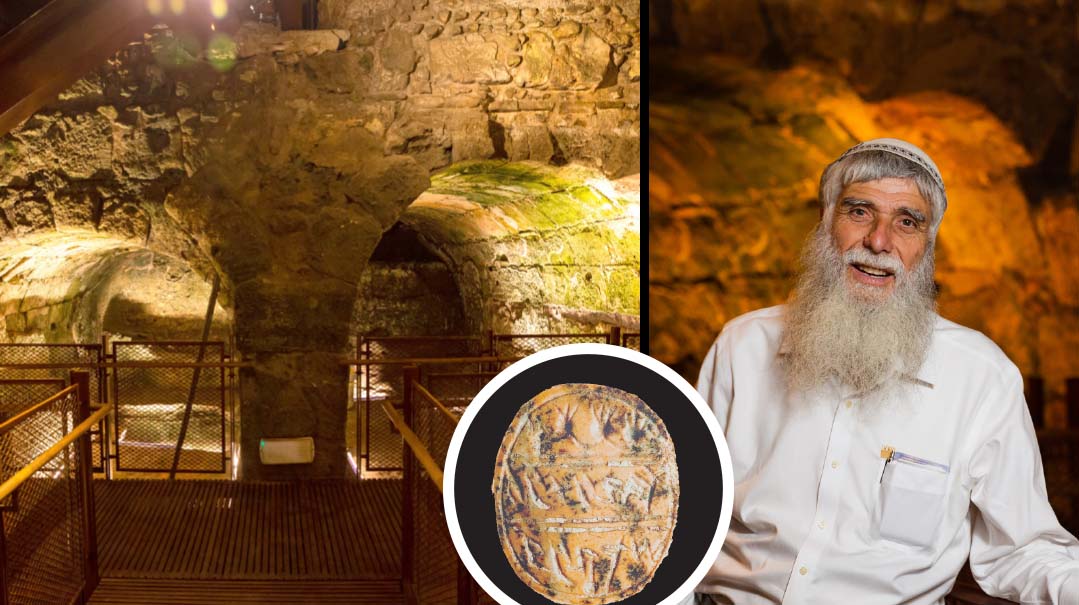
“But the truth is that we were in for a huge surprise. During the digging here we discovered pavement dated to the Roman era, and underneath it we actually found seals from the time of King Chizkiyahu, hundreds of years before. We also found a black seal engraved with the figure of an archer shooting an arrow with the inscription ‘To Chegev’ (i.e. belonging to Chegev) in ancient Hebrew lettering. It’s highly probable that the seal’s owner was an official in the Judean army, and its discovery near the Kosel proves the importance of the building, which belonged to the state bureaucracy during the first Beis Hamikdash.
“And one day we found a signet ring on which was inscribed in ancient Hebrew letters, ‘To Netanyahu ben Yoash.’ This was an important find, because it proves that the owner of the ring, who was almost certainly an official of the kingdom of Judea, lived in the vicinity of the Beis Hamikdash.
“So you see, we stand here watching history unfold, layer by layer.”
Before digging, do you have rough guesses of what you’re going to uncover?
“We can make informed guesses,” Soli emphasizes. “For example, we knew we could expect to find a Roman street here. But did we imagine that we would find artifacts and buildings from the time of King Chizkiyahu? Not in our wildest dreams. And yet we did find them, and that was an excitement that no words can describe.”
What was the most impactful discovery you ever made?
The Tunnels excavation isn’t something new — after the Six-Day War, the Ministry of Religious Affairs began the excavations to expose the continuation of the Kosel, and our organization took over for them about 30 years ago. And despite many fascinating archaeological finds along the way, for me, the most moving was years ago when we unearthed several lower courses of the Kosel, which were covered for 1,700 years. Chazal tell us that the Shechinah never departed from the Western Wall, so to uncover its stones was ‘l’okmei Shechinah m’afra — to raise up the Shechinah from the dust.’”
As we pass newly-installed beams and reinforcements, Soli explains that as much as the archaeologists consider themselves the leaders of these investigations, the real heads are the engineers. They’re the ones responsible for making sure the streets above remain stable and secure.
Here, on top of the area where we’re digging, there’s an entire city built on what is essentially an entire mountain of ruins.
“Essentially, all the ancient land and the remains of destruction were covered over,” Soli says.
“So in all our work we’re guided by engineers, who might even instruct us to stop in the middle of an excavation. Of course, as we dig we have to make sure to support the existing structures above us, so our work is basically double.”

Bedrock Hideout
Soli leads us up a darkened corridor deep under the “Beit Strauss” complex, an ancient building complex purchased by philanthropist Nathan Strauss, which was once a soup kitchen, and today houses the public facilities and the entrance lobby to the Kosel Tunnels.
Under the white mosaic floor of this 1,400-year-old structure—built on what was at the time the street level — is a real mystery building: a 2,000-year-old three-room complex, which had been painstakingly chiseled by hand out of bedrock prior to the fall of Jerusalem in 70 C.E. This building is the first solid evidence of civilian life gone underground so close to the Beis Hamikdash during the Roman siege of Jerusalem.
“This one is a real enigma,” Soli says, “because this is the first structure of its kind discovered in the Kosel area. The complex consists of an open yard and three chambers underneath, all arranged in three levels, one over the other, connected by stairs carved out of the rock.
“This is especially mystifying to us because in Jerusalem 2,000 years ago, as now, most buildings were constructed out of stone above ground. So why did they invest so much time and energy into hewing these subterranean chambers out of the bedrock?
“If you look closely,” he adds, “you can make out depressions at the entrance to the carved-out rooms, no doubt for hinges and bolts, while round and square niches are for shelves and storage, as well as niches for oil lamps — all chiseled out of the bedrock. We also found clay cooking vessels, pieces of oil lamps, a stone mug unique to the Bayis Sheini period, and a fragment of a water basin. Many of these vessels, as others we’ve found in the vicinity, were typically made of clay or stone, as they aren’t mekabel tumah.”
All these findings, Soli says, indicate that the building was in daily use. It might have served as a basement pantry, living quarters, or even a place to hide during raids. It also might have been part of a much larger structure that has since been obliterated.

Making a Splash
If seeing that hideout home wasn’t enough excitement, Soli is leading us toward another recently excavated structure that he guarantees will take our breath away — impressive new sections of one of the most magnificent public buildings from the Bayis Sheini period, uncovered in Jerusalem outside the walls of the Har Habayis.
“Portions of this building were actually uncovered years ago,” Soli clarifies, “and now that we’ve completed work on securing the structure, we’re inviting the public to look.”
He’s right. It takes several minutes for the vastness of this structure to sink in. The building consists of two magnificent halls, with an elaborate fountain in between. The walls of the hall and the body of the fountain are adorned with an ornamental cornice, above which are columns topped with Corinthian capitals, into which pipes were integrated to let the water flow through.
“The building was right off the main road ascending to the Har Habayis, and was probably used for public functions, including possibly the city council, as well as hosting dignitaries before their entrance to the Beis Hamikdash,” Soli explains. “Just try to visualize how splendid the place must have been, with the two ornate reception rooms on either side and a gushing fountain in the middle.”
One of the chambers of this ancient “city hall” was in fact discovered and documented in the 19th century by Charles Warren. Other archaeologists also studied the room in the 20th century, although none of them were able to put it into an accurate context. But after taking up some of the ancient flooring and performing carbon-14 dating on organic materials from the building’s base, as well as finding coins and pottery remains, archaeologists believe the building was constructed around 50 years before the Churban. During those 50 years, it seems as if the opulent fountain was taken out of use, and a mikveh was added.
The building still holds mysteries though, like, for example, what was the water source for the fountain? Researchers suspect that it wasn’t a constantly-flowing spring, but rather hand-filled through an intricate system of lead water piping that was likely only used when important people arrived.
The most shocking thing about his events hall is that it was discovered pretty much in its entirety. That’s because one of the unique features of ancient Jerusalem is that many whole sections were left completely intact under the ground. In general, new construction by later conquerors was over older structures, with the old ceilings serving as building bases, and still-intact chambers underneath used as basements or cisterns, or even hideaway living spaces.
“This is exactly how we found it,” he says. “We didn’t touch a single stone.”
And that’s also an archaeologist’s greatest challenge, especially in an area so rich and well-preserved that every strata has value.
“If we suspect that there may be something under the upper layer of dirt and rock, we drill down a bit and insert a camera to try to figure out what we’re looking at underneath,” he explains. “Once we confirm that there is indeed something to dig for, we get to work clearing away the layers of rubble. Here, for example, once we realized what we were seeing, we made the decision, along with the Israeli Antiquities Authority, to only excavate part of the site in order to preserve other important subterranean structures. Every building is important — we can’t take one apart in order to totally uncover another one.”

Still Purified
As we’re standing right outside one of the ancient entrances to the Har Habayis, it’s really no surprise that we’d find a series of mikvaos that would have been used by the many pilgrims — and, in fact, among the more dramatic finds were the mikvaos unearthed one after another, in their original condition.
Soli points out a wide mikveh taharah. “This is one of the biggest mikvehs dated to around the end of the Bayis Sheini,” he explains. “We haven’t yet dug it out in its entirety, but we suspect it’s bigger than it looks. We suspect it was used mostly by VIPs, but of course we can’t be sure.
“And look here,” he adds. “Here we have another mikveh, also quite impressive, but smaller. If you notice, it has an interesting shape, more rectangular than regular mikvaos, but we measured and found that if one lies down inside it, he’d be submerged precisely according to the halachic requirement.”
Soli steers us toward another mikveh down slanted stone steps. “We don’t know whom this served either, but it’s highly probable that it was used by the Sanhedrin, as it’s right at the foot of the Kosel, the outer wall of the Har Habayis. Next to it we found another magnificent building, which we conjecture was where people gathered after using the mikveh.”
Those ancient mikvaos are no longer in use, but as we made our way back up through the centuries into daylight, we felt purified as well — as we return to the sunlight of above-ground, living Jerusalem, we know we’re connected in such a real, tangible way to something eternal that could never really be destroyed.
(Originally featured in Mishpacha, Issue 880)
Oops! We could not locate your form.
RELATED CONTENT

For the managers of this costume closeout and their masses of customers, it’s the Adar spirit with no window dressing


Artist Yitzchok Moully has upped his message: to make the Jewish flame visible in the public sphere

If Poland is one giant Jewish graveyard, then Krakow is the gravestone

For developer Akiva Zuravin, cranes on Jerusalem’s skyline are the next chapters in the eternal story

Dan Groover's street murals aren't only a fun pop of color, but windows for layers of meaning
