
Remarkably, many Jewish soldiers did manage to uphold their faith under fire
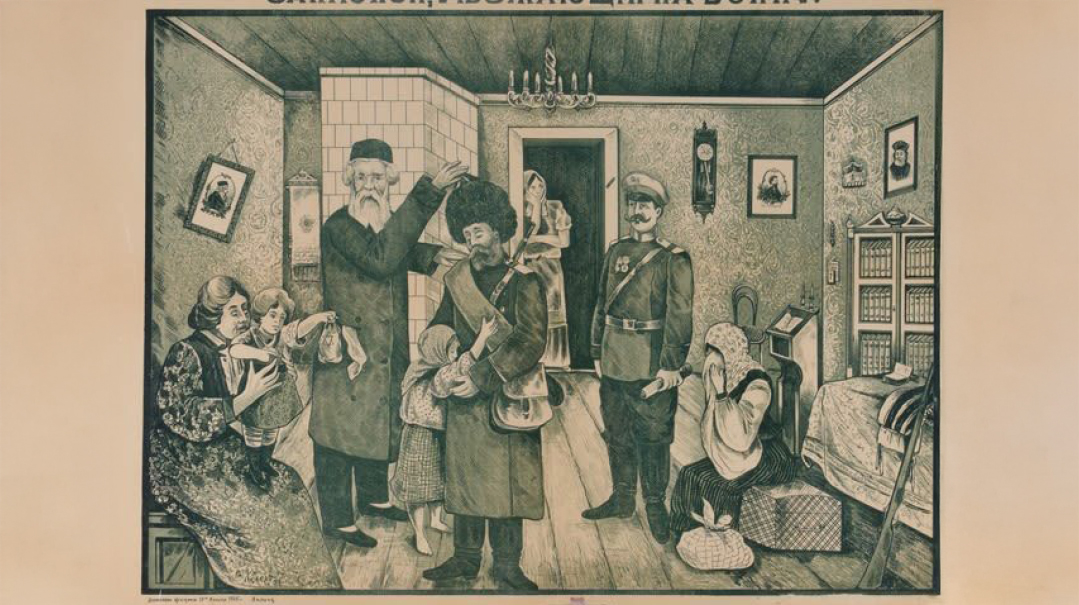
Title: From Port Arthur to Portsmouth
Location: Russia
Document: Lithograph
Time: 1905
ON September 5, 1905, after four weeks of tense negotiations, Russian and Japanese diplomats met in Portsmouth, New Hampshire, to sign a treaty ending a war that had stunned the world and redrawn the map of East Asia.
The Russo-Japanese War began in early 1904, driven by clashing imperial ambitions in Northeast Asia, particularly over rival claims to Manchuria and Korea. That February, Japan launched a surprise attack on Russia’s fleet at Port Arthur, catching the Czar’s forces completely off guard. That bold opening strike set the tone for the conflict. In battle after battle, Japan’s army and navy outmaneuvered and outfought the far larger Russian military, scoring costly but decisive victories.
As the war dragged on, the world looked on in disbelief as the Russian Empire suffered defeat after defeat. By mid-1905, with its treasury drained and revolution brewing at home, Russia was finally ready to seek peace.
At the invitation of President Theodore Roosevelt, envoys of both combatants convened in Portsmouth to negotiate a peace agreement. Roosevelt had selected Portsmouth for its modern facilities and its naval shipyard, which provided security, reliable communication, and a quiet setting away from the political pressures of Washington, D.C. The New England summer also offered a cooler climate for the extended talks.
For nearly a month, Roosevelt worked behind the scenes to broker compromises between the delegations, applying diplomatic pressure and personal charm as needed. When the treaty was finally signed on September 5, 1905, it marked a turning point: Japan was now recognized as a major world power, while Russia was forced to roll back expansionist gains in the Far East. Roosevelt’s mediation not only ended the war, but earned him the Nobel Peace Prize the next year.
For Jews in the Russian Empire, this distant conflict suddenly hit close to home. It came less than a year after the horrific Kishinev pogrom of 1903, and many Jews harbored bitter resentment toward the czarist regime. In fact, Jews around the world quietly hoped for a Russian defeat. Russia’s cruel reputation was well known, and as transcontinental communication improved, the atrocities being committed by the Russians became significantly harder to hide.
By 1904, the Russian draft swept through the Pale of Settlement, pulling young family men and yeshivah students out of their communities and onto troop trains bound for Asiatic Russia. All told, some 30,000 Jewish soldiers are said to have served in the czar’s forces during the Russo-Japanese War, roughly 5 percent of the entire Russian army in that conflict. Nearly 3,000 of those Jewish servicemen never came home, listed as killed or missing in action. Many others returned wounded in body or soul. A disproportionate number of Jewish draftees served as medics and doctors; by one account, fully one-third of the army’s medical units at the front were manned by Jews, tending the fallen even as they faced danger themselves.
The spiritual challenges were daunting as well. The war zone sprawled across Manchuria, thousands of miles from the soldiers’ hometowns in an utterly alien environment. Jewish life was hard to uphold in the trenches of Asia. Back home, families feared not only for their sons’ lives but for their souls.
Nowhere was the anguish felt more acutely than among the followers of Gur, by then the largest chassidic group in Russian-held Poland. The revered Sfas Emes saw an outsized number of his young chassidim conscripted to fight in Manchuria. As the war dragged on, the Rebbe’s court in Gur became a focal point of both practical and spiritual efforts to support those on the front. Hundreds of draft-age men flocked to the Sfas Emes for guidance and blessing before reporting for duty. The Rebbe would receive these young men at his door, speaking with each one individually. He dispensed advice on preserving their Yiddishkeit in the army, often tailoring his counsel to the individual’s needs.
Where possible, the Sfas Emes even aided clandestine efforts to save young men from being drafted. He worked with a network of askanim and intermediaries to bribe military officials for exemptions. Through generous bribes and political pull, he managed to save hundreds from the dreaded Russian army.
Still, despite all efforts, thousands of devout young Jews were ultimately forced to don the czar’s uniform and head into battle. The Sfas Emes prepared them as best as he could for the dual challenge ahead: the physical danger and the spiritual trial. “You are going to fight two battles,” he would say, “one for the czar and one for Hashem.”
He urged one chassid to memorize an entire masechta of Mishnayos before deployment. “Wherever you are, you will be able to review it by heart,” the Rebbe promised.
To another young man he gave an unusual instruction: learn the laws and skill of bris milah. The chassid was perplexed, but obeyed and months later, that knowledge miraculously saved his life, when he was called upon to serve as a mohel for a Russian officer’s son and was freed in gratitude.
When these soldiers-to-be came to say farewell, the scenes were heartrending. Tearful family members stood by as the Gerrer Rebbe clasped the hand of each departing boy, offering last words of chizuk. After those painful goodbyes, the Sfas Emes himself could find no peace.
Throughout the war, the Rebbe refused the comfort of his bed, choosing instead to sleep on the floor as a form of shared burden. Family members later testified that night after night, he would lie on the wooden planks with only his garment beneath him — and by morning, the cloth was soaked with his tears. In the Rebbe’s profound empathy, he physically grieved for his chassidim on the distant battlefields. On the 5th of Shevat/January 11, 1905, the Sfas Emes left this world at the age of 57.
Remarkably, many Jewish soldiers did manage to uphold their faith under fire. From the front lines in Manchuria, letters trickled back home. Some young men posed intricate halachic questions to their respective rabbanim from the trenches, seeking guidance on keeping kosher with meager rations or davening in a foxhole. Others simply described how they kept Rosh Hashanah and Succos in the army, against all odds — assembling makeshift minyanim at the edge of the battlefield, or finding creative substitutes for arba’ah minim come Succos. These dispatches from observant Jewish soldiers offered a glimmer of hope and pride to the anxious communities back home.
When the war finally ended with the Treaty of Portsmouth in September 1905, a sigh of relief rippled through the Jewish communities of the Pale. Their husbands and sons began to return home from the Far East, battered, exhausted, but alive. Many returned with stronger faith, proud that they had held on to their Yiddishkeit under unimaginable stress.
But not all came home the same. Some, disillusioned by the czarist regime, deserted their posts and spent months wandering before finding passage to America. Many more returned only to join the revolution, believing that toppling the Romanov dynasty was the only way Jews would ever achieve equality.
On that fateful September 5, 120 years ago, two empires signed a treaty thousands of miles from the battlefield. But for the Jews of Eastern Europe, the cost of that peace had already been paid — in tears, in faith, and in many cases, in the form of a chair at the table that would remain forever empty.
From Kishinev to Kyoto
The Kishinev pogroms, in which 49 Jews were slain amid appalling brutality, had been widely publicized in the international press. As one historian later noted, the shock of Kishinev even reverberated in Tokyo.
Professor Joseph Klausner was particularly struck by a powerful essay published in early 1904 by Norwegian writer and Nobel laureate Bjornstjerne Bjornson. Titled “Taking Off the Bear’s Skin,” the article warned that Russia posed a dire threat to Europe and the civilized world. As proof, Bjornson cited the 1903 Kishinev pogrom, describing it as a barbaric act, not of lawlessness but of deliberate state policy.
“Pogrom,” he wrote, “is a kind of civil war… the onslaught of one part of the population against another, for evil purposes.”
He argued that any government willing to incite such internal violence was rotten to its core and ripe for defeat.
The twist came a year later, when Klausner, then a student in Lausanne, Switzerland, encountered someone he termed as “a Japanese intelligence agent stationed in Europe.” The agent shared that Japan’s leadership had been locked in a bitter debate over whether to go to war with Russia. At a crucial cabinet meeting in early 1904, Japan’s defense minister presented Bjornson’s article as a moral justification for a preemptive strike, arguing that a nation capable of orchestrating a pogrom could not be treated like a civilized power. According to the agent, this helped tip the scales toward war.
“History takes revenge,” Klausner recalled him saying.
Matzah for Manchuria
Rav Shalom DovBer Schneersohn, the fifth Lubavitcher Rebbe (known as the Rebbe Rashab), launched an ambitious campaign to bring matzah to Jewish soldiers stationed thousands of miles away on the Manchurian front. With quiet determination, he rallied support from leading rabbanim, including Rav Chaim Ozer Grodzinski and Rav Chaim Soloveitchik of Brisk. The Rebbe traveled to St. Petersburg and, with the help of trusted chassidim, secured a meeting with the czar’s minister of the interior.
Eventually, he obtained permission for ten freight cars packed with matzah and kosher provisions, to be distributed across seven key stations along the Trans-Siberian Railway. At his own Seder that year, a telegram arrived from Harbin: The last of the matzos had reached their destination.
The Rebbe rose from his seat and exclaimed, “Baruch Hashem!”
In the frozen wilds of Manchuria, Jewish soldiers gathered for the Seder with matzah in hand and the unspoken comfort that they had not been forgotten.
Articles by Dr. Raphael G. Bouchnik-Chen, Eli Rubin and Yisroel A. Groweiss were utilized in the preparation of this week’s column.
(Originally featured in Mishpacha, Issue 1075)
Oops! We could not locate your form.
RELATED CONTENT

Thessaloniki Jewry’s wealth made the city a major center of Sephardic Jewry in the Ottoman Empire

Remarkably, many Jewish soldiers did manage to uphold their faith under fire

Sir Moses Montefiore of Great Britain and Judah Touro of the United States shared a dream of a thriving Jewish community outside the Old City walls

The origin story of the miraculous rebirth of the Torah world after the Holocaust is captivating

“The ghetto has been struck a hard blow. They demand what is most dear to it — children and old people”

For Rav Naeh, this forced sojourn in a foreign land could have been a footnote in a life already marked by extraordinary scholarship
