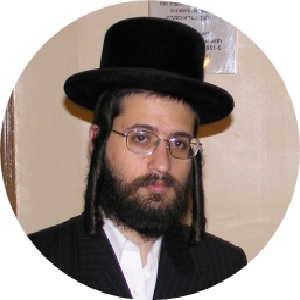
A mezuzah hangs on his door, and kashrus is kept to standard. Yet there’s one off-tune detail: My new friend Hidzer Johan Postma isn’t Jewish

In a quiet Dutch town better known for canals than Jews, a retired police officer spends his days immersed in Torah learning from the more than 3,000 seforim in his library. A mezuzah hangs on his door,
and kashrus is kept to standard. Yet there’s one off-tune detail: My new friend Hidzer Johan Postma isn’t Jewish
Leeuwarden, Holland — When I recently popped into the local Jewish bookstore in Antwerp, where I live, I couldn’t help noticing a middle-aged man with a yarmulke loading books into his cart. I know most of the people around there who would be buying seforim in such quantities, but here was someone I’d never met before, and my curiosity was piqued.
I introduced myself, struck up a conversation, asked him a few general questions, and the more we spoke, the more I realized that I needed to visit this man on his home turf. I learned that his name is Hidzer Johan Postma, and that he lives in Leeuwarden in north Holland, about a three-hour drive from Antwerp. That he studies Torah diligently for hours every day and has what is likely the largest private Torah library in all of Holland. That his home is kosher, there is a mezuzah on his door, his wife lights Shabbos candles, and his married daughter bakes challah every week.
And, that neither he nor his wife are Jewish.
We arranged to meet the following week.
The first thing that struck me upon entering his home was the library: Overflowing bookcases containing more than 3,000 volumes, spanning every category from Tanach to Midrash to Mishnah and Talmud to halachah, chassidus, mussar, and biographies of gedolim — an entire Torah world packed into a quiet Dutch home. It looked like a living catalog for ArtScroll and Feldheim. There wasn’t an English-language title he didn’t have, yet this was no collector’s hobby. Hidzer actually learns these seforim, systematically and passionately, for hours every single day.
Hidzer was born in 1960 in the small Dutch village of Zwaagwesteinde in the province of Friesland, not far from the province’s capital Leeuwarden. Zwaagwesteinde is a place with its own unusual historical relationship to Jews. During World War II, its residents sheltered Jews to protect them from Nazi deportation, but beyond those modern-era events, the region holds a fascinating connection to a much older, legendary Jewish presence. Well-known regional lore claims that the first Jews arrived in the province of Friesland after the Romans banished them following the destruction of the Second Beis Hamikdash. While the legend has no solid historical foundation, it’s frequently woven into local folklore about the ancestry of the Frisian people.
The town had long been known for its peddlers — many of them Jews — who traveled throughout the region selling merchandise.
“Already as a child, maybe at age ten or eleven, religious questions burned inside me,” Hidzer recalls. “One day I asked my father: ‘Does G-d exist?’”
“‘Look at the Jewish people,’ he told me. ‘If they still exist, that is proof that G-d exists.’”
“From that moment,” Hidzer tells me, “I began searching for Him.”
As he speaks, his wife sits nearby, occasionally correcting a detail or adding context. We converse in Dutch, though the couple themselves speak Frisian, an ancient Nordic language still spoken by longtime residents of Friesland.
Professionally, Hidzer entered the police force at a young age and steadily advanced through the ranks. After marrying — his wife is also his distant relative — the couple moved to the nearby city of Sneek, famous for its canals and water sports. But while his professional life progressed normally, his spiritual search only intensified.
“I searched constantly,” he says, “until I met a professor from KU Leuven University in Belgium who taught religion. He introduced me to Hebrew and gave me my first glimpse into Jewish texts.”
Even as a policeman, Hidzer felt instinctively protective toward Jews. In his village there lived a lone Jewish woman named Rozy Bloch.
“One night,” he recalls, “she came to my parents’ home in a panic. Antisemites had painted swastikas on her walls. My parents told me: ‘Hidzer, go protect her.’”
That entire night, he says, he lay hidden in her garden with his service weapon, waiting for the vandals to return. “They never came back,” he says with a faint smile, “and perhaps they were fortunate that they didn’t.”
Meanwhile, Hidzer’s attraction to Judaism continued to grow, and his wife found herself drawn along the same path, though neither understood why. Until he discovered an old book — quite valuable, he says, because there aren’t any copies of it on the market — that would change everything.
He removes the volume carefully from his shelf and places it before me. It tells the story of a man named Solomon — or Shlomo — Levy, a Jewish refugee from Hesse, Germany, who arrived in Zwaagwesteinde over three centuries ago. Levy eventually assimilated into local society, and over the generations his descendants spread throughout the village.
While reading through the genealogies, Hidzer made a stunning discovery: Both his name and his wife’s appeared among Levy’s many descendants.
“I was shocked,” he says. “Suddenly I understood what had always burned inside me. Halachically we are not Jewish. But somehow, there was a Jewish spark within both our souls.”
After that discovery, the couple at first affiliated with a liberal Jewish community in Sneek, although the connection didn’t last long. “Very quickly we realized it was not authentic Judaism,” Hidzer says. “The flexibility with halachah disturbed us.”
Soon afterward, he contacted a secondhand Jewish bookstore in Amsterdam and asked to purchase a set of the Babylonian Talmud.
“The owner, a Jew named Roy Lochers, was quiet,” Hidzer recalls. “He asked me if I was Jewish, and when I told him I wasn’t, he didn’t quite know what to say.
“‘It’s not so simple,’ Lochers explained to me. ‘You first need to acquire basic knowledge before you begin learning the Talmud.’ I asked him if he knew someone who could teach me, but instead of answering directly, he referred me to another Amsterdam bookseller, Daan Daniel, owner of the Samech bookstore, which had serviced the Amsterdam community for four decades until the Daniels made aliyah.”
That connection became transformative. Daniel began supplying Hidzer with Jewish books, starting with a Chumash featuring the commentary of Rabbi Munk.
“That sefer opened my eyes,” Hidzer says.
Soon came Rashi in Dutch, followed by dozens and then hundreds of additional works. To finance his growing Jewish library, Hidzer sold nearly all the secular books in his home — an impressive collection in its own right.
“One day I saw a set of Me’am Lo’ez — the multivolume Torah Anthology — in Daniel’s store, and I desperately wanted it, but he warned me that it was expensive. When I insisted, he wanted to hear directly from my wife that I wasn’t spending all our family money on seforim,” Hidzer recalls.
Only after the couple explained that the funds came from selling their previous library did Daniel relax and continue supplying books.
Before Daniel closed his Amsterdam store and moved to Eretz Yisrael, he urged Hidzer to consider conversion and relocate to Amsterdam.
“We seriously considered it,” Hidzer admits. “We wanted very much to convert.”
He contacted Rabbi Binyomin Jacobs, chief rabbi of the Netherlands, but received a lengthy response discouraging the move. Circumstances prevented them from making the move to Amsterdam, yet if they didn’t live within a fully observant Jewish community, Rabbi Jacobs explained, maintaining a complete Torah life would be nearly impossible.
And so Hidzer remained a Noahide.
Yet in practice, his daily life resembles that of any observant Jew. He davens three times a day, wears a tallis in the morning, keeps kosher to the extent possible, and structures his life entirely around Torah learning. During my visit, after I briefly excused myself, Hidzer was already waiting outside the restroom holding a netilas yadayim cup for me.
Daniel remained a source of close emotional support as well. After Hidzer was violently assaulted by local rioters and left homebound for an extended period, Daniel helped support him emotionally and spiritually. During that difficult period, Hidzer also met another important figure: Dutch military rabbi Wim van Dijk, who guided him in practical Judaism, sent him Jewish journals, and even taught him how to affix a mezuzah to his home.
Of course, Hidzer himself fully understands the halachic limitations of his situation. He is careful never to portray himself as Jewish and consults rabbinic authorities regarding every religious practice he adopts. Still, according to the Rambam, a non-Jew who fulfills mitzvos as one who is “not commanded but performs” nevertheless receives reward.
In 2004, another upheaval changed the couple’s lives. Criminals attacked their home in Sneek, badly shaking Hidzer’s sense of security. As a result, he was transferred from field policing into a dispatch role at the district police headquarters in Leeuwarden. The move ultimately led the family to relocate there permanently. They have now lived in Leeuwarden for more than two decades.
Ironically, the quieter position gave Hidzer more time for Torah. During breaks at work he would speak to fellow officers about Judaism, often surprising them with stories and ideas from Torah.
“The problem among non-Jews,” he explains, “is that most simply know nothing about Judaism, or they have been fed lies. Once they hear the truth, they become fascinated.”
Today, retired from the force, most mornings begin the same way. He disappears into his library and remains there until evening.
“The Torah is my whole world,” he says simply. “Without it, I have no life.”
He studies broadly and intensely: Chumash with Rashi and Midrash, Malbim, Chasam Sofer, Midrash Rabbah, Zera Shimshon, Breslov seforim, and other sifrei chassidus, which he says “teaches us that Torah must not remain an intellectual pursuit alone, but must become part of one’s inner life.”
Recently he has immersed himself in the Zohar and the writings of the Arizal, though cautiously and under rabbinic guidance. He speaks fluently about concepts in kabbalah, but carefully emphasizes the need for restraint and humility in studying the hidden Torah.
The Ramchal occupies a particularly beloved place on his shelves. Mesillas Yesharim, he says, is a sefer he has learned multiple times.
“Perhaps I feel connected to him,” Hidzer says, “because he also spent time in Amsterdam after fleeing persecution in Italy.”
Later, Hidzer takes me on a tour through the remnants of Jewish Leeuwarden. Before the war, more than a thousand Jews lived here, but with the Nazi invasion, most of them were deported between August 1942 and February 1943 and murdered in Nazi death camps. Only a small number survived the war in hiding. The large, magnificent shul came through the war with some damage to its interior but otherwise intact, although the Torah libraries were plundered by the Germans.
Jewish life in Leeuwarden resumed on a limited scale after the war. The shul was rededicated in 1948, but was much too large for the surviving community. As a result, a large part of its interior was donated to the youth village at Kfar Batya in Israel, and the old synagogue building serves as a concert hall.
We continue to the ancient Jewish cemetery, where a local Jew named Avraham meets us at the gate. The remaining Jewish community today numbers only a few dozen, although they occasionally still gather in a small makeshift shul where Avraham serves as baal korei.
The cemetery itself is heartbreakingly beautiful. Birds chirp overhead and a canal cuts peacefully through the grounds. Yet every gravestone tells the story of a vanished world: centuries-old Dutch Jewish families snuffed out in the Holocaust.
The newest gravestone bears the date 8 Teves 5784 (2024). One more woman from the elderly, dwindling community passed away recently.
Nearby stands the former Talmud Torah building, and beside it, a Holocaust memorial listing the names of every Jew from Leeuwarden murdered during the war.
As there isn’t much left of the Jewish community here, most of Hidzer’s relationships with other Jews and with rabbanim are maintained digitally. Though he dreams of visiting Eretz Yisrael, his modest pension does not yet allow it financially. The nearest thriving Jewish center is Antwerp, Belgium.
“There I feel at home,” he says. “When a Jewish child on the street stretches out his hand and says, ‘Shalom aleichem,’ my heart melts.”
Their daughter has already visited Israel and has become even stricter in her observance than her parents. She maintains separate meat and dairy kitchens and bakes challah every Erev Shabbos, although she, too, has yet to convert.
Yet despite not being Jewish according to halachah, Hidzer still experiences antisemitism. Local hooligans hardly distinguish between halachic categories. To them, his appearance alone marks him as Jewish. At home he wears a yarmulke openly, but outside he conceals it beneath a hat. Insults are not uncommon.
Still, he says, his friends, are on his side.
“They appreciate it very much,” he says. “Sometimes I gather them together and tell them about the Jewish people and the Torah. I speak about Creation, about the sun and moon, tell them chassidic stories. They listen with fascination.”
I ask him whether, for all his diligence in learning, he’s ever tried Daf Yomi.
Hidzer sighs. “If only. To truly keep up with Daf Yomi, a person needs a chavrusa. And that, unfortunately, I do not have.”
But he doesn’t despair.
“At the giving of the Torah,” Hidzer says, “the Jewish people reached the highest spiritual level imaginable. Then came the sin of the Golden Calf, and humanity fell from that level. But we’re moving back toward that tikkun,” he says with conviction. “Toward the coming of Mashiach.”
Hidzer waits for Mashiach with all his heart. Until then, he says, he has already found in Torah the answers that once tormented him.
“In Torah,” he says, “I finally found my spiritual peace.”
One final kiss to the mezuzah at the entrance of the Postma home, and I begin the long drive back to Antwerp. The endless green countryside passes beside me unnoticed, because my head is somewhere else — thinking about the mysterious paths through which the Creator guides souls — across centuries, across countries, and sometimes even into a quiet corner of Friesland, where a retired Dutch policeman has built himself a private world of Torah.